
Introduction
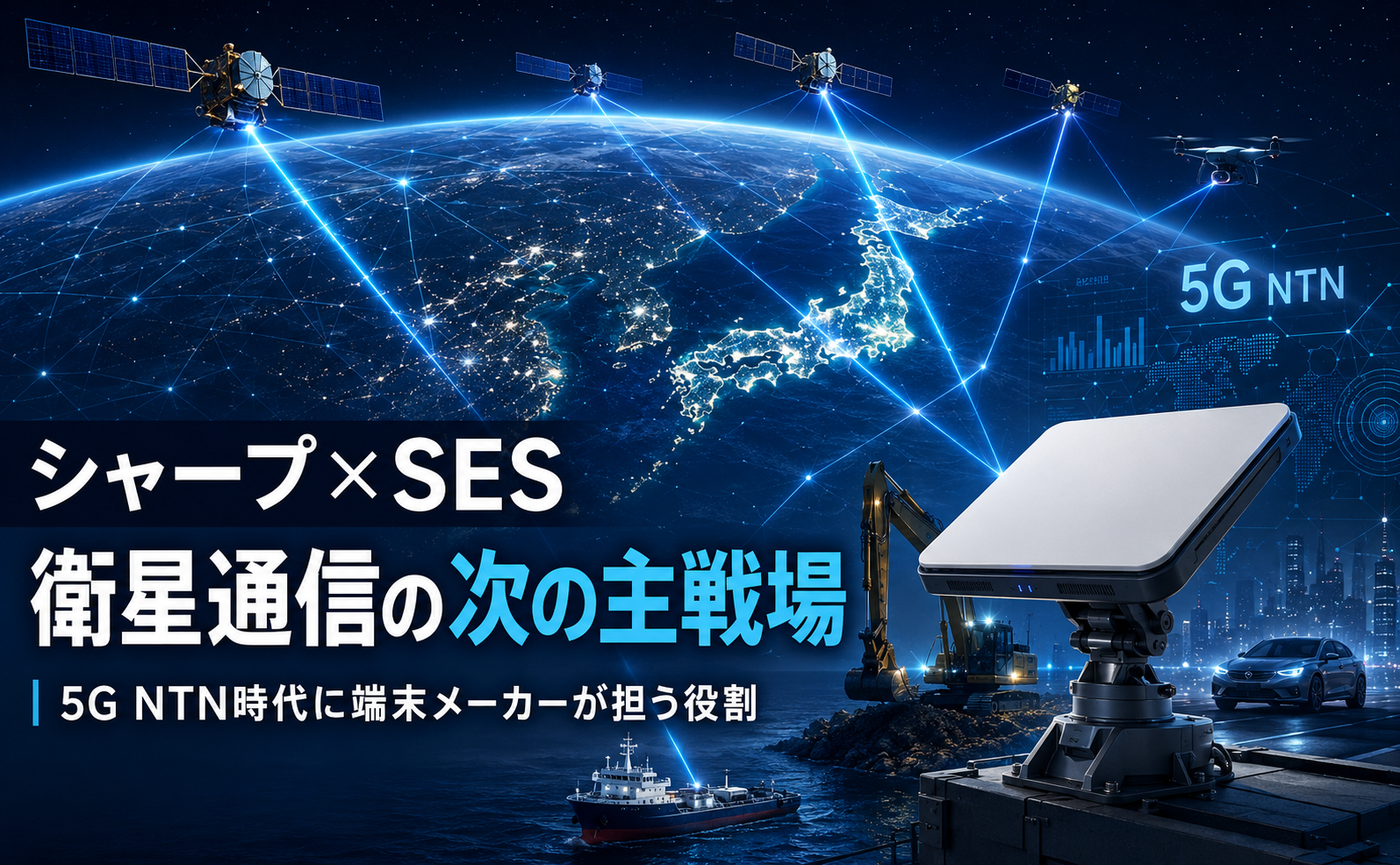
Sharp has reached a basic agreement to partner with SES, a Luxembourg-based satellite operator, in satellite communications services. The partnership concerns the rollout in Japan of “O3b mPOWER,” a medium Earth orbit satellite communications service provided by SES. Sharp plans to begin offering services for construction machinery and ships in 2027, expand the applications to drones in 2030 and automobiles in 2035, and aims to generate 100 billion yen in sales from satellite communications services.
What deserves attention in this announcement is that it is not simply a story about Sharp manufacturing satellite communications terminals. Sharp is seeking to use the communications technology, miniaturization and thinning technology, and knowledge of 5G standardization it has developed through smartphones to help satellite communications spread as industrial infrastructure. Until now, satellite communications have tended to be viewed as a communications method for specialized applications. However, if 5G NTN standardization advances, satellite communications may come to be positioned as communications infrastructure that is continuous with terrestrial mobile communications.
Communications Demand Outside 99% Population Coverage
In Japan, mobile phone population coverage exceeds 99%, which makes it appear that communications infrastructure has reached almost the entire country. However, this figure mainly covers areas where people live. In many industrial settings, such as mountainous regions, at sea, remote islands, disaster sites, construction sites, mines, farmland, and the sky, there are still many places where communications are difficult to access.
This is also why Sharp is focusing on satellite communications. Construction machinery, ships, drones, automobiles, and similar equipment are fields where automation, remote monitoring, and data integration are expected to advance further in the future. Once it is assumed that these devices will always be connected to a network, there will be areas that cannot be covered by terrestrial base stations alone. Satellite communications are likely to become increasingly important as a means of filling those gaps.
Construction machinery and ships, in particular, are rational first targets. Construction machinery is often used in mountainous areas and large-scale construction sites, while ships are inherently used outside the coverage area of terrestrial base stations. In these fields, communications are not merely a matter of convenience; they are directly linked to safety management, operation management, remote operation, maintenance, and fuel efficiency improvement. Sharp’s policy of starting with B2B applications can be described as a realistic strategy for steadily implementing satellite communications.
The Meaning of Choosing MEO
In Japan, when people think of satellite communications, low Earth orbit satellite communications such as Starlink tend to stand out. Because low Earth orbit satellites are close to Earth, they can more easily achieve low latency, but a large number of satellites is needed to cover a wide area.
By contrast, SES’s O3b mPOWER, with which Sharp is partnering, is a service that uses medium Earth orbit satellites. Medium Earth orbit satellites can be positioned as offering lower latency than geostationary satellites while making it easier to cover a wide area with fewer satellites than low Earth orbit satellites. SES’s stated advantages—that it can operate a highly efficient system with around 18 satellites, achieve low latency, and cover the entire globe—also reflect these characteristics.
In satellite communications, the optimal orbit differs depending on the application. Rather than one of low Earth orbit, medium Earth orbit, or geostationary orbit replacing all other options, it is more likely that they will be used selectively depending on communications capacity, latency, terminal size, installation location, cost, and availability. It is significant that Sharp has mentioned not only MEO-compatible terminals, but also LEO-compatible terminals, multi-orbit-compatible terminals, and ultra-compact satellite communications terminals. In the future, terminals may move toward selecting the optimal communications route by switching between multiple satellite networks.
The “Standardization of Satellite Communications” Brought by 5G NTN
The most important keyword in this announcement is 5G NTN. NTN stands for Non-Terrestrial Network. It refers to the concept of using satellites, high-altitude platforms, and similar systems to extend 5G coverage beyond terrestrial base stations.
Until now, satellite communications have been a field where each operator has tended to rely heavily on proprietary specifications. Terminals, satellites, communications methods, and evaluation systems have often been closed, and service development has required time and cost. By contrast, if standardization advances as 5G NTN, device manufacturers, telecommunications carriers, satellite operators, and equipment manufacturers will find it easier to develop products and services on a common technical foundation.
Looking back at the history of mobile phones, the standardization of 3G, 4G, and 5G greatly supported the spread of terminals, the reduction of component costs, and the diversification of services. When Mr. Kobayashi stated that it was not the first time standardization had dramatically changed people’s lives, he likely had in mind this successful experience in the communications industry and was applying it to satellite communications.
However, standardization does not mean that a market will automatically emerge. Standardization is only a foundation for increasing the number of participants and aligning the premises for development. On top of that, easy-to-use terminals, easy-to-adopt pricing systems, operational structures including maintenance and installation, and solutions for each application are required. The fact that Sharp intends to provide not only terminal sales, but also rate plans, maintenance, installation, and solutions on a one-stop basis indicates that it is considering the implementation phase after standardization.
Sharp’s Winning Strategy as a Device Manufacturer
For Sharp, the key to the satellite communications business will be terminals. The structure is that Sharp will partner with SES, which owns the satellites themselves, while Sharp will handle service provision and terminal development in Japan. This division of roles is relatively consistent with Sharp’s strengths.
Through its AQUOS smartphones, Sharp has accumulated technology for incorporating antennas and communications components into limited device housings. Miniaturization, weight reduction, and thinness are also important for satellite communications terminals. Conventional large parabolic antennas impose significant constraints when deploying satellite communications widely across construction machinery, ships, drones, and automobiles. The direction of developing terminals equipped with flat-panel antennas is an important technical theme for incorporating satellite communications into a wider variety of devices.
Particularly when considering expansion to drones and automobiles, terminal size, weight, power consumption, vibration resistance, weather resistance, and installation flexibility will become bottlenecks to adoption. The success or failure of the business will depend not only on the communications quality of satellite communications, but also on how practical the terminal can become.
It is also worth noting that Sharp is leading the standardization of a compact 20-by-20-centimeter terminal. If Sharp can not only create its own products but also become involved in shaping the direction of terminal specifications used in the future market, product development and standardization activities may reinforce each other.
Standard Essential Patents and the Satellite Communications Business
This news is also interesting from an intellectual property perspective. Sharp is said to rank among the top Japanese companies in the number of 5G standard essential patents it holds, and it has been deeply involved in 5G standardization. In 5G NTN as well, Sharp is said to be leading the standardization of methods for testing the characteristics of radio wave propagation through the atmosphere and of compact terminals.
Standard essential patents are patents that must inevitably be implemented in order to comply with a standard. In the communications field, standardization and patents are closely linked. If 5G NTN becomes widespread, the importance of standard essential patents related to satellite communications terminals, network equipment, evaluation devices, and service operations may also increase.
For Sharp, satellite communications is not only a field for terminal sales and service revenue, but also a field where it can make use of its standardization activities and intellectual property portfolio. If 5G NTN-compatible devices increase in the future, companies involved in standard specifications will be more likely to gain technical influence and business negotiating power. This can be viewed not merely as a new business, but as a strategy for reusing Sharp’s assets as a communications technology company.
Creating a Market Different from Starlink
When it comes to satellite communications, Starlink has a strong presence among general consumers. Applications such as direct communication with smartphones and internet connections for homes and business sites are easy to understand and tend to attract attention.
By contrast, the initiative by Sharp and SES will initially focus mainly on B2B applications. This difference is important. In B2B satellite communications, not only communications speed and pricing, but also integration with business systems, maintenance structures, installation work, contract formats, and responses to industry-specific requirements are emphasized. The nature of the required communications differs depending on the application: operation management for construction machinery, navigation management for ships, remote control for drones, and emergency communications or driving data integration for automobiles.
For this reason, the satellite communications market is likely to take the form of multiple options coexisting by application, rather than one giant service swallowing everything. Mr. Kobayashi’s statement that detailed implementation must proceed while competing with others also reflects this nature of the market.
For Sharp, the key to differentiation will not be competing head-on with Starlink on exactly the same field, but rather combining terminals, lines, maintenance, and solutions tailored to industrial applications in Japan. What matters is whether satellite communications can be offered not merely as a “line,” but as a “system” that can actually be used in the field.
Will 2027 Become a Turning Point for Satellite Communications?
Sharp plans to begin services for construction machinery and ships in 2027. It is also said that the unification of 5G NTN standards is expected in 2027. The overlap in timing is symbolic.
If satellite communications are developed as services based on standardized specifications from 2027 onward, the hurdles to terminal development may fall and the number of participating companies may increase. If that happens, satellite communications, which have until now been expensive and specialized, will move closer to becoming general industrial infrastructure.
That said, actual adoption will likely take time. There are many issues to resolve, including satellite communications terminal prices, communications fees, ease of installation, regulatory compliance in Japan, radio wave use, and integration with user-side business systems. The long-term roadmap of expanding to drones in 2030 and automobiles in 2035 can also be understood as being based on these implementation challenges.
Even so, Sharp’s clear statement that it aims to generate 100 billion yen in sales by 2035 shows that it positions satellite communications not merely as a demonstration experiment, but as a long-term growth business.
Conclusion
The partnership between Sharp and SES is not only a move that will increase the options for satellite communications services in Japan; it also shows the role of device manufacturers in the 5G NTN era. Satellite communications are about to change from communications for specialized applications into industrial infrastructure that complements terrestrial networks.
Supporting this change are the standardization of 5G NTN, compact and thin satellite communications terminals, network design that uses multiple orbits, and implementation capabilities tailored to each application. Sharp is trying to enter the practical implementation phase of satellite communications by making use of the communications technology it has developed through smartphones and its knowledge of standardization activities.
The focus going forward will be how much value the construction machinery and ship services planned for 2027 can demonstrate in actual field operations. Satellite communications can become not only an easy-to-understand means of communication during disasters or in mountainous areas, but also a foundation for keeping industrial machinery, logistics, maritime operations, aviation, and mobility constantly connected.
The Sharp–SES partnership is a new challenge by a Japanese company in the satellite communications market, and it can be described as an important step in determining how far 5G NTN will expand the boundaries of communications infrastructure.