
Introduction
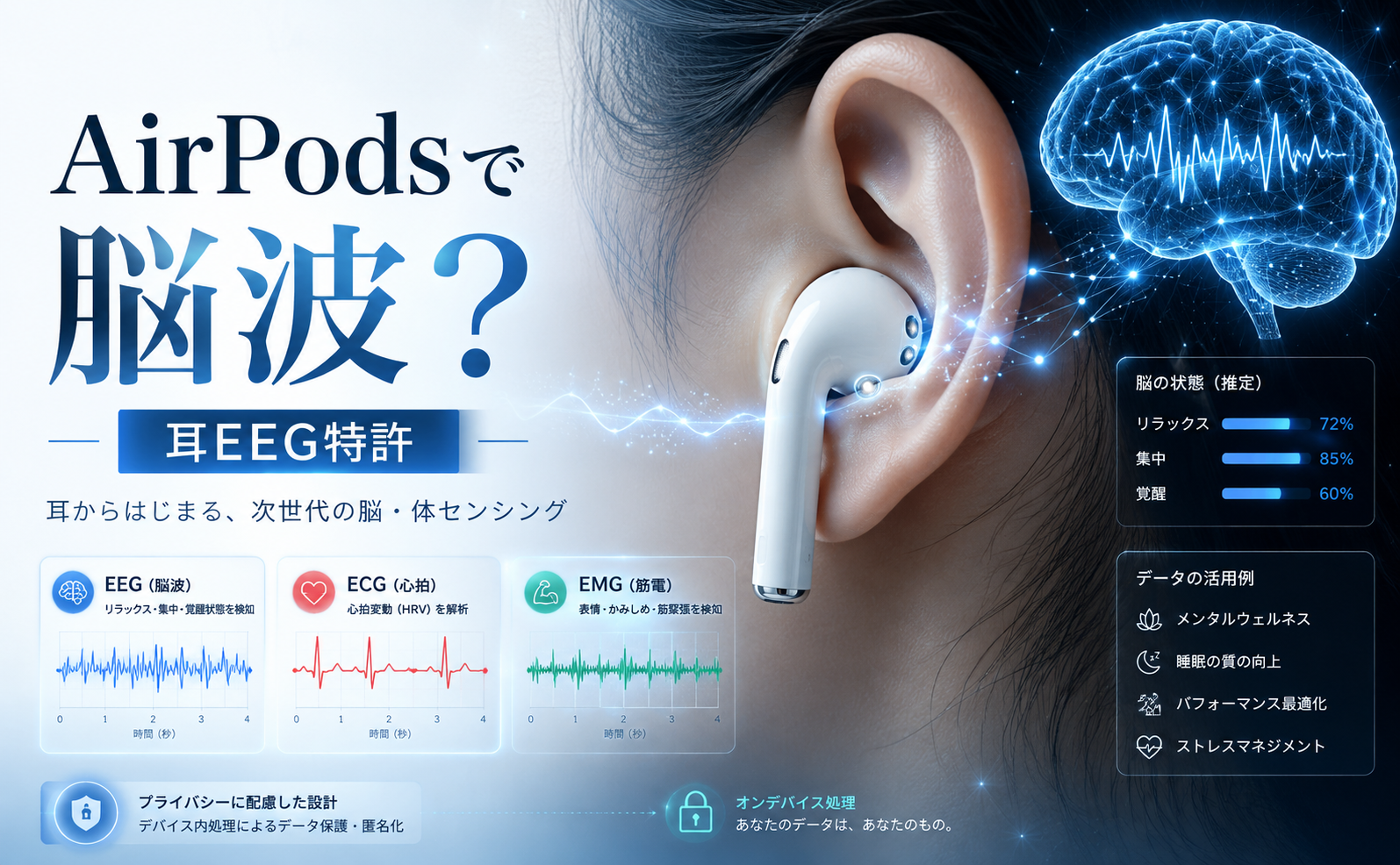
Apple has filed a patent application for technology that would measure biosignals, including brain waves, using earphone-type devices such as AirPods. The target signals include electrical biosignals such as electroencephalography (EEG), electromyography, eye movements, electrocardiography, and electrodermal activity. The concept is to place multiple electrodes inside and around the ear, and then select an appropriate combination of electrodes depending on the user’s condition, thereby accommodating differences in ear shape and wearing conditions among individual users. In the U.S. published application, Apple’s application titled “Biosignal Sensing Device Using Dynamic Selection of Electrodes” was published on July 20, 2023, and Google Patents displays it as “Pending” as of the time of writing. Therefore, this should not be read as meaning that EEG measurement will immediately become a feature of the next AirPods. Rather, it should be understood as evidence that Apple sees biosensing around the ear as an important research and development theme.
The Role of AirPods Is Expanding Beyond “Tools for Listening to Sound”
AirPods were originally devices for music and calls. However, looking at Apple’s product development, the ear is already becoming a place for acquiring health data. AirPods Pro 3 includes a heart-rate sensor that measures heart rate and calories burned during workouts, and Apple’s official information also explains the function of measuring heart rate inside the ear. Apple appears to view the “ear”—a body part that is inconspicuous, worn devices can be attached to on a daily basis, and that allows long contact time with the user—as a new gateway for health management.
Viewed in this context, the present patent is not a simple leap from “heart rate” to “brain waves.” Rather, it can be understood as part of a broader concept of transforming an audio device into a sensor-equipped wearable device. While the Apple Watch has measured the state of the body from the wrist, AirPods may become devices that pick up signals closer to both the body and the brain from the ear.
The Core of the Patent Is Not “Measuring Brain Waves,” but “Selecting Electrodes That Can Measure Them”
What is particularly important in this patent is not the topical appeal of measuring brain waves with AirPods itself. The more essential point is that, based on the premise that ear shape and wearing conditions differ from person to person, the device dynamically selects an appropriate combination from multiple electrodes.
Brain waves are generally measured by attaching electrodes to the scalp. Ear-EEG, which places electrodes inside or around the ear, has the advantage of being less conspicuous and easier to incorporate into daily life compared with methods that attach electrodes across the scalp. On the other hand, ear shape varies greatly from person to person, and even for the same person, the wearing position and the state of contact with the skin can change over time. Apple’s patent specification also identifies, as issues, the possibility that accurate measurement may require customization to each user’s ear and that accuracy may decline due to changes in ear shape.
To address this, the patent proposes a mechanism in which more electrodes than necessary are arranged on the earphone side, and electrodes that can easily pick up signals at a given moment are selected. Looking at the claims, the patent describes configurations such as a switching circuit that connects a subset of multiple electrodes to a sensor circuit, and selecting electrodes based on factors such as impedance, distance between electrodes, and contact area with the body. It also presents the idea of weighting multiple signals and integrating them into a more appropriate biosignal.
In other words, this patent is not based on the simple idea of “putting electrodes on AirPods.” It addresses an implementation challenge: how to obtain stable biosignals from earphones that are not necessarily worn in exactly the same position every time.
Sleep, Focus, Fatigue—What Could Become Visible?
If brain waves could be measured on a daily basis, sleep would likely be one of the first applications. Sleep stages are closely related not only to heart rate and body movement, but also to changes in brain waves. Apple researchers have published research on methods for analyzing EEG signals using self-supervised learning, and the evaluation targets include a sleep-staging dataset using EEG measured from the ear. However, this research does not mean that the technology will be implemented directly as an AirPods feature. At this stage, it should be understood cautiously as indicating that Apple is researching foundational technologies for brain-wave analysis internally.
Even so, the direction is very easy to understand. Current wearables have mainly measured the “state of the body,” such as heart rate, heart-rate variability, body temperature, activity level, and sleep duration. If brain waves are added, it may become possible to handle information closer to the “state of the mind,” such as sleep depth, transition to wakefulness, daytime sleepiness, sustained concentration, and mental fatigue.
Daytime applications could include recording focus sessions and suggesting when to take breaks. During work, study, before driving, or after long online meetings, if brain-wave-derived indicators could show whether the user is overexerting themselves or whether their concentration is starting to decline, the technology would enter not only the field of health management, but also the field of productivity management.
Competing Fields Are Already Moving
Consumer and research-oriented devices that measure brain waves from the ears or head are already beginning to appear on the market. Neurable’s MW75 Neuro LT is introduced as headphones that use 12-channel EEG sensors to measure brain activity and track focus with AI. IDUN Technologies is also developing Guardian Earbuds, ear-worn EEG devices intended for EEG recording and monitoring in home environments.
From this perspective, Apple’s concept is not a far-fetched vision of the future. Rather, as of 2026, the competition appears to have shifted toward how brain-wave sensing can be incorporated into everyday form factors, prices, comfort levels, and user experiences. Apple’s strength lies not in standalone sensors, but in experience design that combines AirPods, iPhone, Apple Watch, the Health app, and the overall iOS ecosystem. The differentiating axis will not only be the accuracy of brain-wave measurement itself, but also how the measured data is presented and how it leads to improvements in daily life.
What This Means for Users in Japan
For users in Japan, this technology has considerable practical relevance. People are spending more time wearing earphones on commuter trains, in offices, in cafés, while working from home, and while watching videos before bed. Even people who are reluctant to wear a smartwatch all the time may use earphones routinely.
If AirPods become capable of acquiring information close to brain waves, the gateway to health management will broaden. Possible uses include understanding sleep quality in greater detail at night and reviewing trends in concentration and fatigue during the day. In particular, for people struggling with lack of sleep, chronic fatigue, or reduced concentration, this could become a clue for reviewing their own condition without relying solely on subjective feelings.
On the other hand, in Japan, caution regarding health data and personal information is also important. The term “brain waves” tends to create greater psychological resistance than heart rate or step count. Even if the technology does not read “what a person is thinking” and only estimates sleep or focus states from patterns of electrical activity, users may perceive the data as extremely sensitive. If Apple enters this field, it will need to provide very careful explanations regarding where the data is stored, whether it is provided to third parties, how the boundary with medical functions is drawn, and how scores are displayed.
The Biggest Challenge Is Avoiding “Numbers That Merely Look Plausible”
When brain-wave sensing enters consumer products, accuracy is not the only major challenge. Rather, it is important to avoid producing “numbers that merely look plausible” and causing users to be swayed by them.
For sleep stages, it is relatively easy to connect the data with existing sleep research and medical evaluation standards. However, states such as concentration, fatigue, stress, and cognitive load involve complex definitions and measurement conditions. Even the same brain-wave pattern may have different meanings depending on the task, physical condition, sleep deprivation, caffeine intake, and surrounding noise.
For this reason, even if brain-wave-related features are added to AirPods, it is unlikely that they would immediately appear as functions that “accurately measure concentration on a 100-point scale.” More realistically, Apple may begin with limited and easier-to-explain use cases, such as understanding sleep states, displaying trends during short focus sessions, suggesting breaks, or linking with relaxation audio.
Apple’s Aim as Seen from the Patent
This patent redefines AirPods as “small computers placed in the ear.” They may do more than play sound: they may measure heart rate from the ear and, in the future, may handle brain waves, electromyography, eye movements, and skin responses. This can be seen as an extension of the health management that the Apple Watch has performed on the wrist to the area around the ear.
However, a patent is not a product announcement. Apple files patent applications for many technologies, and not all of them are incorporated into products. This technology may represent research-stage work, an option for future products, or defensive rights acquisition. Therefore, it would be premature to assume that brain-wave measurement will necessarily be included in AirPods in the near future.
Even so, the direction indicated by this patent is significant. The next axis of competition in wearables is shifting away from simply increasing the number of sensors and toward how naturally, continuously, and meaningfully health data can be acquired in a form that blends into daily life. If AirPods become that gateway, earphones will evolve from “tools for listening to sound” into “tools for understanding one’s own condition.”
Conclusion
Apple’s AirPods-related patent points to a future in which biosignals, including brain waves, are measured around the ear. What deserves particular attention is the dynamic selection of an appropriate combination from multiple electrodes in order to accommodate differences in ear shape and wearing conditions. This is an implementation-oriented technique for acquiring stable biosignals with an earphone-type device, and it shows a problem setting that appears to be more conscious of commercialization than a mere idea patent.
At the same time, commercialization involves many challenges, including measurement accuracy, wearing comfort, electrode durability, privacy, the boundary with medical functions, and how information is presented to users. At present, it is not yet possible to say definitively that AirPods will be able to measure brain waves.
Even so, considering that AirPods Pro 3 has already moved into heart-rate measurement, it is clear that the area around the ear has become an important location in Apple’s healthcare strategy. We still do not know what the next AirPods will measure. However, this patent clearly shows that an era is approaching in which we may understand not only the “state of the body,” but also the “state of the mind,” through the ear.