
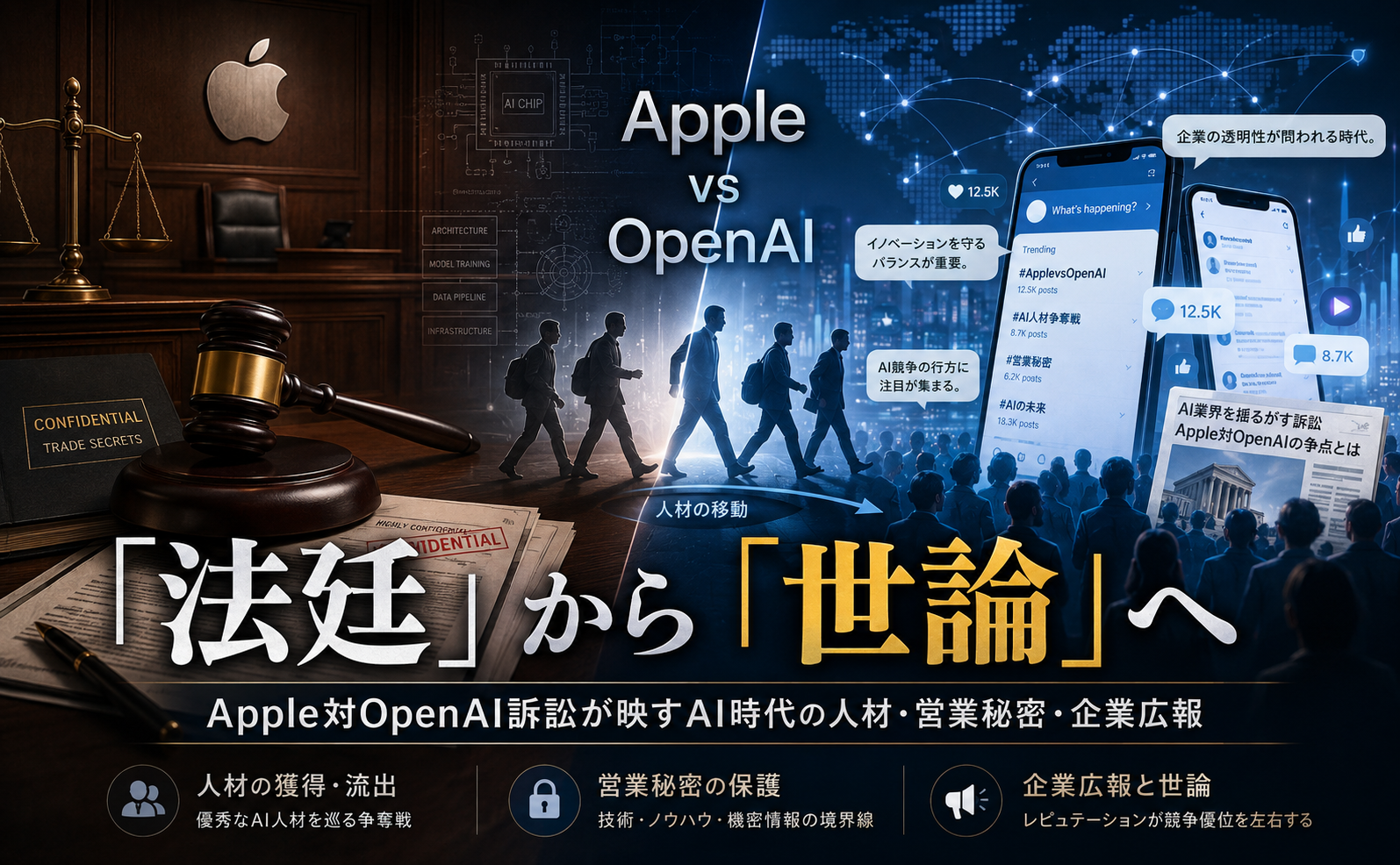
On August 3, 2026, OpenAI published a statement titled “Apple is getting this wrong,” in which it comprehensively rebutted the trade secret lawsuit filed by Apple against OpenAI and several former Apple employees. OpenAI argued that Apple’s allegations contained factual inaccuracies and released emails exchanged between the companies’ legal representatives, as well as iMessages between Apple employees and former Apple employee Chang Liu.
Apple, meanwhile, alleges that OpenAI obtained and used confidential hardware-related information through former Apple employees. It has also sought a preliminary injunction prohibiting access to, acquisition of, use of, or disclosure of the information in question. At this stage, the court has not issued a final ruling on which party’s claims will ultimately prevail.
OpenAI’s Strategy of Rebutting the Allegations in Public
What is particularly notable about OpenAI’s statement is that the company did not limit its rebuttal to the litigation process. Instead, it publicly released emails and messages, effectively bringing the dispute into the court of public opinion.
OpenAI claims that Apple’s outside counsel confused two individuals with Asian surnames and sent an email to the wrong person. It also claims that Apple later acknowledged that its assertion that it had consulted OpenAI’s chief legal officer was untrue. In addition, OpenAI released messages that it says show Apple employees contacting Liu after he had left the company and asking him to help locate materials needed for their work.
This appears to be a strategy intended not merely to refute individual allegations in Apple’s complaint, but also to create the impression that Apple’s investigation and fact-checking were themselves inadequate. Trade secret litigation can take a considerable amount of time to reach a final legal resolution. In the meantime, the dispute may affect recruitment, business relationships, product development, and corporate reputation. OpenAI may therefore have concluded that it needed to present its own narrative at an early stage rather than simply wait for the court’s decision.
That said, the emails and messages made public were selected by OpenAI. They do not, by themselves, establish the complete factual record of the litigation. Media reports have similarly characterized the statement not as a formal court filing, but as a public rebuttal intended to foster the impression that Apple’s allegations contain inconsistencies.
Being Able to Access Information Is Not the Same as Being Authorized to Use It
One of the issues surrounding Liu is the allegation that he remained able to access Apple’s systems after leaving the company.
OpenAI argues that this was a case of “residual access” caused by Apple’s failure to properly terminate a former employee’s access privileges. It further maintains that Liu was searching for materials at the request of current Apple employees and was not obtaining information for an improper purpose.
From the standpoint of information security and trade secret management, however, having the technical ability to access information is not the same as having the legal or internal authorization to do so. Even if a former colleague requested assistance, several separate questions must still be examined: whether the person making the request had formal authority, what information was accessed, whether any information was saved or transferred, and how it was subsequently used.
Conversely, if Apple left its systems accessible after Liu’s departure, that may raise questions about whether the company had taken reasonable measures to protect its trade secrets. It is not enough for a company simply to regard information as confidential. The information must be objectively managed as secret through measures such as restricting access privileges, disabling accounts upon termination, recovering company devices, monitoring data transfers, and applying confidentiality markings.
The case may therefore call into question not only the conduct of individual employees, but also the company’s information governance practices, including its procedures for managing departing personnel.
The Boundary Between Employee Mobility and Trade Secrets
Apple’s lawsuit is not merely a case involving the removal of files. It arises against the backdrop of intensifying competition for experienced engineers and designers as AI companies expand into hardware.
Apple alleges that OpenAI attempted to systematically obtain confidential information concerning Apple’s designs and manufacturing processes through former Apple employees, recruitment activities, and relationships with suppliers. OpenAI denies that it intended either to obtain or use another company’s trade secrets.
A careful distinction must be made between the general knowledge and skills that employees acquire through years of professional experience and trade secrets that belong to their former employer.
Engineers cannot completely leave behind their knowledge and experience when they change jobs. The spread of technology through employee mobility, and the resulting emergence of new companies and industries, are essential to innovation. At the same time, this does not justify taking confidential design drawings, undisclosed manufacturing conditions, supplier information, prototype specifications, internal evaluation results, or similar materials and using them at a new employer.
When companies assert trade secret protection too broadly, it may function as a de facto noncompete restriction and impede employee mobility. Conversely, if the removal of specific confidential information is tolerated in the name of employee mobility, the foundation that enables companies to recover their research and development investments may be undermined. A central question in this litigation will be how these two interests should be balanced.
The Hiring Company’s Compliance System Is Also Under Scrutiny
In trade secret disputes, scrutiny is directed not only at the former employee accused of taking the information, but also at the measures adopted by the company that hired that person.
With respect to Tang Tan, OpenAI states that he consistently instructed his team not to seek or use the confidential information of other companies.
From a corporate risk-management perspective, however, it is not enough that an individual issued verbal warnings. Companies need mechanisms to prevent candidates from presenting nonpublic materials from their former employers during recruitment interviews, written commitments upon hiring, reviews of devices and data brought into the company, retention of development records, and evidence demonstrating that the technology was developed independently of information from the employee’s former employer.
In particular, when a company recruits a large number of engineers from a competitor, simply telling them not to bring confidential information from their previous employer is insufficient. The company must verify that no such information has been introduced, isolate suspicious data, and establish procedures allowing its legal and intellectual property teams to investigate where necessary.
Design histories, meeting records, test results, source code histories, and drawing revision records that demonstrate independent development may also become critical evidence in future disputes.
From Collaboration Partners to Competitors
The relationship between Apple and OpenAI is not one of simple competition. In 2024, Apple announced an integration allowing users to access ChatGPT through Siri and other Apple services. At the same time, OpenAI has been expanding beyond software into consumer hardware. Apple’s complaint has also reportedly been framed with OpenAI’s hardware business in mind.
In other words, the two companies are both collaboration partners and potential competitors for control of future user touchpoints.
As long as AI remains merely one feature of the smartphone, OpenAI needs Apple’s platform. However, if new devices designed around AI become widely adopted, the very gateway through which users access information and services could change. The current dispute is therefore not only about the alleged removal of information in the past. It is also one episode in the competition over who will lead the next generation of AI devices.
For this reason, Apple’s request for a preliminary injunction could have the effect not only of protecting confidential information, but also of restricting OpenAI’s hardware development at an early stage. Whether Apple’s allegations will be accepted, however, will depend on the evidence presented concerning what information OpenAI actually obtained and how it used that information.
Practical Lessons for Companies
The most important lesson from this dispute is that trade secret management does not end with the signing of a nondisclosure agreement.
Companies must promptly disable departing employees’ accounts, reliably recover company devices and storage media, detect large-scale downloads occurring before or after an employee’s departure, and require that work-related inquiries to former employees be routed through an official contact point. Companies hiring employees from competitors must likewise prevent them from bringing materials from their former employers and maintain records documenting the process of independent development.
External communications after a dispute arises have also become increasingly important. When a company files a complaint, the opposing party will respond not only before the court, but also before customers, employees, job candidates, business partners, and investors. If a complaint contains inaccuracies or allegations that were insufficiently verified, those portions may be extracted and used to challenge the credibility of the entire case.
Corporate legal departments therefore need not only the ability to formulate legally sustainable claims, but also the foresight to anticipate how those claims will be perceived by the public once disclosed.
The Outcome Will Be Determined by Evidence, Not Public Statements
OpenAI’s statement has considerable persuasive force as a challenge to Apple’s allegations. In particular, the misdirected email and the messages showing requests from Apple employees to a former colleague create the impression that Apple’s account is more complicated than it initially appears.
The outcome of corporate litigation, however, is not determined solely by the quality of public statements or reactions on social media. The court will decide, based on the evidence, whether the information at issue qualifies as a trade secret, who accessed what information, whether the acquisition or use was improper, and whether there is a connection between that information and OpenAI’s development results.
The lawsuit demonstrates that competition in the AI era is evolving beyond model performance and product functionality into a broader struggle involving talent, design expertise, manufacturing technology, supply chains, and user touchpoints.
It is not yet possible to determine whether Apple is legitimately exercising its rights to protect trade secrets or responding too aggressively to the departure of employees and the emergence of a new competitor. Nor is it currently clear whether OpenAI’s public rebuttal presents the complete factual record.
What is clear is that companies cannot wait until litigation begins to address the challenge of balancing trade secret protection with the free movement of talent. Routine access controls, compliance procedures during recruitment, records of independent development, and proper offboarding processes form the foundation for protecting both a company’s technology and its people.