
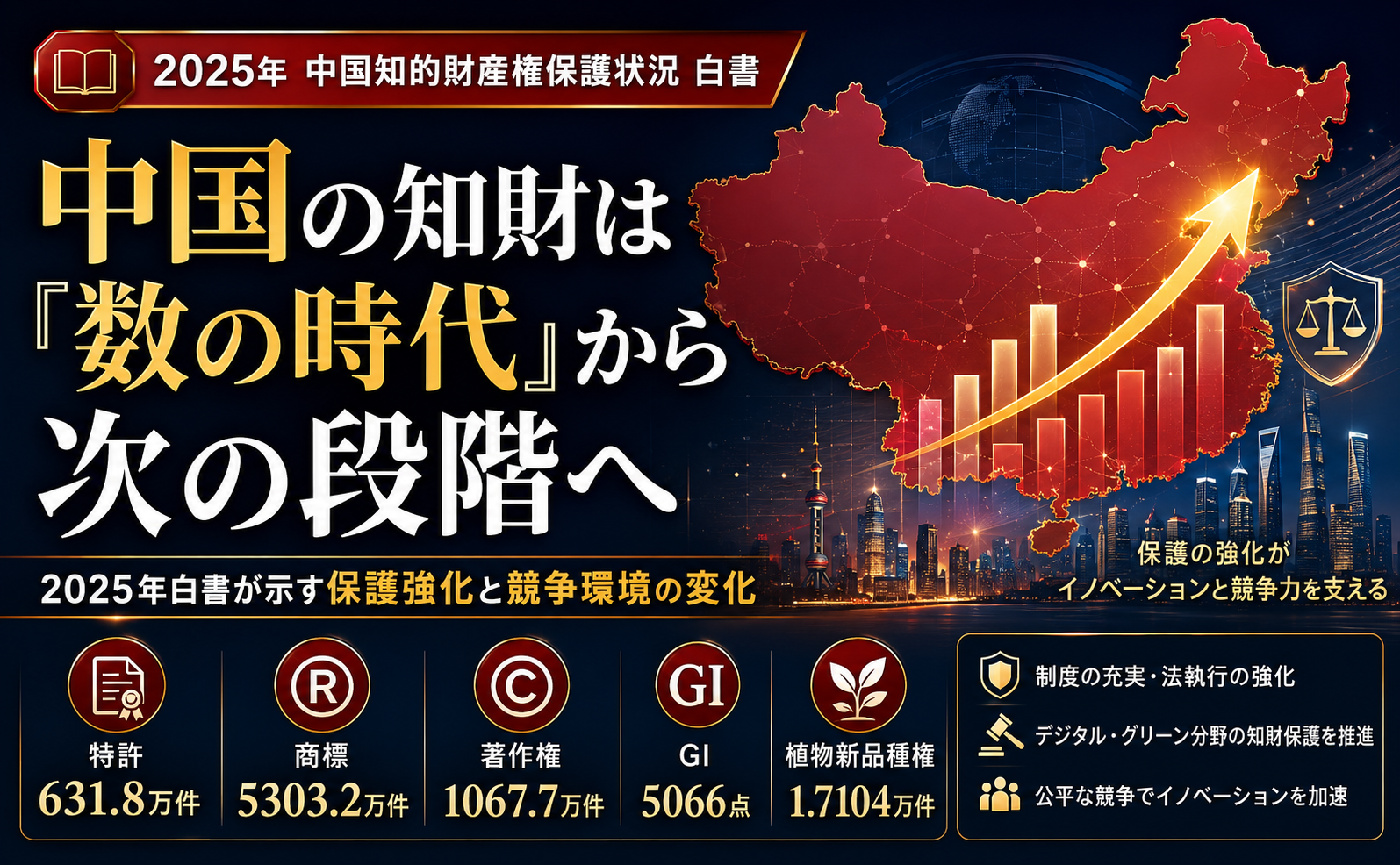
According to the 2025 White Paper on the Status of Intellectual Property Rights Protection in China, released in China on the 7th, the number of valid patents in force had reached 6.318 million by the end of 2025, up 11.1% year on year. In addition, the number of valid registered trademarks stood at 53.032 million, the annual total of copyright registrations reached 10.677 million, and the cumulative number of recognized geographical indication (GI) products rose to 5,066. Moreover, applications for new agricultural plant variety rights increased 15.26% year on year to 17,104, suggesting that both the stock of intellectual property and the operation of the relevant systems in China continue to expand. This white paper does more than simply present large numbers. It leaves a renewed impression that China positions intellectual property at the core of its industrial policy, technological competition, and brand strategy.
The first point worth noting is the broad base of intellectual property
What stands out first in these figures is that the numbers are rising across a wide range of fields, not only patents but also trademarks, copyrights, GIs, and plant variety rights. This indicates that China’s IP policy is not directed solely at certain advanced technology sectors. Rather, it is aimed at the comprehensive administration of IP systems covering manufacturing, the content industry, agriculture, and the protection of regional brands.
The increase in patent numbers means that R&D activity and the conversion of technological成果 into rights remain highly active. Meanwhile, the scale of trademark registrations suggests that the importance of brand protection in corporate activity is rising another notch. In addition, the accumulation of copyright registrations and GIs appears to reflect that the Chinese economy is expanding beyond a simple mass-production model toward a value-added model that incorporates cultural and regional value.
An increase in numbers also means intensifying competition
In a market with more than 6.31 million valid patents and more than 53 million valid registered trademarks, the very existence of rights becomes an everyday condition of competition. This carries important implications not only for Chinese companies but also for foreign companies entering the Chinese market.
A large number of patents means that prior art searches and freedom-to-operate clearance become more important in order to secure room for technological development. A large number of trademarks means that from the stage of selecting a brand name or product name, companies must examine the risk of conflict with existing rights more carefully than ever. In other words, intellectual property in China is no longer merely a matter of filing applications and being done with it. It is increasingly becoming a basic precondition for doing business itself.
While the increase in filings and registrations demonstrates the growing thickness of protection, it also means that the likelihood of rights conflicts and rights enforcement scenarios may rise. For that reason, companies are required to design not only “IP to file,” but also “IP to defend” and “IP that does not collide with others.”
What the white paper shows is not just the number of protected rights
A white paper like this should not be viewed merely as a document listing statistics. What matters is the message that China is continuously developing intellectual property protection as a foundation of national competitiveness.
In the past, discussions of intellectual property in China were strongly shaped by concerns over counterfeit goods and inadequate rights protection. Today, however, at least in terms of institutions and numbers, it is clear that China has made a major shift toward establishing protection frameworks on a large scale and steadily building an operational track record. Of course, the sheer number of rights and the actual quality of enforcement or effectiveness of judicial relief are separate issues. Even so, it is difficult to deny that the presence and weight of the system itself are growing year by year.
In that sense, when looking at China, the old image of it as simply “a country with weak IP protection” is no longer sufficient. Rather, it may now be closer to reality to see it as “a massive rights market where the impact of institutional operation is extremely significant.”
What the increase in GIs and plant variety rights suggests
One particularly interesting aspect of this white paper is that it clearly presents figures for GI products and new agricultural plant variety rights as well. This shows that China does not treat IP as something reserved only for high-tech sectors, but also links it to agriculture and regional development.
GI is a system that recognizes value in the connection between a region’s name, quality, and traditions. The cumulative total of 5,066 recognized GI products means that the protection and utilization of regional brands have advanced on a fairly broad scale. Likewise, the increase in applications for plant variety rights indicates that incentives for variety development and rights acquisition are also functioning in the agricultural sector.
This can be seen as evidence that China is trying to connect IP not merely to legal affairs, but also to local economies, agricultural competitiveness, and the formation of export brands. The fact that IP policy is becoming increasingly cross-industrial is something that deserves even more attention going forward.
Implications for Japanese companies
For Japanese companies, the figures in this white paper should not be dismissed with the general observation that “China has become an IP powerhouse.” What matters more is that the baseline conditions for doing business in China have become far more exacting than before.
In technology-related fields, companies must consider how to incorporate a China filing strategy from the R&D stage itself. In branding, securing trademark rights before launching a product is becoming even more important. In content-related sectors, proper copyright management and licensing arrangements are indispensable. Moreover, for businesses connected to food products or regional brands, the relationship with GIs can no longer be ignored.
What Japanese companies need is to stop viewing China merely as a sales destination or production base and instead recognize it head-on as a gigantic market densely covered by its own IP rules. An increase in rights means a corresponding increase in negotiations, disputes, licensing, invalidation actions, and monitoring.
The next focus will shift from “expansion in quantity” to “selection by quality”
That said, the more the number of IP rights continues to grow, the more the next question will be quality. As the number of rights in force expands, it becomes increasingly important to ask how effectively those rights are actually being used, how closely they are tied to competitive advantage, and to what extent the quality of those rights is being maintained.
In the case of patents, what matters is not just the number of registrations, but also the strength of claim scope, practical enforceability, and resilience in litigation. In the case of trademarks, the key is not mere stockpiling, but how closely they are tied to actual brand value. As for GIs and plant variety rights, the focus will likely shift from the mere number of recognitions or applications to how they contribute to industrial development and regional revitalization.
In that sense, this white paper appears to show not only that Chinese IP is still on an expansionary trajectory, but also that it is entering a stage in which the substance of those rights will be examined more rigorously.
Conclusion
The newly released 2025 White Paper on the Status of Intellectual Property Rights Protection in China clearly shows that the scale of IP protection in China continues to expand. Looking at the multifaceted figures for patents, trademarks, copyrights, GIs, and plant variety rights, it is evident that China is positioning IP at the center of both economic policy and competitive strategy.
What matters is not to consume this development merely as a piece of news about growing numbers. The accumulation of intellectual property is also a mirror reflecting changes in a country’s industrial structure, competitive environment, and business risk. For companies and practitioners involved in the Chinese market, this white paper may well have served as a renewed reminder of the reality that intellectual property in China is becoming ever more consequential.