
Introduction
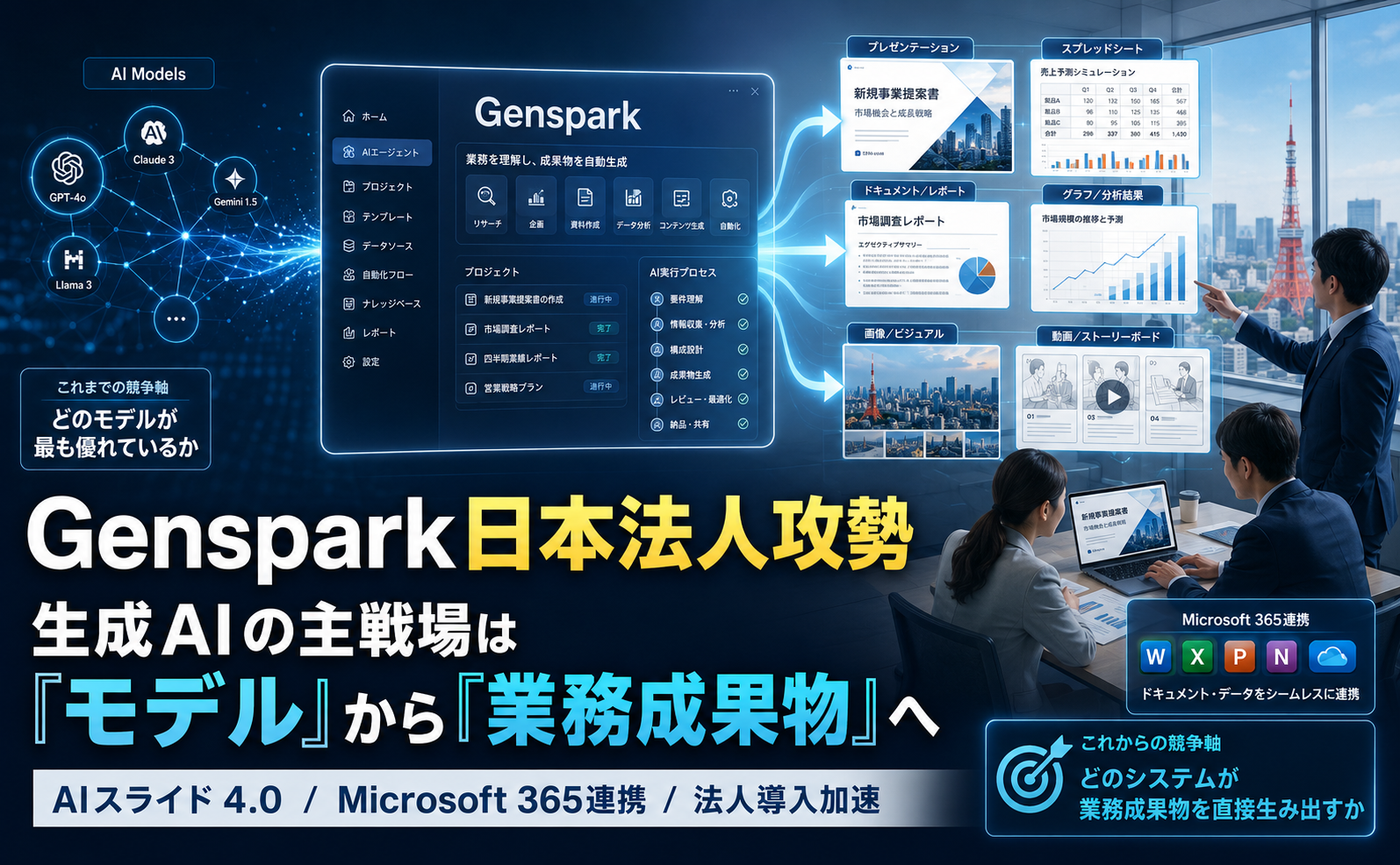
Genspark, a provider of AI workspaces, is accelerating its corporate expansion in the Japanese market. At a media roundtable held in May 2026, the company introduced its latest features, including the slide generation function “AI Slides 4.0” and integration with Microsoft 365, while also highlighting adoption cases among Japanese companies. Globally, Genspark has already surpassed 5,000 corporate users. In Japan, major companies such as ASKUL, Dentsu, Hankyu Hanshin Properties, Funai Consulting, and Bellsystem24 have begun full-scale use of the platform.
Genspark’s defining feature is that it integrates more than 70 AI models, including those from OpenAI, Anthropic, and Google, into a single workspace. Based on user instructions, it can call the optimal model and autonomously generate documents, slides, images, videos, spreadsheets, and other materials. This development suggests that the axis of competition in generative AI is shifting from “which AI model is superior” to “how directly AI can create practical business deliverables.”
Genspark Is Not Aiming to Reduce “Time Spent Using AI,” but to Replace the Work Itself
What is important about Genspark’s corporate expansion is that this is not simply a matter of introducing chat-based AI into companies.
In conventional generative AI use, the typical workflow has been for users to enter prompts, for humans to revise the generated text or information, and then to transfer it into tools such as PowerPoint or Excel. In this case, AI remains an assistant that supports only part of the work.
By contrast, what Genspark is proposing is a workspace that generates final deliverables in an end-to-end manner. With AI Slides, users can generate slides that reflect company-specific templates, fonts, and presentation frameworks. With AI Sheets, users can search financial information and patent information, perform spreadsheet calculations, generate formulas, and format outputs. That data can then be reused in slides, podcasts, manga-style explanatory materials, and other formats.
In other words, Genspark’s value lies not in “generating text,” but in “generating deliverables that can actually be used in internal business operations.” This is where its appeal in the corporate market lies.
The Significance of Microsoft 365 Integration
Genspark’s integration with Microsoft 365 also carries major significance in the corporate market.
In many Japanese companies, PowerPoint, Excel, and Word form the foundation of everyday work. No matter how powerful an AI tool may be, if it can only be used in an environment separate from existing workflows, it is unlikely to take root in the workplace. Employees would need to open a new tool, transfer data, and reshape the output into existing documents.
If Genspark can be called as an AI agent from PowerPoint or Excel, AI will no longer be a standalone application. It will become embedded in existing work. This not only lowers the barrier to adoption, but also increases the frequency of use within companies.
In corporate adoption of generative AI, what matters more than raw performance is whether employees can use it naturally in their actual workflows. In that sense, Microsoft 365 integration could become a powerful entry point for Genspark’s expansion in Japan.
The Dentsu Case Shows the Practical Value of “Presentation-Creation AI”
One of the most noteworthy points in this announcement is the effect of Genspark’s adoption at Dentsu. Within two months of introduction, the company reportedly reduced workload by an average of 6 hours and 12 minutes per person per week in the teams using the tool, equivalent to about 40 working days per year. In slide creation alone, the reported reduction was an average of 25 hours per person per month.
These figures show that, in corporate use of generative AI, one of the areas where results are easiest to see is presentation and document creation.
In Japanese companies, a great deal of time is spent preparing materials for internal explanations, sales proposals, meetings, approvals, and reports. Particularly in large companies, employees must adjust not only the content itself, but also the appearance, structure, tone, brand rules, and how the material will be presented to managers or clients.
When a tool like Genspark enters this area, it affects not merely time savings, but the productivity structure of white-collar work itself. If the time spent creating materials is reduced, it becomes easier to redirect time toward higher-value work such as planning, analysis, customer response, and decision-making.
However, Partial Adoption Makes It Difficult to See the Benefits
On the other hand, as Genspark itself acknowledges, many Japanese companies are currently using the tool only within limited departments, making it difficult to see a clear return on investment.
This is a common issue in many generative AI implementations. Simply testing AI at the individual or departmental level does not transform the overall business process, so the impact remains limited. For example, even if one employee can create materials faster using AI, if the subsequent processes of review, approval, revision, and sharing remain unchanged, the overall improvement in productivity will be limited.
For Genspark to truly take root in the corporate market, simply introducing the tool will not be enough. Companies need to design their workflows by deciding which tasks should be delegated to AI, at which stages humans should review the output, how much internal data AI should be allowed to use, and who should evaluate the quality of the deliverables.
For this reason, it is natural that Genspark is seeking to strengthen partnerships with consulting firms and system integrators. Full-scale adoption in large companies is unlikely to progress unless the initiative goes beyond selling AI tools and extends into redesigning workflows around AI.
“Integration of More Than 70 AI Models” Is Both a Strength and a Differentiation Challenge
One of Genspark’s major characteristics is that it integrates more than 70 AI models into a single workspace. Rather than requiring users to choose among models, Genspark is designed to call the optimal model according to the task.
This is an easy-to-understand value proposition for users. In corporate workplaces, it is not easy to understand the differences among models from OpenAI, Anthropic, Google, and others, and to use them properly depending on the task. If Genspark handles that selection in the background, users can focus solely on the deliverables.
However, this design also presents a challenge in terms of differentiation. Services that bundle multiple LLMs tend to rely on similar foundation models, which can make their functions and accuracy converge. If competitors can use similar models, simply being able to use “many models” is unlikely to become a long-term advantage.
Therefore, Genspark’s real competitive edge is not the number of models. It lies in its orchestration capability: which model it uses, in what order, for which task, and how it turns the results into usable deliverables.
Competition with First-Party AI
In the corporate AI market, AI model developers such as OpenAI and Anthropic are also strengthening their support for enterprise adoption. Anthropic has expanded its partnership with PwC, and OpenAI is also moving further into AI development and implementation support for enterprises.
This trend is a threat to Genspark. If companies that own foundation models begin offering enterprise implementation support and business applications, services like Genspark that sit in the middle layer will constantly be required to prove their differentiation.
Conversely, however, Genspark also has potential as a neutral integration layer. The ability to use models from OpenAI, Anthropic, Google, and others across providers, without being tied to a specific model, is attractive to companies. For enterprises that want to avoid dependence on a specific vendor, an AI workspace like Genspark can become a viable option.
Future competition will not be decided simply by model performance, but by how deeply AI can penetrate real business operations.
The Distinctiveness Shown by the Internal Development Platform “Light-out Factory”
Another noteworthy aspect of Genspark is its internal development platform, “Light-out Factory.” This is a system in which AI picks up Issues on GitHub and carries out code generation, screenshot capture, and pull request creation in an end-to-end manner.
Genspark explains that, of its approximately 70 employees, 50 are engineers, and that nearly 100% of its code is written by AI. The fact that one employee can submit dozens of pull requests per day symbolizes the company’s speed of development.
This is not merely a case study in internal efficiency. It shows that Genspark itself is using AI to increase its own development speed and reflect those results in product improvement. In other words, Genspark is not only a company that sells AI, but also a company that operates its organization on the premise of AI.
The phrase used by Zhu, “a self-evolving autonomous organization,” may sound somewhat grand. However, looking at the company’s development structure, it is clear that Genspark is at least aiming for an operating model different from that of traditional software companies.
For Japanese Companies, the Issue Is Not Whether to Adopt AI, but Whether They Can Change Their Workflows
For Japanese companies, the biggest issue when adopting an AI workspace like Genspark is not simply the tool’s performance. What matters is whether they can change their workflows on the premise of AI.
Genspark can be applied to a wide range of tasks, including presentation creation, data analysis, sales proposals, patent information research, internal reporting, and training material creation. However, each of these tasks involves internal rules, approval processes, quality standards, and information management rules. Even if AI becomes capable of producing deliverables, its impact will remain limited unless companies decide where to incorporate it into their business workflows.
In corporate use, governance issues such as information leakage, copyright, confidential information, output accuracy, and the handling of internal data cannot be avoided. In particular, when dealing with patent information, financial information, customer information, or internal strategy documents, it is important to balance AI convenience with risk management.
The companies that can maximize the benefits of Genspark will not be those that simply distribute AI tools. They will be companies that can clearly distinguish between tasks to be entrusted to AI and tasks for which humans remain responsible.
Conclusion
Genspark’s corporate push in Japan shows that the generative AI market has entered a new phase. Until now, attention has focused on which AI model is the most powerful and which chat AI is the most convenient. In the corporate market, however, the key questions are already shifting to how directly AI can produce practical business deliverables, how naturally it can fit into existing workflows, and how clearly it can demonstrate workload reduction after implementation.
By integrating more than 70 AI models, connecting with Microsoft 365, and moving into the generation of deliverables such as slides, spreadsheets, images, and videos, Genspark is trying to move AI closer to being not merely a “conversation partner,” but a “business executor.”
However, its future success will not be determined by tool functionality alone. What matters is whether Japanese companies can redesign their workflows around AI, and whether Genspark can deeply embed itself in each company’s operations and continuously produce results.
Whether Genspark truly spreads in the Japanese market will likely serve as a test case for whether generative AI can evolve from a convenient tool into a business infrastructure that transforms the way companies work.