
Introduction
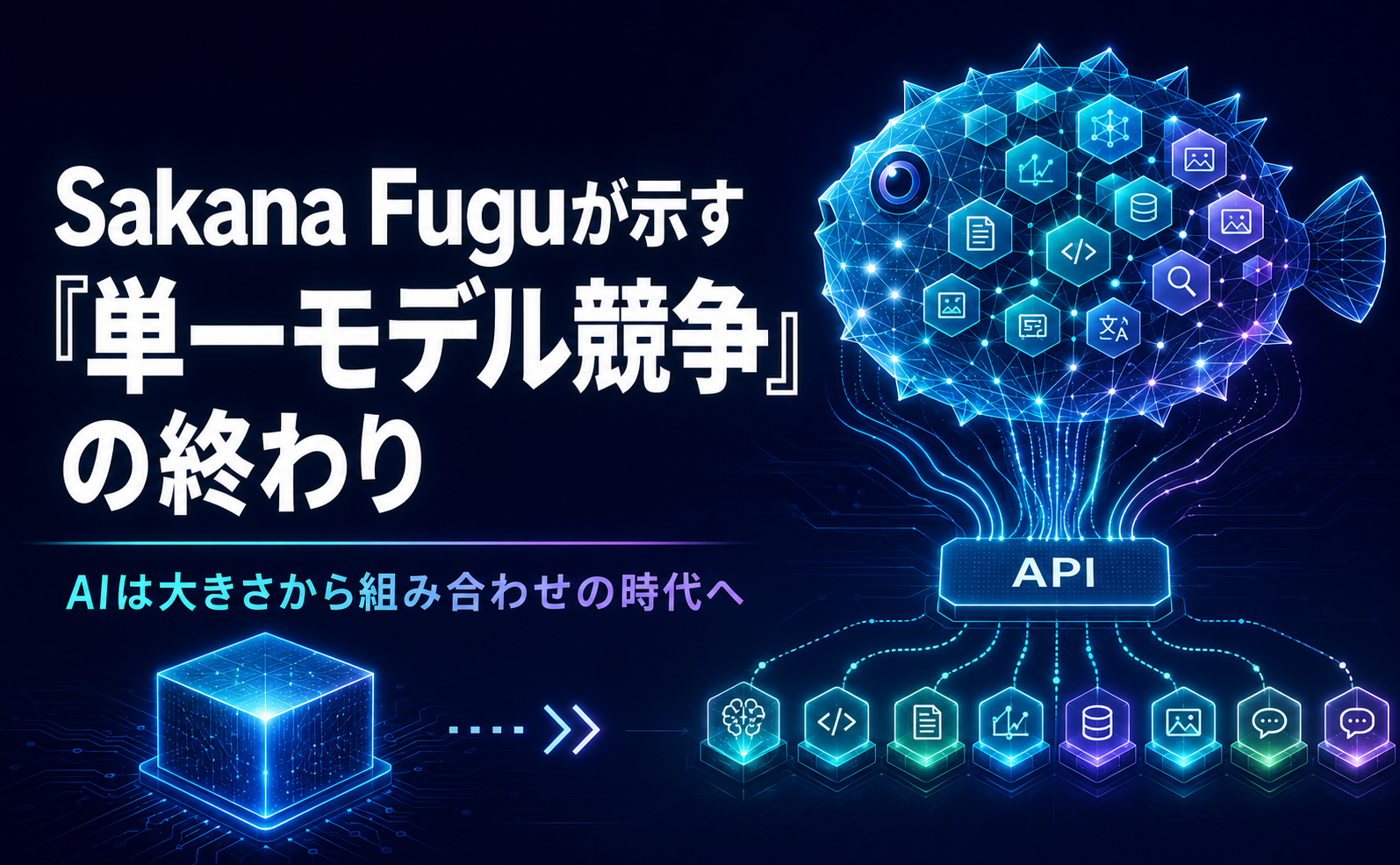
Sakana AI has launched “Sakana Fugu,” an AI service that internally coordinates multiple AI models while allowing users to access it externally as a single API model. Sakana Fugu is a multi-agent orchestration model that, when a user sends an instruction to a single endpoint, internally determines whether to handle the task with a single model or by combining multiple specialized models, depending on the nature of the processing required.
Two models are offered: “Fugu,” designed for everyday coding, code review, chatbots, and similar use cases, and “Fugu Ultra,” designed for high-load tasks such as data analysis, reproducing academic papers, cybersecurity analysis, and literature and patent research. Sakana AI explains that Fugu Ultra has demonstrated performance comparable to frontier models such as Anthropic’s Claude Fable 5 and Claude Mythos Preview.
What is important about this news is not simply that a new high-performance AI model has appeared. Rather, it is that the axis of AI competition is beginning to shift from “how powerful one giant model can become” to “how multiple models are selected, combined, and verified.”
The Limits of the Era of Choosing “One Strongest Model”
Until now, a major issue in using generative AI has been which model to choose. Users have had to select different models depending on the purpose: one model for text generation, another for coding, another for long-document comprehension, and another for reasoning.
However, real-world work is not that simple. In patent research, for example, one needs the ability to read technical literature, organize differences in inventions, adjust wording from a legal perspective, and abstract differences from prior art. This is neither mere searching nor mere writing. It is work in which multiple abilities are combined step by step.
The same applies to software development, research, financial analysis, and security diagnostics. In complex tasks, a single model does not necessarily make optimal judgments from beginning to end. Combining a model that is strong at planning, a model that is strong at code execution, a model that is strong at verification, and a model that is strong in specialized knowledge may ultimately lead to higher-quality results.
Sakana Fugu is based on the idea of shifting this “model selection” from the user to the AI side. From the user’s perspective, they are simply calling one model. Internally, however, model selection, task allocation, result verification, and integration into the final answer are being performed.
The Significance of Turning Multi-Agent Systems into an “Ordinary API”
The idea of multi-agent systems itself is not new. Systems that assign roles to multiple AIs and have them debate, verify, or divide up work have already been used in research and experimental settings.
However, using such systems stably in actual business operations is not easy. This is because it requires designing which model to call, how many rounds of interaction to allow, at what stage to introduce verification, how to retry when something fails, and how to control costs. While multi-agent systems are powerful, the complexity of implementation and operation has been a major challenge.
What makes Sakana Fugu interesting is that it attempts to hide this complexity behind a single API. Users and developers can send requests in a form close to conventional OpenAI-compatible APIs and leave the internal orchestration to Sakana Fugu.
This means that the abstraction layer for using AI is moving one level higher. Until now, humans have had to think about “which model to use.” Going forward, what may become important is “which AI system to use to bundle together a group of models.”
A Practical Countermeasure Against Dependence on a Single Vendor
In this announcement, emphasis is placed not only on technical performance but also on the risk of dependence on a single vendor. This is an extremely important perspective.
AI models are no longer just convenient tools. They are increasingly being integrated into corporate operations, public administration, finance, research, and critical infrastructure. In such a situation, depending on the API of a particular single company for the core of one’s operations creates not only technical risks but also geopolitical and institutional risks.
Regulations, export controls, national policies, and changes in corporate strategy could suddenly alter the conditions for accessing a model. Usage fees may change, or the model may become unavailable in certain regions or for certain purposes. For companies using AI as part of their business infrastructure, this is a risk that cannot be ignored.
A structure like Sakana Fugu, which allows the group of models used behind the scenes to be swapped out, offers one answer to this risk. If the capabilities of the overall system can be maintained by combining other models even when one model becomes unavailable, the fault tolerance of the AI system as a whole increases.
This is not merely technical redundancy. It is a matter of supply chain management in the AI era, and by extension, a matter of AI sovereignty.
Expected Use Cases
Sakana Fugu seems particularly well suited not to one-off questions, but to complex, multi-step tasks.
For example, in code review, it is necessary not only to point out bugs but also to examine design issues, security concerns, insufficient testing, and maintainability from multiple perspectives. In literature research and patent research, searching, reading, comparison, classification, summarization, extraction of differences, and final judgment are required. In reproducing academic papers, implementation, experimentation, analysis of failure causes, and repeated attempts are necessary.
In these tasks, what is required of AI is not merely the accuracy of a single response. What matters is persistence: noticing errors along the way, revising hypotheses, trying alternative methods, and compiling the final deliverable. This background likely explains why Fugu Ultra is positioned for high-load work.
Issues That Require Attention
On the other hand, systems like Sakana Fugu also require caution.
First, it may become difficult to see which models were used internally and how they were used. Treating the system like a single model is an advantage from the user’s perspective, but in work that requires accountability and reproducibility, transparency of the internal process becomes important.
Second, there are issues of cost and latency. Coordinating multiple models may produce higher-quality results than using a single model, but it may also increase processing time and computational resources. Especially in use cases that require real-time performance, it will be important to distinguish between Fugu and Fugu Ultra appropriately.
Third, benchmark results must also be read carefully. Demonstrating high performance on benchmarks is important, but the value in actual business operations can vary greatly depending on the nature of the data, prompt design, operating environment, and required level of accountability. Companies adopting such systems need to verify not only official performance evaluations but also how reproducible the results are on their own tasks.
AI Competition Is Moving from “Individual Models” to “Model Operations”
The arrival of Sakana Fugu appears to indicate that competition in the AI industry has entered a new stage.
Until now, companies capable of developing larger and more capable single models have held an advantage. Going forward, however, how existing groups of models are combined, how roles are assigned among them, how they are made to verify one another, and how they are operated stably will likely become just as important.
Especially in enterprise use, top performance alone is not enough. Stability, cost, regulatory compliance, data management, explainability, and vendor diversification are all required. Sakana Fugu is valuable in that it attempts to respond to these practical demands in the form of a “model that bundles multiple models.”
Conclusion
Sakana Fugu is not merely a new AI model. It is an attempt to change the way AI itself is used. Instead of users choosing models, AI selects models according to the task, coordinates them, and integrates the results. This idea has the potential to make the use of generative AI more advanced and more practical.
Of course, challenges remain, including internal transparency, reproducibility, cost, and the division of responsibility. Even so, as the risk of dependence on a single vendor becomes increasingly real, an approach that flexibly combines multiple models will likely become more important.
The evolution of AI may not proceed only in the direction of creating “one smarter model.” The question from now on will be how to bundle multiple forms of intelligence and transform them into reliable outcomes. Sakana Fugu can be seen as an example that presents this direction as a commercial product.