
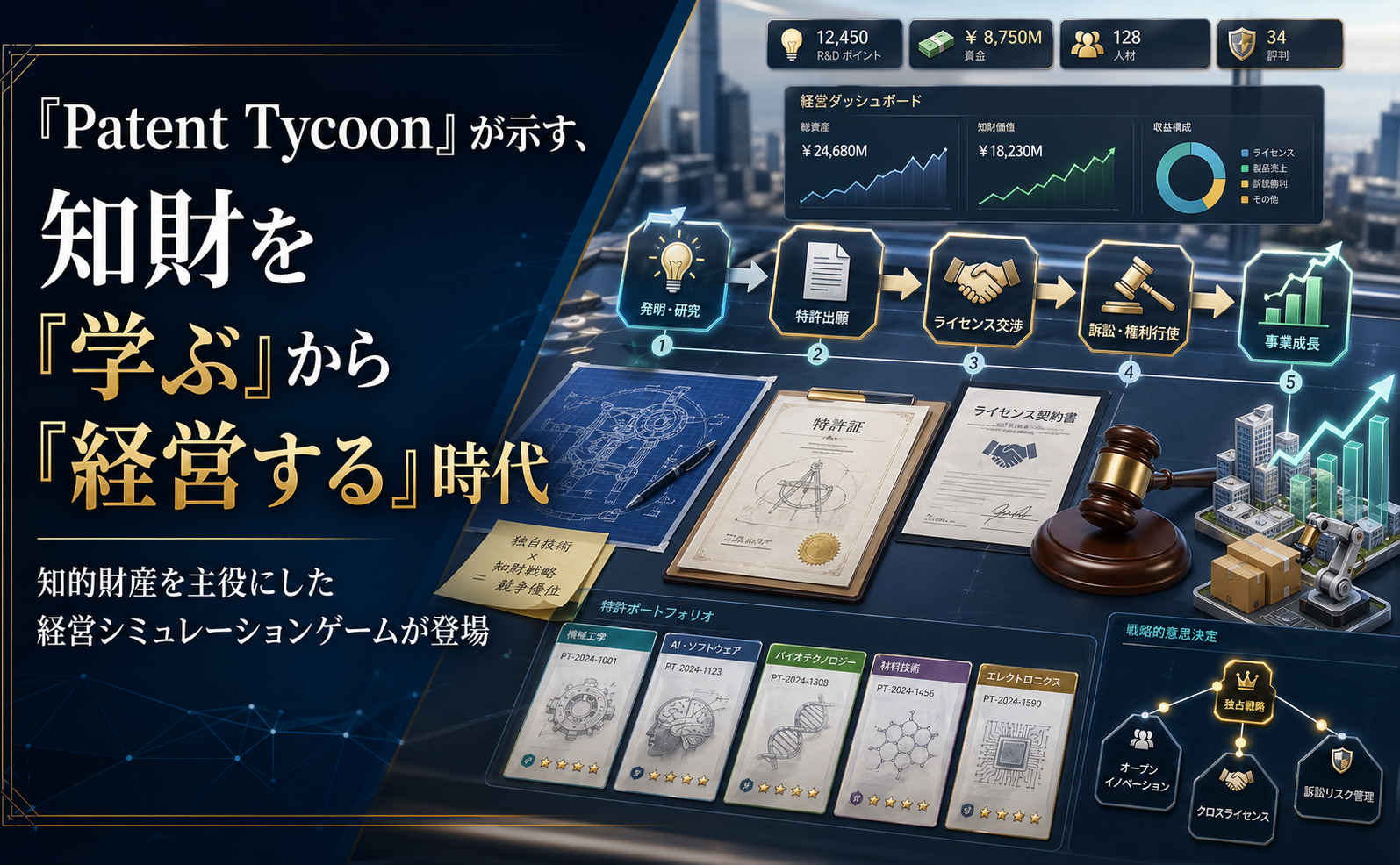
A Business Simulation Game with Intellectual Property at Its Core
Independent game developer Traste has released Patent Tycoon, an intellectual property management simulation game for PC, for free on Steam. The game is a business simulation in which players aim to expand their market by making use of their company’s technologies and intellectual property through research and development, patent applications, license negotiations, litigation, invalidation trials, and more.
Players take on the role of a corporate executive, developing new technologies, launching products based on those technologies, obtaining patents, and strengthening their company’s competitiveness. At the same time, they must also face IP-related risks, including license negotiations with competitors, patent infringement lawsuits, and responses to invalidation trials.
The game also includes a story element in which the player awakens as the “100th challenger.” As players trace the records of the 99 predecessors who attempted the same challenge in the past, they advance their corporate management and patent strategy while drawing closer to the truth hidden in the world. One of the game’s distinctive features is that it combines business simulation and storytelling while using intellectual property as its central theme.
Intellectual Property Is No Longer “Only for Experts”
What makes Patent Tycoon particularly interesting is that it does not treat intellectual property merely as legal knowledge. Instead, it places IP at the center of business decision-making.
When people hear the word “patent,” they often imagine “a right that protects an invention” or “a system that grants exclusivity over technology.” In actual corporate activity, however, patents affect many different areas, including product competitiveness, barriers to market entry, license revenue, negotiation leverage, litigation risk, and corporate valuation during fundraising.
In other words, obtaining a patent is not the end of the story. Which technology should be filed as a patent application? Which market should be secured? Should the technology be licensed to other companies, or kept exclusively within the company? When infringement is discovered, should the company file a lawsuit or pursue negotiations? The accumulation of these decisions becomes the company’s growth strategy itself.
In that sense, making intellectual property the core system of a game is a very effective way to communicate the essence of IP intuitively.
Whether to File a Patent Application Is Also a Business Decision
In this game, players can acquire technology through research and development, launch products based on that technology, and obtain patents to enhance their competitiveness. This way of thinking also applies to real-world corporate management.
However, in real IP strategy, the existence of an invention does not automatically mean that a patent application should be filed. Filing an application costs money, and obtaining a granted patent takes time. In addition, filing an application means that the contents of the invention will be disclosed. Depending on the technology, keeping it confidential as know-how may be more advantageous than disclosing it through a patent application.
On the other hand, obtaining a patent may allow a company to restrain competitors from entering the market or to conduct license negotiations on more favorable terms. Patents can be useful not only for protecting the company’s own products, but also for business alliances, business sales, and explanations to investors.
How far the game reproduces these kinds of decisions will need to be confirmed through actual gameplay. Still, the design itself, which treats “technology development,” “patent filing,” and “market expansion” as an integrated process, is close to the concept of IP management.
License Negotiations Change How IP Is Viewed
Another important point is that license negotiations are included as an element in a work themed around intellectual property.
Patents are not only tools for excluding other companies. They can also become assets that generate license revenue by allowing other companies to use the patented technology. A company may enter markets it cannot develop on its own through other companies, or monetize its technology while avoiding direct conflict with competitors.
Understanding patents not only as “weapons,” but also as “negotiation tools” and “sources of revenue,” is essential for understanding IP management. In recent years in particular, business negotiations based on intellectual property have become increasingly important in areas such as open innovation, startup investment, standard-essential patents, and cross-licensing.
The fact that Patent Tycoon incorporates license negotiations into its game system could serve as an entry point for understanding intellectual property in a more multidimensional way.
The Inclusion of Litigation and Invalidation Trials Adds Realism
The game also features IP risks such as patent infringement litigation and invalidation trials. This prevents patents from being treated simply as “power-up items.”
In real IP practice, the party that owns a patent is not always in an advantageous position. If a patent holder enforces its rights, the opposing party may request an invalidation trial. The validity of the patent may be challenged, the interpretation of the scope of rights may become an issue, and litigation costs and reputational risks to the business may also arise.
Likewise, if a company is accused of infringing another company’s patent, it must consider multiple options, including an injunction against product sales, damages, design changes, and license negotiations.
This uncertainty is precisely what makes IP strategy difficult. It is necessary to consider not only whether a company has strong patents, but also how durable those patents are in a dispute, how much room there is for negotiation, and what impact the dispute may have on the business. If players can experience these elements as part of a game, the game may offer a sense of tension close to that of real-world intellectual property practice.
The Value of Experiencing IP, Rather Than Simply Studying It
Intellectual property inevitably involves many technical terms, making it a field that can feel distant to beginners. Terms such as patent application, examination, notice of reasons for refusal, amendment, scope of rights, infringement, invalidation trial, and license agreement are not easy to understand for people who have not encountered them in practice.
With a game, however, players can learn intuitively through the relationship between actions and outcomes, even if they do not fully understand the system from the beginning. They invest in research and development, obtain patents, respond to competitors, earn revenue through licensing, and prepare for litigation risks. By experiencing this sequence of events, players can more easily understand what intellectual property means within corporate activity.
This also has significant value from the perspective of IP education. It allows people to experience intellectual property not merely through classroom learning, but as a series of business decisions.
The Meaning of Storytelling in an IP Game
Patent Tycoon is not merely a numerical management-style business simulation. It also includes a story in which the player, as the “100th challenger,” approaches the truth of the world.
This setting seems surprisingly compatible with the theme of intellectual property. IP is a system in which new technologies are built upon the accumulation of past technologies. It involves investigating prior art, identifying differences from past inventions, and securing rights for new value on that basis.
The story of “what the 99 predecessors aimed for, why they failed, and what they left behind” can also be read as a metaphor for prior art and technological history within the patent system. A new challenger must choose the next move based on past failures and achievements. This structure is common to corporate management, research and development, and patent practice.
If the story and IP strategy are successfully connected, players will not merely increase numbers. They will also encounter questions such as why technology should be protected, why companies compete, and what should be passed on to the next generation.
A Work Worth Noting for the IP Industry
Patent Tycoon is a work that deserves attention not only from game fans, but also from the intellectual property industry.
In the IP field, communicating the importance of the system to the general public has long been a challenge. Although the patent system is important to society, its structure and practical significance are not easily understood. Patent firms, corporate IP departments, researchers, startup founders, and students all have very different levels of understanding when it comes to IP.
Against this backdrop, an additional entry point into intellectual property through the form of a game may help broaden the base of IP literacy. It is meaningful that players can experience patents not as a “difficult legal system,” but as a “strategic element that affects business.”
For startups and individual developers in particular, IP is often a topic that gets postponed. However, if a business is built around technology or branding, it is important to understand IP concepts at an early stage. A work like Patent Tycoon may become one such trigger.
The Difference Between “Gamification” and Reality Should Be Kept in Mind
At the same time, because the game deals with intellectual property as a game, there will naturally be differences from the real system. Actual patent practice is extremely complex, involving differences between national systems, uncertainty in examination, the quality of application documents, claim drafting, prior art searches, contract negotiations, litigation jurisdictions, evidence collection, and more.
A game needs to abstract these elements in an understandable way. Therefore, strategies that are effective in the game will not necessarily apply directly to real-world IP strategy.
However, this is not so much a flaw as it is a natural simplification for a game. What matters is that players gain a sense that intellectual property affects business management. As an entry point for accurately learning the real system, an abstracted experience may in fact be more suitable.
From “Protection” to the “Core of Management”
What Patent Tycoon shows is a perspective that sees intellectual property not merely as a defensive system, but as a core element of management.
Traditionally, patents have often been regarded as something obtained “to prevent imitation.” In modern IP strategy, however, that alone is not enough. Patents are assets for building competitive advantage, cards for negotiating with other companies, and tools for determining a company’s position in the market.
Experiencing the sequence of research and development, commercialization, patent filing, licensing, litigation, and invalidation trials within a game can be useful for understanding intellectual property in a more practical way. If more people come to see IP not as a “legal issue,” but as a “management issue,” the position of IP within corporate activity may also change.
Conclusion
Patent Tycoon is an ambitious work that allows players to experience the specialized theme of intellectual property in the form of a business simulation and story. Through elements such as research and development, patent applications, license negotiations, litigation, and invalidation trials, it may help players intuitively understand how IP relates to corporate management.
Intellectual property is not a closed field handled only by experts. The way of thinking behind IP is becoming increasingly important not only for those who create technology, but also for those who grow businesses, invest in companies, and choose products.
The emergence of a work like Patent Tycoon may serve as one trigger for making intellectual property more accessible and expanding interest in IP management. As a game that can be enjoyed while prompting players to think about what patents are, what it means to protect technology, and how IP can be used in management, it is a work whose future development is worth watching.