
Introduction
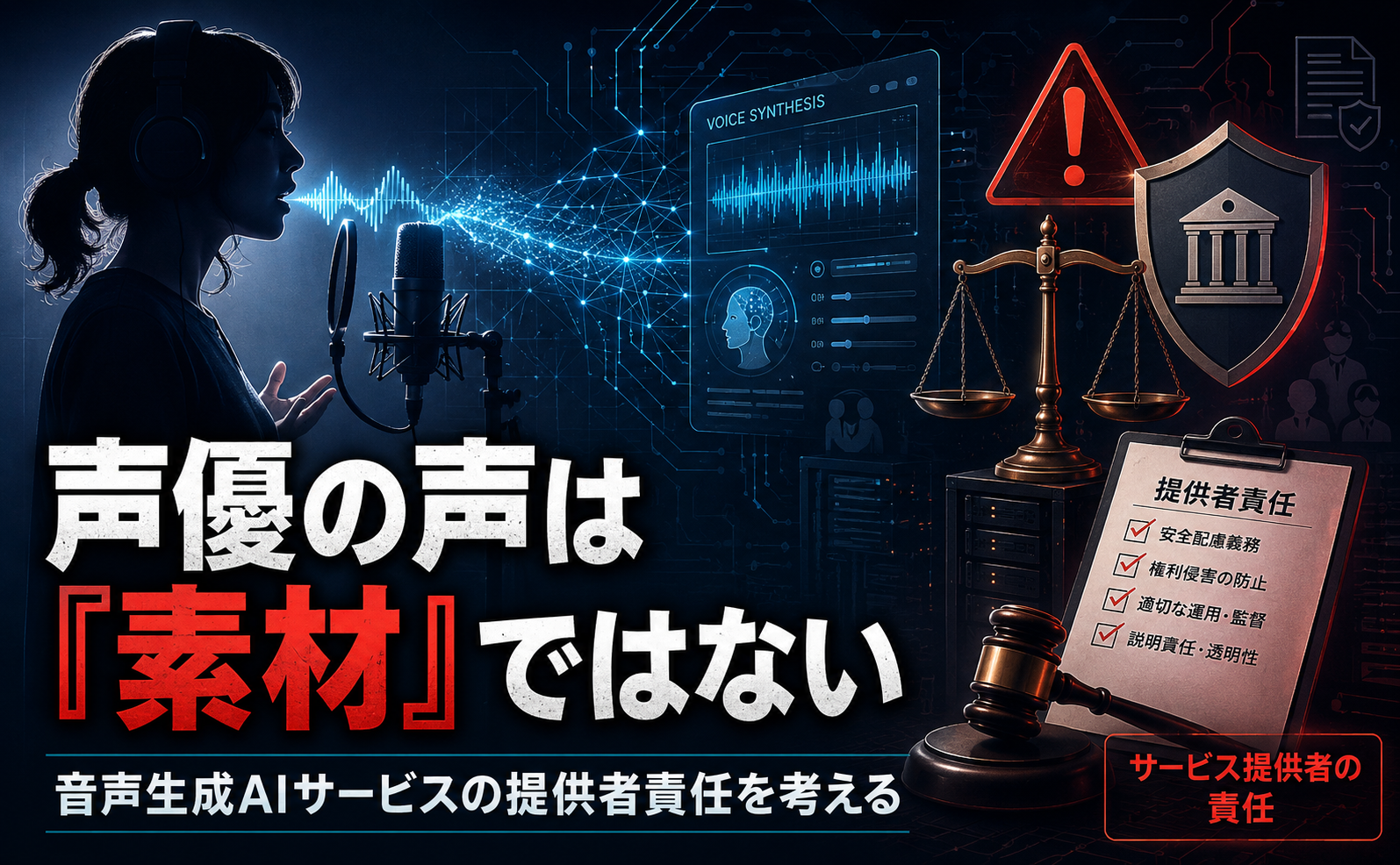
Criticism is growing against overseas voice-generating AI services that allow users to select the voices of voice actors or celebrities, enter text, and generate audio that resembles those voices. According to reports, a service provided by a U.S. company displays voice samples bearing the names of Japanese anime characters and celebrities, and paid plans allow users to create longer audio clips. In some cases, voices appear to have been registered without the consent of the voice actors themselves. Megumi Ogata, known for roles such as Shinji Ikari in Neon Genesis Evangelion, has expressed serious concern, saying that these services treat voices as if they were “free materials” and use them for business.
In response to this situation, organizations representing voice actors and actors are calling on the government to take action, and an expert panel of the Ministry of Justice is expected to discuss the illegality of providing voice-generating AI services themselves. In addition, Kenjiro Tsuda has filed a lawsuit with the Tokyo District Court seeking the removal of videos that allegedly imitate his voice without permission. Legal and social debate over “AI-generated voices” is now entering a more serious phase.
The Core Issue Is Not Limited to “Uploaders”
The first point that deserves attention is that the responsibility of voice-generating AI service providers, not only that of individual users who make unauthorized use of voices, is beginning to be questioned.
Until now, unauthorized use of voices through generative AI has often been discussed in connection with individual videos or audio clips posted on social media. However, even if such posts are removed one by one, the harm will continue to recur as long as services capable of generating similar voices remain available. As a lawyer noted in the report, responding only to individual social media posts can easily become a game of whack-a-mole.
For this reason, the importance of the current debate lies in determining how far duties of care and responsibility should extend not only to those who use such services to create unauthorized audio, but also to those who provide the environment in which such audio can be created.
Is It Enough Simply to “Prohibit It in the Terms of Service”?
Service operators explain that their terms of service prohibit users from registering the voices of voice actors and others without permission, and that they take measures such as removal when violations are reported.
However, this raises a major issue. Even if such conduct is prohibited under the terms of service, if voice samples bearing the names of Japanese voice actors or anime characters are actually displayed and serve as a factor attracting users, is it really sufficient to say that “users registered them on their own”?
In particular, if the service advertises itself with messages such as being “cheaper than hiring voice actors,” it can be understood as marketing the service as a substitute for the work of professional voice actors. In such circumstances, if audio closely resembling famous voice actors or characters is available, service providers should be required to implement stricter verification and removal systems.
Voices Involve Both Personality and Professional Value
For voice actors, a voice is not merely audio data. It is professional value itself, built from acting, expression, experience, connection to roles, and relationships with fans.
The voices of anime characters, in particular, are deeply connected not only to the voice qualities of the voice actors themselves, but also to the personalities of the characters and the memories associated with the works. When AI becomes capable of reproducing those voices and making them speak different lines, the problem goes beyond mere imitation. It creates a situation in which a person or character is made to say something they never actually said.
This is not only a matter of economic loss. It also concerns the person’s image, reputation, credibility, and the audience’s trust in the fictional world of the work. Unauthorized use of a voice means that a person’s expressive identity is consumed regardless of that person’s own will.
Impact on Young Voice Actors
As Megumi Ogata has pointed out, this issue is not limited to famous voice actors. If voice-generating AI services become widespread, opportunities for young voice actors may be taken away.
For example, if low-budget videos, advertisements, games, streaming content, and similar projects increasingly choose to “make do with AI voices rather than hiring real voice actors,” young voice actors will have fewer opportunities to gain experience. The voice acting industry is one in which accumulating experience leads to the next job. If entry-level work is replaced by AI, this will also affect talent development across the industry as a whole.
In addition, if AI voices can be made to resemble famous voice actors without permission, “famous voice actor-style” AI voices may be chosen over voices performed legitimately by young voice actors. This distorts the market value of the profession of voice acting.
Why the Debate Over Publicity Rights Matters
It is also important that organizations such as the Japan Actors Union are asking the government to raise awareness regarding liability for infringement of publicity rights.
Publicity rights are based on the idea of protecting the customer-attracting power of the names, portraits, and similar attributes of celebrities. In a case like this, where a service uses the names of voice actors or characters to attract users and provides a service capable of generating audio resembling those voices, it may be evaluated as commercially exploiting the appeal that those voices and names possess.
Of course, the extent to which a voice itself is legally protected is not an easy question to organize under current law. Several legal frameworks may be relevant, including copyright, publicity rights, personality rights, and tort liability. For that reason, it is highly significant that the Ministry of Justice’s expert panel will discuss the illegality of service providers’ conduct.
From Removal-Based Responses to Preventive System Design
What will be needed going forward is not only ex post removal, but also preventive mechanisms to stop unauthorized registration in the first place.
For example, when publishing a voice model bearing the name of a celebrity or voice actor, a system could require confirmation of permission from the person in question or the rights holder. In addition, for models that use names clearly evoking existing voice actors or characters, service providers should not simply leave them online until a report is filed; they need to monitor them proactively.
Rules are also needed to clearly indicate when audio is AI-generated and to prevent misunderstanding that the person actually made the statement. On social media in particular, short audio clips and videos can easily spread after being separated from their original context, making mechanisms to prevent misidentification indispensable.
Technological Development and Respect for Professions
There is no need to reject voice-generating AI itself entirely. When used with the person’s consent, it can be applied to narration, dubbing, accessibility, creative support, and other fields. The problem is using technological convenience as a reason to disregard the rights and wishes of the person whose voice is being used.
A voice actor’s voice is not mere data. It is an expressive asset built through professional effort. If it becomes normal for voices to be trained on, registered, generated, and commercially used without the person’s permission, the relationship of trust in creative production will collapse.
What is needed in the AI era is not to stop the use of technology, but to clarify rules on consent, compensation, labeling, and responsibility. If someone wants to use a voice, they should obtain permission from the person or rights holder and pay appropriate compensation. This basic principle must also be enforced for AI services.
Conclusion
This news shows that generative AI has begun to enter in earnest the field of “voice,” an area that is highly personal and has significant professional value. Until now, responses have centered mainly on the removal of individual videos generated without permission, but going forward, system design that includes the responsibility of service providers will be unavoidable.
Treating the voices of voice actors and celebrities as materials that anyone can use freely not only infringes the rights of the individuals concerned, but also undermines the value of voice work itself. The discussions at the Ministry of Justice and Kenjiro Tsuda’s lawsuit should become important turning points in considering “voice rights” in the AI era. Before a voice is data, it is a person’s expression. Rules must be created without forgetting that premise.