
Introduction
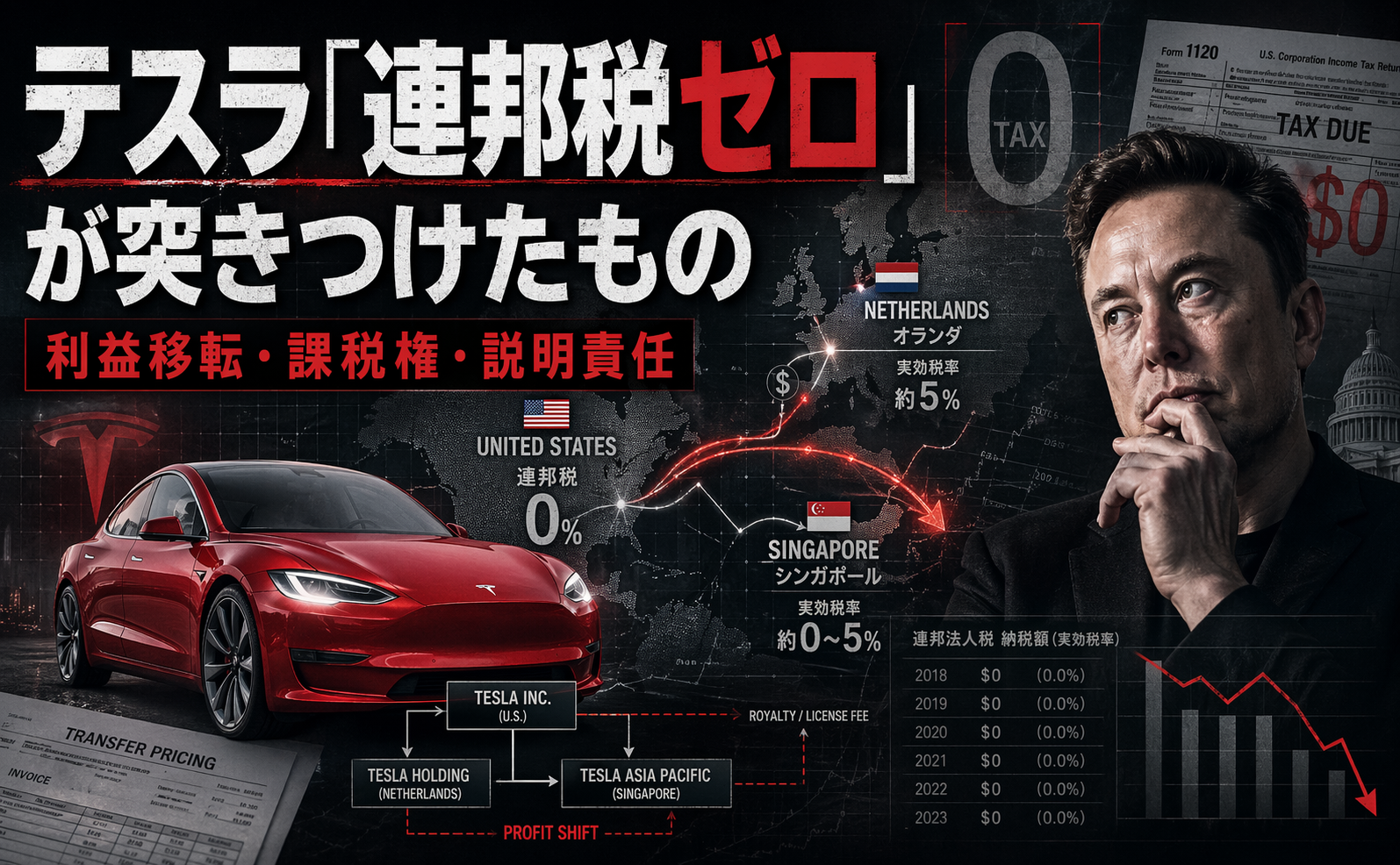
It has become clear from Tesla’s annual report and other disclosures that the major U.S. electric vehicle manufacturer paid no U.S. federal income tax for fiscal 2025. In addition, a Reuters investigation suggests that, although a combined total of $18 billion in profit has recently been booked through entities in the Netherlands and Singapore, those profits may not have been taxed locally either. According to the reporting, there is no indication that Tesla’s tax practices were illegal. At the same time, however, the company appears to reflect a classic pattern of “profit shifting” through the use of intellectual property rights and cost-sharing arrangements. Moreover, the contrast between these practices and Elon Musk’s public remarks about reducing government spending and worrying about fiscal deficits means that this issue cannot be dismissed as merely a matter of tax technique. This news can be seen as an opportunity to reexamine tax minimization by global corporations, the taxing authority of states, and the accountability of corporate executives.
Even if profit shifting is not “illegal,” it remains a serious social issue
The first point to keep in mind is that what has been reported does not automatically mean tax evasion or illegal conduct. Multinational corporations have long shifted profits by taking advantage of low-tax jurisdictions or legally favorable corporate structures, and this has been a widespread practice in international taxation for many years. In particular, for companies that own intellectual property, where patents, know-how, and brand value are assigned can greatly affect where profits are recognized.
However, legality and social legitimacy are not the same thing. Companies earn profits by relying on public infrastructure such as roads, power grids, an educated workforce, legal systems, and market order. For that reason, the idea that they should bear an appropriate tax burden in the countries where their business activities actually take place is entirely natural. When a company generates major sales in the United States while its profits appear to flow to another country or into a near-tax-free structure, it is unsurprising that many people find that troubling.
The real issue here is where the profits were generated
The essence of this news story is not simply whether Tesla paid tax or did not pay tax. More importantly, the question is where those profits should be regarded as having been generated.
According to the reporting, Tesla entities in the Netherlands and Singapore received enormous profits, yet the substance of those entities, the nature of their operations, and the activities that actually produced those profits are difficult for outsiders to discern. Moreover, the Dutch entity is reportedly registered as a nonresident partnership, has no employees, and is not required to file financial statements or pay taxes. If that means that substantial research and development, managerial decision-making, and brand formation are in fact directed from Tesla’s U.S. headquarters, while profits are allocated overseas solely for tax purposes, then concerns about the fairness of taxation naturally intensify.
In other words, what is being questioned is not just the size of the numbers, but the alignment between profits and economic substance. If research, development, and managerial control are centered in Austin, Texas, while the profits alone end up elsewhere, that is likely to be seen as a structure designed to exploit gaps in the system.
Is Tesla “exceptionally bad”?
One point that requires caution is this: if we single out Tesla as uniquely blameworthy, we risk misunderstanding the structure of the problem. Profit shifting is not a technique unique to Tesla. It is a common scheme that many multinational companies have used for years. In industries where intellectual property has significant value—especially IT, pharmaceuticals, branded consumer businesses, and automobiles—tax structuring has long been part of competitive strategy.
In that sense, this news should be understood not so much as “Tesla is bad,” but rather as making visible a structural problem: under the current international tax rules, such outcomes are possible. Corporate executives face pressure to maximize shareholder value, and they have incentives to adopt tax-saving measures that are permitted under the rules. That is precisely why the real issue is not only corporate ethics, but also the extent to which governments and international institutions have allowed these loopholes to persist.
That said, Tesla is more likely than many other companies to attract intense scrutiny. It symbolizes a “socially desirable future” through electric vehicles and renewable energy, and Musk himself has repeatedly made strong statements on public policy and fiscal discipline. The larger the ideals and the rhetoric, the more closely actual tax practices will be examined for consistency.
The gap between Musk’s rhetoric and Tesla’s tax practices makes the issue look bigger
This story has become major news not simply because of the scale of the tax savings. It also stands out because Elon Musk has made remarks suggesting that one should not rely on what amount to tax “loopholes,” and the contrast between those statements and Tesla’s apparent tax structure leaves a strong impression.
Of course, it would be overly simplistic to equate an executive’s personal statements with the tax design of an entire corporate group. Corporate taxation is built over time by specialists in legal affairs, finance, and international tax, and it cannot be fully explained by a single remark from a CEO. Even so, if a top executive publicly criticizes fiscal deficits or wasteful government spending, then a corresponding level of accountability arises with respect to how his own company engages with the public finances on which it depends.
In that sense, this reporting is not merely about taxation. It is also about corporate governance and reputation. For someone like Musk, who is not only a business leader but also a figure with significant political and social influence, tax transparency is directly tied to brand value itself.
Preferential treatment for green companies and criticism of tax avoidance can coexist
One reason Tesla’s tax burden has been light is said to be the carryforward of losses from years of deficits, along with U.S. green energy tax incentives. These points need to be considered calmly and separately.
It is entirely consistent with public policy for governments to offer tax incentives to promote renewable energy and the adoption of EVs. In pursuing decarbonization and industrial development, it is not unusual for governments to use subsidies or tax reductions. This is a form of relief intentionally created by the system and, in that sense, a publicly disclosed policy choice.
By contrast, reducing taxable income itself by assigning intellectual property in a particular way or designing a corporate structure to move profits into low-tax jurisdictions is different in nature from policy-based support. The former is relatively easy to explain socially, while the latter is closer to regulatory arbitrage and is difficult for ordinary taxpayers to see. As a result, even though both may reduce a company’s tax burden, they are received very differently by society.
In other words, there is no contradiction between accepting tax incentives intended to support green industries and criticizing excessive profit shifting. On the contrary, it is important to discuss those two things separately.
Why are these issues attracting renewed attention now?
One reason is that the rules of international taxation themselves are at a turning point. As digital companies and IP-dependent firms have expanded, the traditional idea of taxing profits where factories or stores are located has become less capable of capturing economic reality. In response, governments have sought to curb excessive profit shifting through measures such as a global minimum tax and stronger transfer pricing rules.
Tesla’s case is attracting attention precisely because it overlaps with that broader concern. Even in manufacturing, once the weight of intangible assets increases—through brand value, software, autonomous driving technology, battery control systems, and supply chain management—a company can no longer be understood simply as one that “makes and sells physical products.” Tesla is both a car company and an intellectual property company. And as an intellectual property company, it is difficult for Tesla to avoid the issues surrounding profit shifting.
What this news shows is that, in an era when the boundary between manufacturing and IT has become blurred, the old assumptions underlying international tax systems are becoming increasingly difficult to sustain.
For investors, sustainability matters more than the cleverness of tax minimization
From an investor’s perspective as well, this issue does not end with the simple idea that a lighter tax burden boosts profits. In the short term, tax minimization can help earnings. In the long term, however, it brings risks such as regulatory change, back taxes, litigation, political criticism, and brand damage. As ESG investing expands, investors evaluate not only environmental performance but also governance and tax transparency.
This is especially true for a company like Tesla, whose future value depends heavily on expectations and brand strength. The market’s scrutiny of accounting and tax transparency is therefore likely to be more severe. What investors really want to know is not “How much tax did the company save?” but “Is the quality of those profits sustainable?” If changes in the rules could cause the company’s tax burden to rise sharply, then that should be reflected in valuations as uncertainty surrounding future cash flows.
Conclusion
The reporting surrounding Tesla may appear at first glance to be a story about how much tax one company did or did not pay. In reality, however, it raises a much broader question: by which country’s institutions are giant multinational corporations supported, and to which country should they return an appropriate share of the burden?
Since no sign of illegality has been found in Tesla’s methods, this is not an issue that should immediately be discussed in purely condemnatory terms. Even so, the question remains whether legality alone is enough. If enormous profits accumulate in entities with little real substance, while the countries where those profits were actually generated see their tax bases eroded, then the burden ultimately falls on ordinary taxpayers and future generations.
What the Tesla case shows is that no matter how advanced a company’s technological innovation may be, it cannot escape questions of taxation and accountability. At the same time, it also shows that the conditions making such arrangements possible arise not only from corporate behavior, but from inconsistencies among national legal systems. That is why what is needed now is neither simple corporate criticism nor blanket defense of the existing system, but a more reality-based discussion about where profits are truly generated and how they should be taxed.