
Introduction
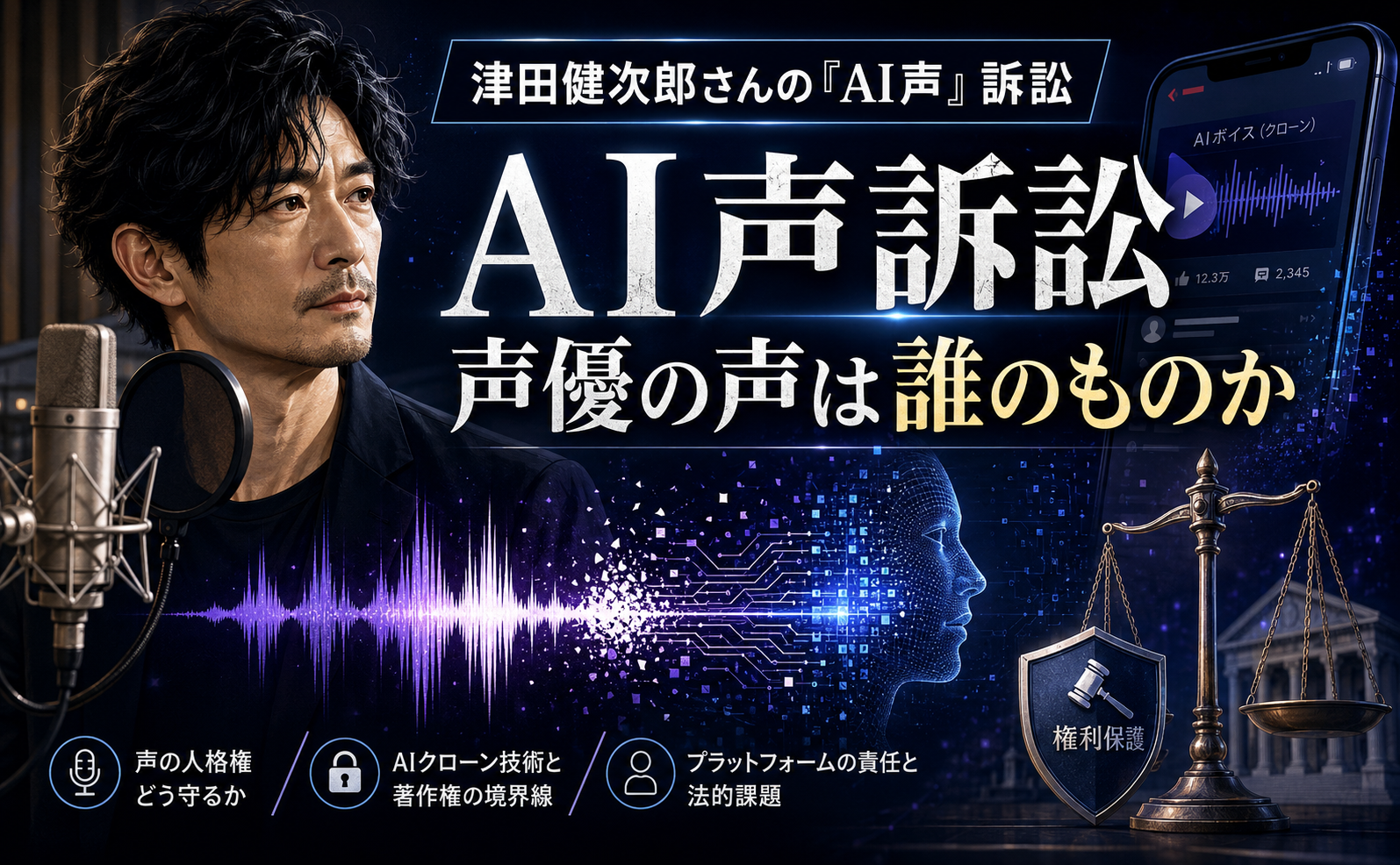
It has been reported that popular voice actor Kenjiro Tsuda has filed a lawsuit with the Tokyo District Court against the operator of the video-sharing app TikTok, seeking the removal of videos that allegedly imitate his voice without authorization using generative AI. According to reports, an unidentified account posted more than 180 videos on TikTok featuring narration that mimicked Tsuda’s voice through generative AI, and Tsuda’s side is claiming, among other things, infringement of his right of publicity. The lawsuit was filed in November 2025 and has attracted attention as a case involving the unauthorized use of a person’s “voice” through generative AI.
Kenjiro Tsuda is a voice actor known for roles such as Kento Nanami in Jujutsu Kaisen, and he is also active as an actor. For that reason, this issue is not merely about “videos featuring a similar voice” being posted online. For voice actors, the voice is not only a means of expression, but also an essential source of value that identifies the person and draws public interest toward works and products.
The Issue Is How to Protect “the Voice Itself”
What is particularly important in this lawsuit is that the subject of dispute is not a photograph of the face or the person’s name, but the “voice.”
Traditionally, the right of publicity has become an issue when the customer-attracting power of a celebrity’s name, likeness, or similar attributes has been used without permission. In Japan, this right is not so much a right defined in detail by statute as one that has been recognized through case law. In recent years, however, as generative AI has made it possible to reproduce a person’s voice with high precision, there has been growing debate over whether “voice” should also be protected as information that identifies the person. In legal practice as well, it has been indicated that a voice may fall within the scope of the right of publicity.
On the other hand, protecting the voice itself under copyright law generally faces a high hurdle. A voice is a sound produced by the vocal organs, and it is often understood not as “expression” itself under copyright law, but as a means of expression. Therefore, in cases like this one, the matter must be examined not only from the perspective of copyright, but also through multiple legal frameworks, including the right of publicity, the Unfair Competition Prevention Act, and personality-based interests.
The Weight of the “Universal Male Voice” Argument
According to reports, TikTok’s side has sought dismissal of Tsuda’s claims, arguing that the voice at issue is a “universal male voice.”
This argument reveals the core of the lawsuit. In other words, the question is whether the voice is merely a low and calm male voice, or whether it is distinctive enough that ordinary viewers would be reminded of Kenjiro Tsuda.
A voice actor’s voice is not merely a tone of sound. Vocalization, pauses, intonation, breath, treatment of sentence endings, and associations with particular roles all accumulate to form the person’s brand. Especially in the case of someone like Tsuda, whose voice itself is highly recognizable, if AI-generated audio evokes his voice, viewers may perceive it as though he were involved.
Accordingly, in court, it is likely that not only the similarity of the audio, but also the manner in which the videos were presented, the number of posts, whether they were monetized, viewers’ perceptions, and associations with his name or representative works will be considered comprehensively.
For Voice Actors, the “Voice” Is a Professional Asset
This issue is serious because, for voice actors, the voice is truly the core of their work.
For actors, facial and bodily expression may be central; for singers, the singing voice; and for voice actors, vocal performance lies at the heart of professional value. If generative AI enters this field and makes it possible to mass-produce “similar-sounding voices” without the person’s consent and distribute them as videos, there is a risk that the market for the person’s work will be eroded.
For example, in fields such as advertising, explainer videos, games, audiobooks, and character voices, people may begin to think that, instead of hiring the voice actor, they can simply create a similar voice using AI. This is not merely a problem of fan-created posts. It is a problem of replacing a voice actor’s professional value without authorization.
Moreover, AI can make it appear as though the person is saying things they never actually said, using a voice that resembles their own. If such technology is used for political statements, product endorsements, extreme remarks, or fraudulent inducements, it may damage the person’s reputation and public image. A distinctive feature of unauthorized voice use in the generative AI era is that economic harm and personal harm can easily overlap.
The Responsibility of Platforms Is Also at Issue
In this lawsuit, the defendant is not the unidentified account, but the operating company of TikTok. This point also has important significance.
When the person who posted AI-generated voice content cannot be identified, the realistic party for the rights holder to address is the platform. If the poster is anonymous, the videos spread in large numbers, and reposting continues even after deletion, it is difficult to stop the harm by pursuing only individual posters.
Of course, it is not realistic for platforms to conduct a complete prior review of every post. However, after receiving a specific report from a rights holder, the question of how quickly and effectively a platform should respond will become increasingly important.
Rights infringements involving generative AI have low production costs and are easy to mass-produce. As a result, there will likely be more situations in which the traditional approach of “delete the problematic post once it is found” is insufficient. Platforms may be required to develop more effective mechanisms, such as identity verification, detection of AI-generated voices, reporting channels for rights holders, and measures to prevent reposting.
A Line Must Also Be Drawn with Freedom of Expression
That said, this does not mean that all expressions resembling someone’s voice should be prohibited.
Impersonation, parody, criticism, and fan creations have played important roles as part of expressive culture. If expressions that imitate the characteristics of voice actors or actors are regulated too broadly, there is a risk of chilling freedom of expression and derivative creative culture.
What should be treated as problematic are uses that mislead people into believing the voice is the person’s own, uses that profit from the person’s customer-attracting power, uses that damage the person’s reputation, and uses that create the appearance of the person’s authorization. In particular, high-precision voice imitation through generative AI is more likely than traditional impersonation to cause misidentification of the person, making it necessary to draw the line more carefully than before.
This lawsuit will be an important opportunity to see how the court approaches that line-drawing.
Steps Companies and Creators Should Take
This news is not an issue limited to the voice acting industry. It concerns all businesses that handle voices, including advertising agencies, video creators, game companies, anime production companies, voice synthesis service providers, and SNS operators.
Going forward, when companies use voices through generative AI, they will need, at a minimum, to obtain clear permission from the person or rights manager, define the scope of use by contract, distinguish between use for training and use for generation, and confirm that the voice does not too closely resemble that of a third party.
Voice actors and actors, for their part, will also need to clarify in performance contracts and recording agreements whether use for AI training is permitted, whether creation of voice clones is allowed, the scope of secondary use, use after the end of the contract, and treatment in overseas distribution. It is likely that the traditional concept of simply granting permission to use recorded audio will increasingly be insufficient to cover the risks of the generative AI era.
Conclusion
Kenjiro Tsuda’s lawsuit is a symbolic case that asks how the voices of voice actors should be protected in an era when “voice” can easily be copied and mass-produced through generative AI.
Until now, discussions about protecting the rights of celebrities have often centered on names and likenesses. However, for voice actors, narrators, actors, and singers, the voice is an important asset that strongly connects the person’s personality with their professional value. Now that generative AI can reproduce such voices without authorization, legal systems, contract practice, and platform operations are all being forced to change.
This lawsuit will not immediately resolve every issue. Even so, it raises a clear question against the idea that something can be freely used simply because it was “created by AI.”
A voice is not merely data. It identifies a person, creates trust, and supports their work as a core element of expression. In the generative AI era, to what extent and by what means should that value be protected? This lawsuit may become a major turning point for Japan’s entertainment industry and intellectual property practice.