
Introduction
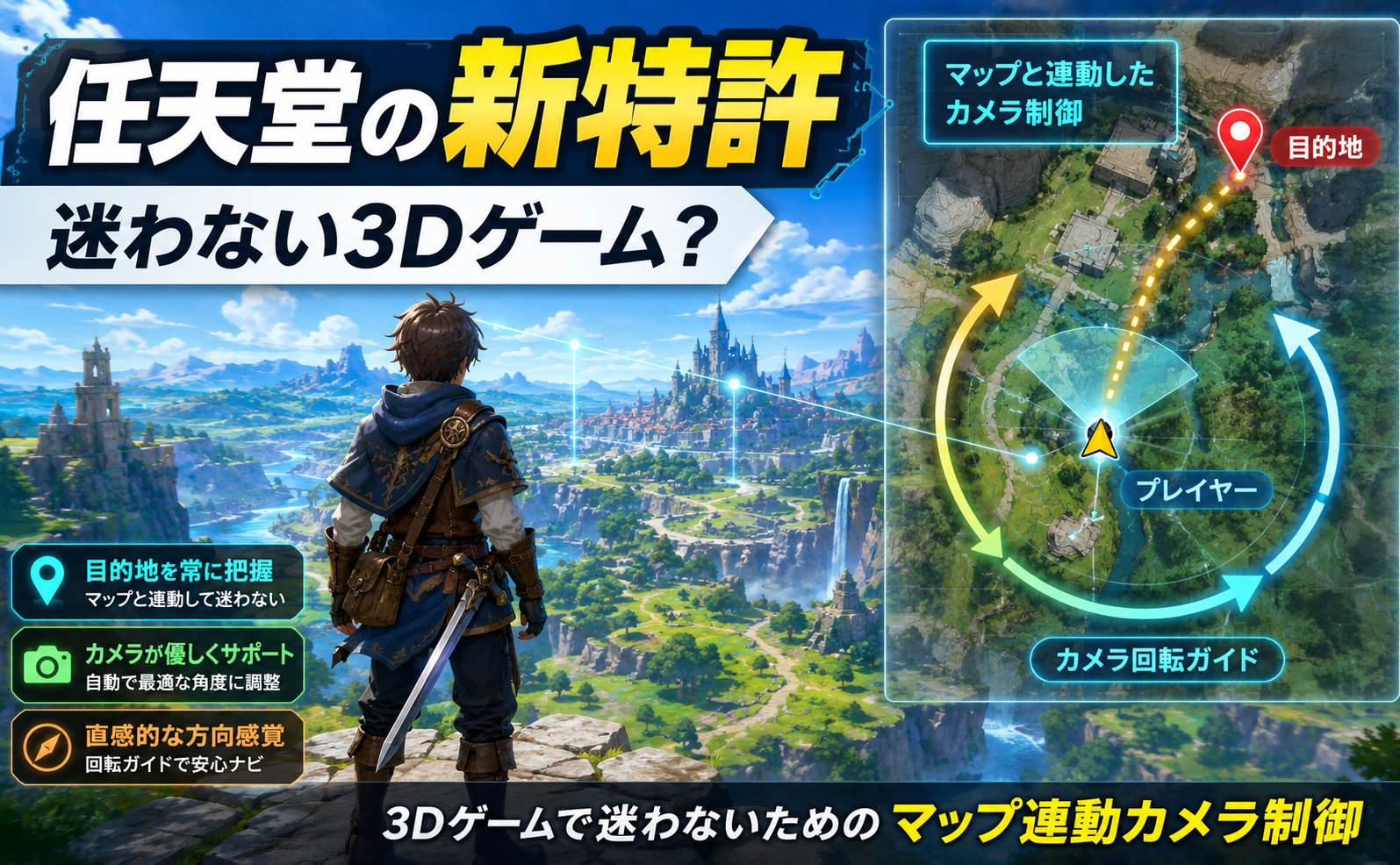
A patent filed by Nintendo in February 2024, concerning technology that links an in-game map with camera control in a 3D space, was officially issued on June 9, 2026. The patent lists Shigeru Miyamoto and Yushi Kando as inventors, and describes mechanisms such as display switching, camera rotation, and automatic movement designed to help players avoid losing their sense of direction in 3D spaces.
Specifically, the system switches from the normal 3D gameplay screen to a map screen showing the virtual space from above, allowing the player to specify a desired direction or location using a cursor or similar input. Then, when returning to the normal screen, the camera direction is not changed instantaneously. Instead, the camera rotates toward the target direction over a predetermined period of time. This makes it easier for the player to visually understand which direction they are now facing.
This patent is not merely about a convenient feature. It contains interesting material for considering playability in 3D games, exploration experiences, the modernization of remakes, and Nintendo’s characteristic approach to user experience design.
The Core Issue: How to Support Players Who Get Lost in 3D Spaces
In 3D action games and 3D adventure games, players sometimes lose their sense of direction. This is especially true in wide fields, complex terrain, or scenes involving frequent changes in viewpoint, where it can become difficult to keep track of where one is, which direction one is facing, and where the destination lies.
Mini-maps and full maps are typical means of addressing this problem. However, even if the player can understand the direction of the destination by looking at the map, an abrupt change in camera direction when returning to the normal screen may instead cause confusion. This is because the spatial relationship understood on the map can be lost the moment the player returns to the 3D space.
What makes this patent noteworthy is that it attempts to bridge the “sense of direction understood through the map” with the “sense of viewpoint after returning to the 3D screen.” Rather than simply switching between the map screen and the gameplay screen, the design supports the player’s cognition by inserting a continuous process of camera rotation between the two.
The Significance of Not Switching the Camera Abruptly
A distinctive feature of this patent is that the camera direction is not changed immediately when returning to the normal screen. If the only goal were to point the camera in the specified direction, it would technically be possible to switch the viewpoint instantly. However, doing so could prevent the player from following the change in viewpoint, causing them to lose track of their current position or direction of travel.
For this reason, the patent describes a configuration in which the direction of the virtual camera changes over a predetermined period of time. This is significant because it treats in-game camera control not merely as display processing, but as a form of presentation that helps the player understand the game space.
In games, comfort is not determined solely by processing speed. On the contrary, transitions that are too fast can leave the player’s cognition behind. This patent can be understood as a mechanism that deliberately takes time in order to naturally convey to the player the sense that the direction has changed.
Combining Map Operations with Automatic Movement
The patent also presents an example in which a character automatically moves to a point specified on the map. It describes processing in which a route to the destination is calculated and the character is moved if the destination is reachable, while automatic movement is not executed if an unreachable point has been specified.
This aspect goes further than simple camera control. When the player indicates on the map, “I want to go here,” the game may assist not only by showing the direction but also by supporting the movement itself.
At the same time, excessive automation could undermine the enjoyment of exploration and the player’s sense of control. What matters, therefore, is not that the game does everything on behalf of the player, but that it provides assistance only to the extent necessary when the player gets lost. Nintendo’s game design has long emphasized a balance between intuitive controls and the player’s agency in play. This patent can also be read as an extension of that approach.
How Should We View the Connection to The Legend of Zelda?
Regarding this patent, some observers overseas have pointed to a possible connection with The Legend of Zelda series, partly because the drawings show a character carrying what appears to be a sword on their back. In addition, since The Legend of Zelda: Ocarina of Time is scheduled to appear for Nintendo Switch 2 in 2026, some have speculated about a relationship with that title.
However, the existence of a patent and the implementation of that function in a specific game are separate matters. The drawings and embodiments in a patent document are examples used to explain the invention, and they do not necessarily indicate the specifications of an upcoming title. Therefore, at present, it cannot be concluded that this patent is directly related to a remake of Ocarina of Time.
That said, a sense of direction in 3D space, camera control, and coordination with maps are important elements for exploration-based adventures such as The Legend of Zelda. Ocarina of Time, in particular, is known as one of the works that laid the foundation for 3D action-adventure games. If that classic experience were to be reconstructed for modern players, improvements to camera control and map operations would be unavoidable themes.
Remakes Require More Than Visual Beauty
In recent game remakes, attention tends to focus on higher-definition graphics and enhanced sound. However, when rebuilding older 3D games for modern audiences, what truly matters is the updating of controls, visibility, and user interfaces.
Camera work and control systems that were once innovative may feel inconvenient to today’s players. In particular, 3D games from that era were created at a time when standards for camera control had not yet fully solidified. For that reason, remakes face the challenge of determining how much modern comfort can be incorporated while preserving the atmosphere of the original.
The coordination between maps and camera control shown in this patent could serve as one answer to that challenge. If it can reduce the burden of disorientation and viewpoint control without damaging the original world or the tactile feel of exploration, it may lead to a remake that is more readily accepted by both longtime fans and new players.
Nintendo-Like Assistance That Does Not Over-Explain
Nintendo games often use designs that allow players to understand things naturally through actual play, rather than forcing them to read long explanations. This patent is highly compatible with that philosophy.
For example, if the player specifies a destination on the map and, upon returning to the normal screen, the camera slowly turns toward the target direction, the player can understand without verbal explanation that “this is the way to go.” This is a design in which the screen display itself functions like a tutorial.
Kindness in game design does not necessarily mean increasing the amount of textual information. Rather, by combining elements such as gaze guidance, camera movement, character orientation, and screen transitions, it is possible to communicate the game’s intention to the player without imposing a burden. This patent can be viewed as a technical means of supporting such nonverbal guidance.
What the Patent Reveals About Nintendo’s Interests
What can be read from this patent is that Nintendo continues to place importance on “ease of play in 3D spaces.” Rather than focusing only on powerful hardware or beautiful visual expression, the company appears to be paying attention to experiential design: how players perceive space, how they get lost, and how they move toward their destinations.
A patent is a document that reveals one part of a company’s research and development. Of course, technology described in a patent is not always implemented in products exactly as written. However, it does provide clues as to what kinds of problems the company is trying to solve technically.
This invention concerns not a flashy new feature, but a fundamental kind of comfort that allows players to continue playing naturally. That is precisely why it can be called a very Nintendo-like patent.
Conclusion
Nintendo’s new patent presents mechanisms for linking a map screen with a 3D gameplay screen, including camera control and automatic movement designed to make it harder for players to lose their sense of direction. In particular, the point that the camera rotates toward the target direction over a predetermined period of time when returning from the map screen to the normal screen, rather than switching instantly, is noteworthy as a design that carefully supports the player’s cognition.
At present, it is unclear whether this patent is related to a remake of The Legend of Zelda: Ocarina of Time. However, from the perspective of exploration in 3D space, viewpoint control, and map utilization, it is certainly an effective concept when reconstructing classic titles like that work for modern audiences.
The evolution of games cannot be discussed solely in terms of graphics or processing power. Detailed design that allows players to enter a world naturally, without getting lost or becoming fatigued, is also an important form of evolution. This patent is an interesting example showing that Nintendo is still carefully focused on precisely that aspect of game design.