
Introduction
On June 3, intelligence agencies from the “Five Eyes” intelligence-sharing alliance of the United States, the United Kingdom, Canada, Australia, and New Zealand warned that Chinese operatives have been using online recruitment platforms to approach and recruit individuals with access to sensitive information. According to the warning, they posed as recruiters or headhunters on platforms such as LinkedIn and Indeed, contacting people involved in defense, diplomacy, the military, strategic industries, and related fields.
This news should not be viewed merely as another case of espionage. Behind it lies an international competition over advanced technology, human resources, data, patents, corporate acquisitions, and state subsidies. While China has been pursuing the acquisition of technology from overseas, it has also been tightening restrictions on the outflow of its own technologies and data. From the perspective of other countries, this appears to be an asymmetric form of competition: using open markets to absorb foreign technologies while placing its own market and domestic technologies under state control.
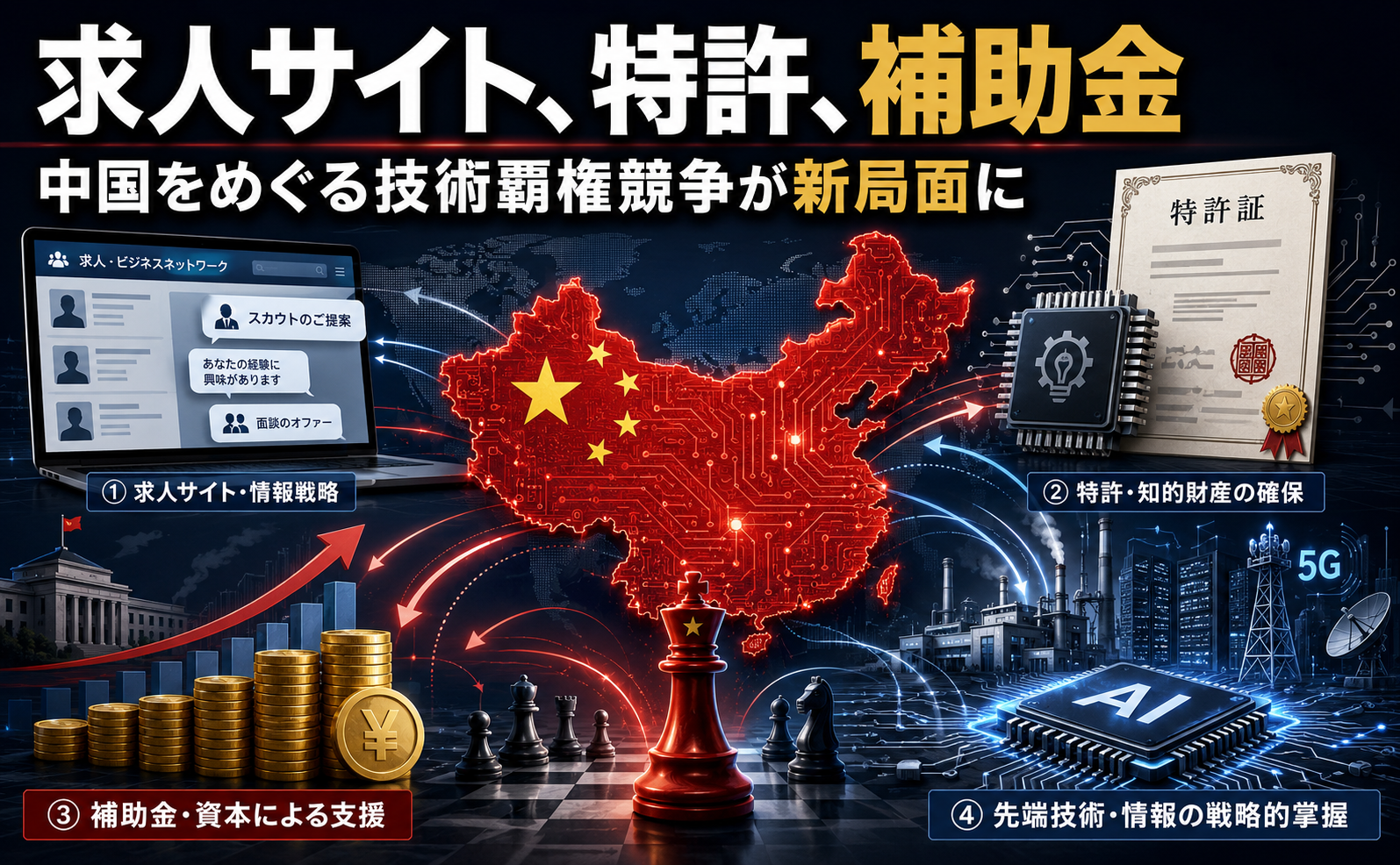
This series of reports shows that the struggle for technological hegemony is no longer determined solely by research and development capabilities or manufacturing capacity. Job sites, patent rights, investment regulations, subsidy policies, and even AI-based social control are beginning to be linked together as parts of national strategy.
When Job Sites Become Places for “Information Acquisition” Rather Than “Talent Acquisition”
One point that deserves particular attention in the latest warning is the alleged use of ordinary job sites and business-oriented social networking services as entry points for espionage activities.
Traditionally, when people think of espionage, they tend to imagine covert approaches to diplomats, military personnel, government officials, and similar targets. In modern security, however, the targets are not limited to people who directly possess classified information. Engineers in the defense industry, researchers in diplomacy and security, think tank personnel, and people involved in strategic industries such as semiconductors and AI may also hold fragments of important information.
Contact through job sites has the characteristic of appearing natural. In the job market, it is not unusual to receive messages from unknown recruiters or headhunters. If the approach is presented as a high-paying opportunity, an overseas company role, a consulting project, or a request to prepare a research report, a person may initially become involved without recognizing any illegality.
In other words, the problem is not limited to the blatant act of “stealing classified information.” A request that initially appears to involve organizing public information or providing a general opinion may gradually move into nonpublic information, internal circumstances, human networks, or the background to policy decisions. This kind of step-by-step approach can be seen as a distinctly modern risk.
What China’s Tightening of Outbound Investment Regulations Means
At the same time, the Chinese government has been strengthening regulations on overseas transactions involving its advanced technologies, data, and investors. According to reports, China’s State Council announced comprehensive new rules expanding the authority of regulators to review overseas transactions related to Chinese investors, technologies, data, and national security.
This is not merely a matter of financial regulation or investment management. In fields such as AI, data, semiconductors, quantum technology, and biotechnology, the transfer of technologies or personnel abroad through corporate acquisitions or investments is itself regarded as a security issue. It has also been reported that the Chinese government objected to the acquisition of a Chinese AI company by a foreign company and ordered the transaction to be unwound.
What matters here is that China, too, treats technology outflow as a matter of national security. While China has actively pursued the acquisition of technology from overseas, it remains highly cautious about the transfer of its own promising technologies abroad.
This structure highlights the issue of “reciprocity” in international technology transactions. If companies or investors from one country can freely acquire technology companies overseas, while similar activities by foreign companies are strictly restricted in that country’s own market, the conditions of competition cannot be called equal.
Patent Transfers May Be Legal, but Strategic Imbalances Can Become a Problem
According to a study by the German Economic Institute reported by Reuters, China has acquired ownership of more than 11,300 patents developed in Germany over the past 20 years.
Of course, the transfer of patent rights to foreign companies is, in itself, a normal economic activity. Patent ownership often changes across borders through corporate acquisitions, joint research, licensing agreements, business transfers, or the movement of researchers. The patent system grants an exclusive right for a certain period in exchange for the disclosure of an invention, and that right can be transferred as a property right.
The issue, however, lies in the scale and direction of such transfers.
When companies or state-linked capital from a particular country acquire large numbers of foreign patents in specific strategic fields, the situation may be viewed as more than the accumulation of individual transactions. It may amount to the transfer of a technological foundation. A patent is not merely a paper right. It contains the substance of an invention, the direction of research and development, surrounding information on related technologies, and clues to future business development.
Acquiring a patent means not only gaining freedom to practice the technology, but also obtaining the power to restrict others from practicing it. Therefore, the large-scale transfer of patents in strategic fields abroad can become an issue not only for industrial competitiveness but also for economic security.
Subsidies Distort Market Competition
An OECD report has analyzed that the ratio of subsidies received by Chinese companies from the government was three to eight times higher than that of companies in other countries and regions. It pointed out that in manufacturing sectors such as solar panels, semiconductors, steel, and shipbuilding, government grants, tax incentives, and low-interest loans from state-affiliated financial institutions have had a major impact on market competition.
Subsidies are not always bad in themselves. Countries provide subsidies to important sectors as part of industrial policy. Renewable energy, semiconductors, batteries, pharmaceuticals, and the defense industry are policy support targets in many countries.
However, when the scale of subsidies is extremely large and they are used to support low-price competition aimed at expanding market share, the problem becomes serious. If subsidized companies export products at prices that disregard profitability, companies in other countries that do not receive subsidies can no longer withstand the competition. As a result, even if consumers benefit from cheap products in the short term, supply chains may become dependent on a particular country and industrial foundations may be lost in the long term.
This problem has already become visible in the fields of solar panels and batteries. As a result of price competition, Chinese companies have come to possess overwhelming supply capacity, making it increasingly difficult for other countries to avoid dependence on Chinese products when pursuing energy policy and decarbonization policy.
China’s Fiscal Capacity Will Be a Key Issue Going Forward
That said, even if Chinese companies have received large-scale subsidies over the past 20 years, it does not necessarily mean that the same model can continue indefinitely. The Chinese economy faces structural problems such as a real estate downturn, local government debt, youth unemployment, and sluggish consumption.
The deterioration of local government finances is particularly important. China’s industrial support has been driven not only by the central government, but also by local governments. Through land, financing, taxation, infrastructure, and subsidies, local governments have promoted the attraction of companies and the development of industries. However, if land-related revenues decline due to the slump in the real estate market and local governments lose fiscal leeway, it will become difficult to maintain the conventional subsidy-based policy model.
In that case, the Chinese government may seek to maintain its national strategy not only through direct financial support for companies, but also through other means such as regulation, data management, outbound investment control, social control, and information control. In other words, the center of gravity may shift from industrial policy supported by money to industrial policy that encloses industries through institutional mechanisms.
The Risk That Containing Dissatisfaction Will Take Priority over Economic Recovery
Within China, dissatisfaction is said to be rising among young people and nonregular workers affected by the economic slowdown. There have also been reports of repeated tragedies involving people forced to work in dangerous conditions.
Under normal circumstances, employment measures, income support, social security, and the reconstruction of local government finances would become important in such a situation. However, if the government comes to prioritize containing dissatisfaction over economic recovery, society will become even more rigid.
If systems are developed that use AI to analyze social media posts, browsing of overseas websites, and similar activities in order to score political risk, this is more a matter of governing technology than economic policy. If technology is used not to enrich society, but to detect and suppress public dissatisfaction in advance, it reveals the negative side of technological hegemony.
What Japanese Companies and Professionals Should Watch Out For
This news is not irrelevant to Japan. Japan possesses many technologies of high strategic value, including semiconductors, materials, precision machinery, robotics, batteries, environmental technologies, medical devices, telecommunications, and AI-related technologies. Not only large corporations, but also small and medium-sized enterprises, universities, research institutions, and startups may become targets.
What requires attention is not limited to obvious illegal acts. Risks may be embedded in contacts that appear to be ordinary business dealings, such as proposals for joint research from foreign companies, technical advisory agreements, requests to prepare research reports, recruitment approaches, consulting projects, and negotiations over patent transfers or licenses.
When dealing with patents and know-how, it is necessary to examine not only the wording of contracts, but also the counterparty’s beneficial owner, capital relationships, the destination of data transfers, ownership of joint research results, the treatment of improvement inventions, the scope of confidential information, and the relationship with export control regulations.
Technical information before patent filing requires particular caution. Careless disclosure before filing may not only create problems involving loss of novelty, but also lead to the leakage of information that should have been kept confidential as know-how. The perspective of separating information that should be disclosed through patents from information that should be managed as trade secrets is becoming increasingly important.
The Boundary Between “Free Trade” and “Security” Is Changing
In international business until now, corporate acquisitions, patent transfers, joint research, and recruitment have generally been treated as free economic activities. However, in an era when advanced technologies are directly connected to the military, surveillance, critical infrastructure, and social control, the areas that cannot be explained solely by free transactions are expanding.
Contacting people through job sites may be a recruitment activity, but it can also become a means of gathering information. Acquiring patents may be a transfer of property rights, but it can also become a means of technological control. Subsidies may be measures to foster industry, but they can also become tools for distorting international markets. Outbound investment regulations may be security measures, but they can also become tools for enclosing domestic technologies.
In this way, in modern technological competition, the boundaries between legal and illegal, private sector and state, and economy and security are becoming blurred. Japanese companies and research institutions need to assess not only whether a transaction with a counterparty is formally legal, but also what strategic context that transaction is placed in.
Conclusion
This series of reports shows that the competition for technological hegemony over China has entered a more complex and multilayered stage. The use of job sites to approach talent, the tightening of regulations on overseas transactions, the acquisition of German-origin patents, the expansion of market share through massive subsidies, and the use of AI to contain domestic dissatisfaction may appear, at first glance, to be separate news stories.
At their root, however, they share a common structure. It is the idea of treating technology, human resources, information, intellectual property, and capital as resources of national strategy.
What matters for Japan is not to end with emotional criticism of China. What is needed is to calmly identify the routes through which technology may flow out and to manage patents, trade secrets, contracts, export controls, research and development, and recruitment in an integrated manner.
Technology is not only a source of corporate competitiveness, but also an asset connected to national security. We have entered an era in which a single message on a job site, one joint research agreement, or one patent transfer may influence future industrial competitiveness. For that very reason, companies and professionals need to heighten their sensitivity more than ever when it comes to protecting technology.