
Introduction
It has been reported that two individuals, including the head of the Japan Cycling Association, were arrested on suspicion of fraud for allegedly deceiving two men in Kagoshima Prefecture and taking money from them. According to reports, the two allegedly told the men, among other things, that “it will cost 30 million yen to file a patent application; if you lend us the money, we will give you 600 million yen,” and are suspected of receiving a total of 30 million yen. It has also been reported that the representative of a technology development company made it appear as though he held patent rights relating to bicycles and other technologies, and showed a written commitment suggesting that the Japan Cycling Association would purchase those patent rights for 10 billion yen.
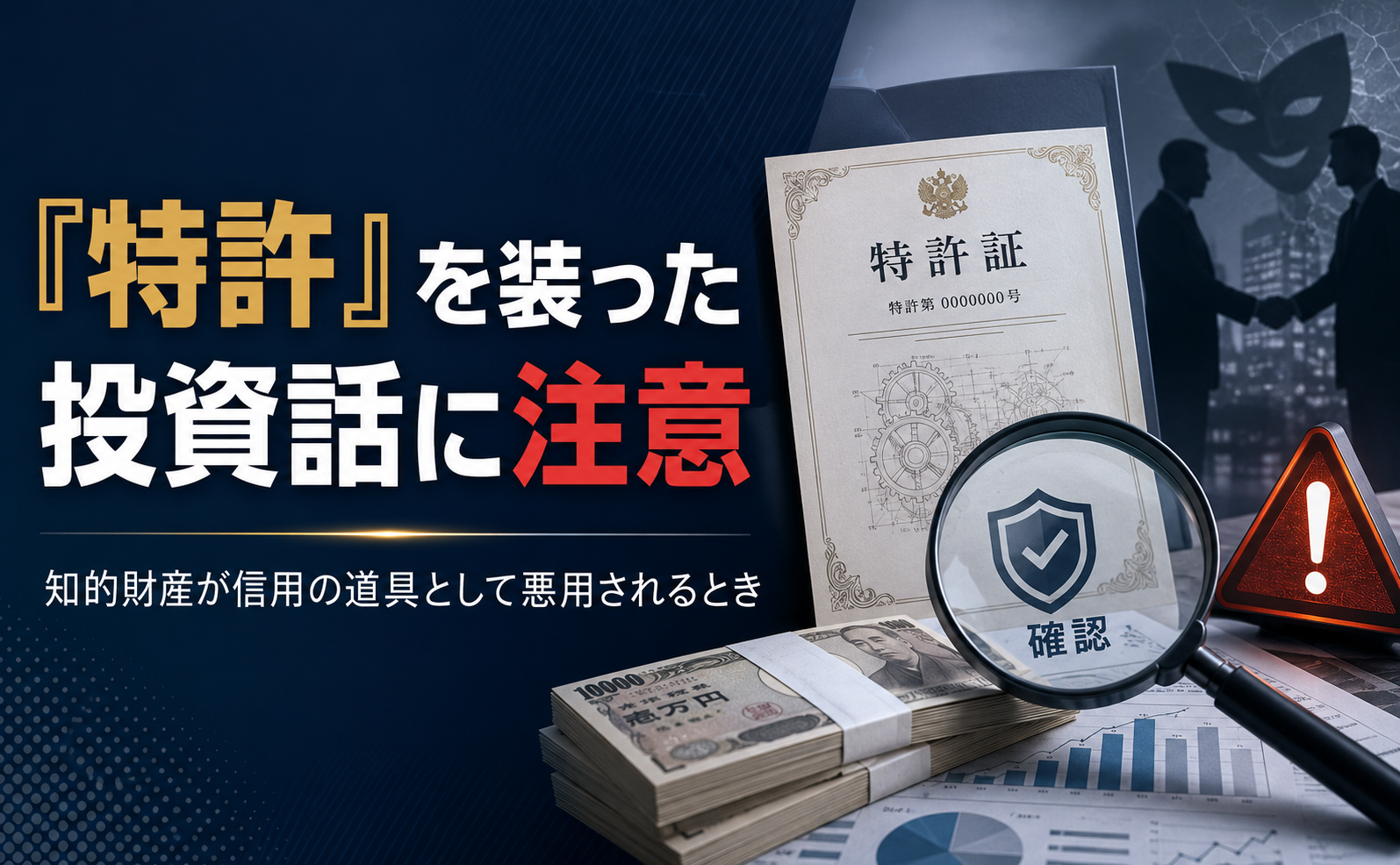
This incident should not be viewed merely as one example of investment fraud. A major issue lies in the fact that terms such as “patent,” “technology development,” and “acquisition of rights” were allegedly used as materials to lend credibility to an investment pitch. Intellectual property is originally a system for protecting technologies and businesses. However, the general trust placed in that system can, in some cases, be exploited.
The Credibility Carried by the Word “Patent”
The word “patent” carries strong credibility. When many people hear the word “patent,” they tend to associate it with impressions such as “technology recognized by the government,” “an invention with future potential,” or “a right with significant business value.” In fact, patents can play an important role in corporate valuation, technology partnerships, license agreements, fundraising, and other business activities.
However, the existence of a patent and the existence of business value in the underlying technology are separate matters. Likewise, the fact that a patent application is pending, that a patent right is owned, and that a third party plans to purchase a patent right all have entirely different meanings.
What is at issue in the reported case is that the suspects allegedly made it appear as though patent rights existed and further explained that those rights would be purchased at a high price. This can be regarded as a case in which the credibility of the intellectual property system itself may have been used to mislead investment decisions.
The Unnaturalness of the Explanation That “A Patent Application Will Cost 30 Million Yen”
According to reports, the explanation given was that “a patent application will cost 30 million yen.” Of course, costs relating to patents vary significantly depending on the subject matter, the number of countries involved, the filing strategy, and the steps required until rights are granted. If a large-scale portfolio involving foreign filings is involved, substantial costs may indeed be incurred.
However, if the explanation is simply that “30 million yen is needed for a patent application,” the breakdown must be carefully checked. The meaning differs greatly depending on which countries the applications will be filed in, how many applications are involved, whether applications have already been filed or will be filed in the future, and whether the amount includes patent attorney fees, translation fees, official fees, and costs for responding to office actions.
In addition, an explanation that multiple existing patent rights will be combined “into one through a patent application” is also a phrase that should be carefully examined from the perspective of ordinary patent practice. There is generally no system that simply combines multiple patent rights into a single patent right. It is possible to file a new application based on existing technical content, but even in that case, the application must satisfy requirements such as novelty and inventive step.
When receiving this kind of explanation, it is important not to be convinced merely by the word “patent,” but to check specific details such as application numbers, registration numbers, the names of right holders, the status of the rights, the relevant technology, and the contents of the contract.
A Written Commitment Alone Does Not Prove Either the Existence or the Value of Rights
According to the reports, the suspects allegedly showed a written commitment suggesting that the Japan Cycling Association would purchase the patent rights for 10 billion yen. What must be noted here is that the existence of a document such as a written commitment is separate from the actual existence of the rights and from whether the acquisition will in fact be performed.
The existence of patent rights can be checked through databases such as those maintained by the Japan Patent Office. If the registration number is known, it is possible to check information such as the right holder, applicant, title of the invention, claims, and current status of the right. For pending applications, the contents may be checked using the application number or publication number.
By contrast, a private written commitment or memorandum is merely a document prepared between the parties. Separate verification is necessary to determine whether the document is genuine, whether the signatory had proper authority, whether the conditions have been satisfied, and whether there is actual ability to pay. In particular, when extremely high returns are presented, such as “if you lend 30 million yen, we will give you 600 million yen” or “we will purchase it for 10 billion yen,” more careful verification than usual is required.
The Boundary Between Intellectual Property Business and Fraudulent Schemes
Business activities using intellectual property are by no means suspicious in themselves. The sale and purchase of patent rights, license agreements, joint research, technology transfer, and investment in startups are all widely conducted as legitimate business activities. When excellent technology is protected by patents and then implemented in society, it can contribute to industrial development.
However, in legitimate intellectual property business, the contents of the rights, the right holder, contractual terms, the feasibility of the technology, revenue prospects, and risks are examined specifically. Funds are not raised merely on the basis of explanations such as “there is a patent,” “a major company or organization will buy it,” or “huge profits will be generated in the future.”
A patent does not guarantee business success. Even where a patent exists, the technology may be difficult to commercialize, may lack demand, may infringe the rights of another company, or may have a narrow scope of rights that does not easily lead to a business advantage. Therefore, when making an investment decision, it is necessary to look not only at whether a patent exists, but also at the substance of the right and the realism of the business plan.
Points to Check in an Investment Pitch
When receiving an investment pitch based on patents, the first thing to check is whether the patent right actually exists. It is necessary to confirm the registration number or application number and check the right holder and current status of the right through the official database of the patent office.
Next, it is necessary to confirm whether the person or company providing the explanation is truly the right holder, or whether they have lawfully obtained a license from the right holder. If a person who does not own the patent right explains it as though it were their own right, that alone is a serious problem.
Furthermore, with respect to any contract or written commitment presented, it is important to check matters such as the counterparty’s authority to sign, the conditions, timing of payment, termination clauses, and treatment in the event of breach. In particular, any pitch promising returns many times or dozens of times the original amount within a short period should be reconsidered calmly.
If there are doubts, it is advisable to consult specialists such as a patent attorney, attorney at law, or certified public accountant. In some cases, the existence of a patent can be checked in a relatively short period of time. Having a third party conduct a check before moving a large amount of money can help prevent harm.
Protecting Trust in Intellectual Property
If the reported facts are true, the issue is not limited to the amount of damage suffered. Serious attention should also be paid to the fact that social trust in the patent system may have been used as material for fraudulent explanations.
The intellectual property system grants exclusive rights for a certain period in exchange for the disclosure of inventions. Its purpose is to promote technological development and industrial growth. For that very reason, when the word “patent” is used for improper fundraising, it may create distrust toward the system as a whole.
At the same time, it is important that cases like this lead to wider awareness of basic methods for checking patents. Patents are a specialized system, but basic checks such as confirming registration numbers, application numbers, right holders, and current status are highly effective in investment and transaction settings.
Conclusion
It is dangerous to make an investment decision based solely on explanations such as “it has value because there is a patent” or “it is safe because a major organization plans to purchase it.” Patents are important rights, but they do not by themselves guarantee business success or large profits.
This incident shows that while intellectual property can create business credibility, there is also a risk that such credibility may be abused. In investment pitches involving patents, it is necessary to verify each matter one by one: the actual existence of the rights, the right holder, the contract terms, and the realism of the business plan.
To make proper use of intellectual property, it is important not only to trust the system, but also to have the ability to verify it.