
Introduction
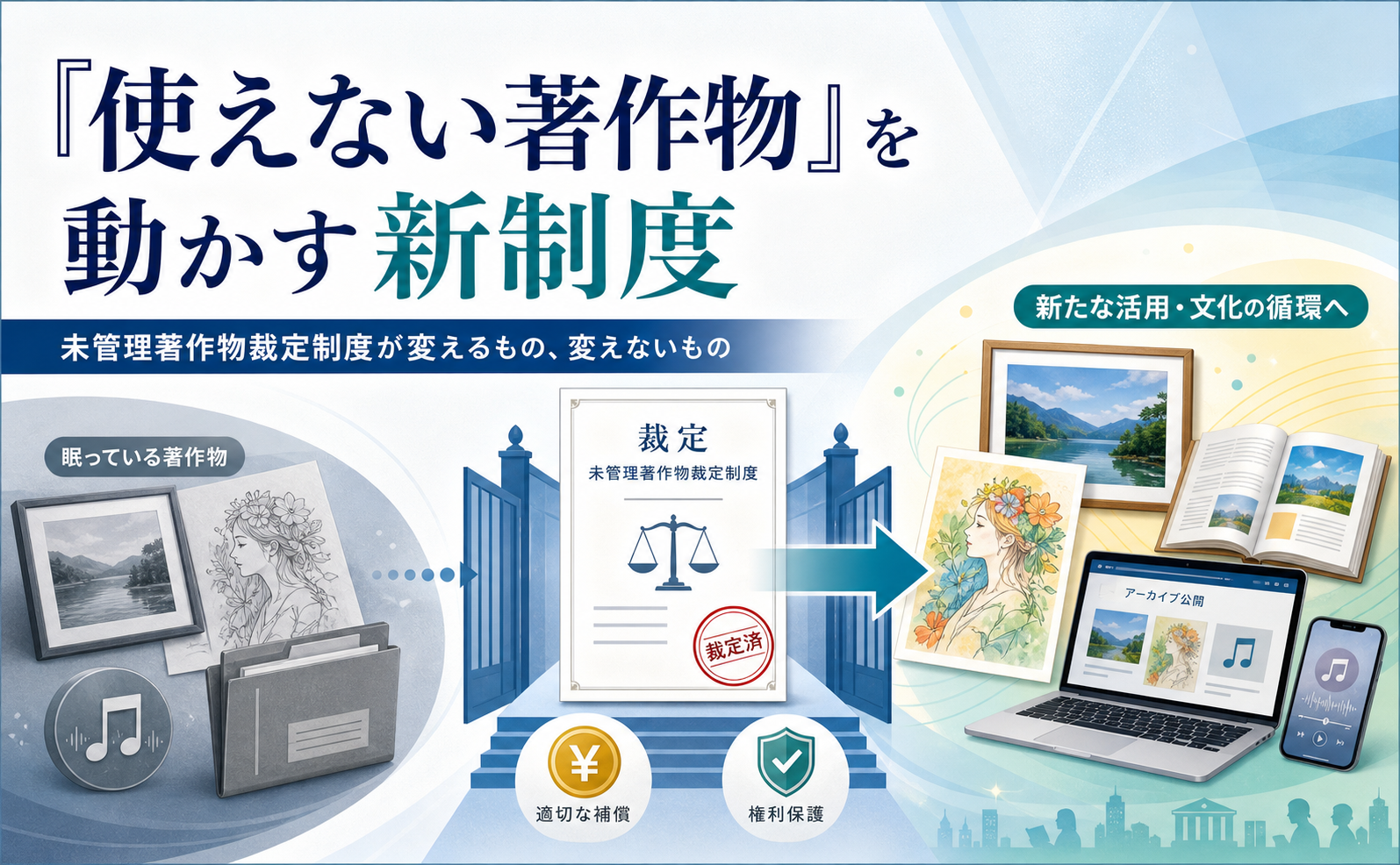
On April 1, 2026, Japan launched the “Unmanaged Works Adjudication System.” This system allows certain copyrighted works—such as illustrations, photographs, and musical compositions—to be used lawfully under specified conditions, even when the rights holder’s intentions regarding use or their contact information cannot be confirmed and it is therefore unclear whether permission can be obtained. To do so, a user must obtain an adjudication from the Commissioner of the Agency for Cultural Affairs and pay compensation. The practical administration of applications, eligibility screening, and compensation-related procedures is handled by the Copyright Research and Information Center (CRIC), a public interest incorporated association.
The internet contains a vast amount of content for which the creator can be identified to some extent, yet no usage rules are provided, no contact information is available, or no response is received even after an inquiry is made. Japan has long had an adjudication system for cases in which the copyright holder is unknown or cannot be found. In practice, however, the burden of searching for the rights holder was heavy, and many works remained dormant—unusable despite a desire to use them. This new system can be understood as a mechanism for giving such “dormant works” a legal path back into use.
The Core of the System Is Not “Unknown Rights Holders,” but “Unknown Intentions Regarding Use”
One important feature of the new system is that, whereas the previous system mainly envisioned situations in which the rights holder’s identity or whereabouts were unknown, the new system addresses situations in which the rights holder’s intentions regarding use cannot be confirmed. In other words, even where the copyright holder is not completely untraceable, works may still fail to enter circulation simply because no terms of use or contact point have been provided. This system is designed to place such works into circulation under certain conditions.
This distinction captures the copyright issues of the digital era with considerable accuracy. On today’s internet, the work itself may be easy to find, while the point of contact for rights clearance is not. By expanding the scope from “unknown rights holder” to “unknown intention,” the system creates a more realistic option than before for scenarios such as reviving older content, archiving, secondary use, and the reuse of local materials or individually published works.
This Is Not a System That Lets You Use a Work Freely After 14 Days
That said, some readers of the news may come away with the impression that “if you contact the person and get no response for 14 days, you can freely use the work.” But the system is not that simple. According to the official materials, the system may apply only where no usage rules or contact information are provided and, even if a contact address is discovered through a search, there has been no response for 14 days. Even then, use becomes possible only after going through a series of procedures: filing an application with a registered confirmation body, satisfying the eligibility review, obtaining an adjudication from the Commissioner of the Agency for Cultural Affairs, and paying compensation. Mere silence does not automatically make the work free to use.
Moreover, the system applies only to works that are not under collective rights management and for which the rights holder’s intentions regarding whether the work may be used are not clearly expressed. Conversely, works managed by copyright management organizations, or works for which usage rules or contact information are stated near the work itself or on the rights holder’s website, are in principle excluded from the system. Misunderstanding this point could lead to the dangerous assumption that “anything online can be used if no one replies,” but the design of the system is in fact the opposite: it excludes works for which an intention has been expressed, and deals only in a limited way with works for which no such indication exists.
What the New System Really Changes Is Not an “Exception,” but the Infrastructure of Circulation
If this system is viewed merely as a kind of copyright exception, its real significance may be missed. In substance, it is less a relaxation of unauthorized use than a framework for providing an alternative channel of circulation—through public adjudication and compensation—in areas where the ordinary licensing market does not function. The Agency for Cultural Affairs itself explains the purpose of the system as achieving both smoother use of content and appropriate remuneration for creators, while also rediscovering the value of buried works and connecting them to new creative activity.
In that sense, the system transforms an all-or-nothing situation—“it cannot be used because permission cannot be obtained”—into one of “conditional usability.” It should be especially meaningful, depending on how usable it proves in practice, in fields where rights clearance has often become clogged despite strong social value: revivals of past works, recirculation of out-of-print content, digital archiving, and the organization and publication of educational, research, and regional cultural resources. The system alone will not suddenly produce dramatic change, but it can reasonably be expected to remove at least one bottleneck in the circulation process.
New Practical Implications for Creators
At the same time, this system is not designed only for users. According to the Agency for Cultural Affairs’ FAQ, if a rights holder wishes to keep their work outside the scope of the system, they can do so by clearly stating usage rules—such as “unauthorized reproduction prohibited”—and providing contact information for licensing inquiries on their own website, social media, or around the work itself. In addition, in February 2026, operation began for both a cross-sector rights information search system and a rights information registration system for individual creators and others, establishing mechanisms to make rights holders’ statements of intent easier to find.
Seen from the other side, this means that creators will increasingly need to do more than simply publish their work. They will also need to indicate how they want it to be used and where they can be contacted. In the past, even if contact information or usage terms were not provided, the consequence was often merely that would-be users were inconvenienced. Going forward, however, that very absence may become the entry point for use under the system. The framework does incorporate protection for rights holders: they may request rescission of an adjudication, and if it is rescinded, use must cease and they may receive the compensation paid up to that point. But if they wish to avoid unwanted uses in the first place, prior expression of their intentions becomes all the more important.
The Key to Widespread Adoption Will Be Ease of Use and Public Awareness
Even so, the mere existence of the system does not mean that everyone will begin using it immediately. The Agency for Cultural Affairs’ FAQ states that use of the Unmanaged Works Adjudication System requires, in addition to a 13,800-yen fee paid to the registered confirmation body, compensation depending on the work and the manner of use. It is therefore likely that the system will begin functioning less as a tool for casual everyday online use or light reposting, and more as a framework for uses involving a certain degree of business purpose, continuity, or public significance.
From that perspective, what will determine the system’s success or failure may be less the legal framework itself than the clarity of its practical operation. How far must a user search before applying? How much compensation will be required? How smoothly will the process proceed from application to adjudication? And how easily can a rights holder express their intentions? If these points remain unclear, the result could be a system that exists but is not used, or one that is mainly misunderstood. If, on the other hand, the search systems and registration mechanisms function together as an integrated whole, this could become a highly practical reform for the circulation of content in Japan.
Conclusion
The Unmanaged Works Adjudication System is best understood not as a system that weakens rights, but as one that returns to society—through compensation—copyrighted works that would otherwise remain buried because rights clearance cannot be achieved. At the same time, it is also a system that strongly underscores for rights holders the importance of indicating usage conditions and contact information. In the internet age, copyright cannot be managed through a simple binary choice between protection and liberalization. This new system deserves attention as an institutional response that has finally begun to address the problem of works that exist in the space between those two poles: works that cannot circulate.