
Introduction
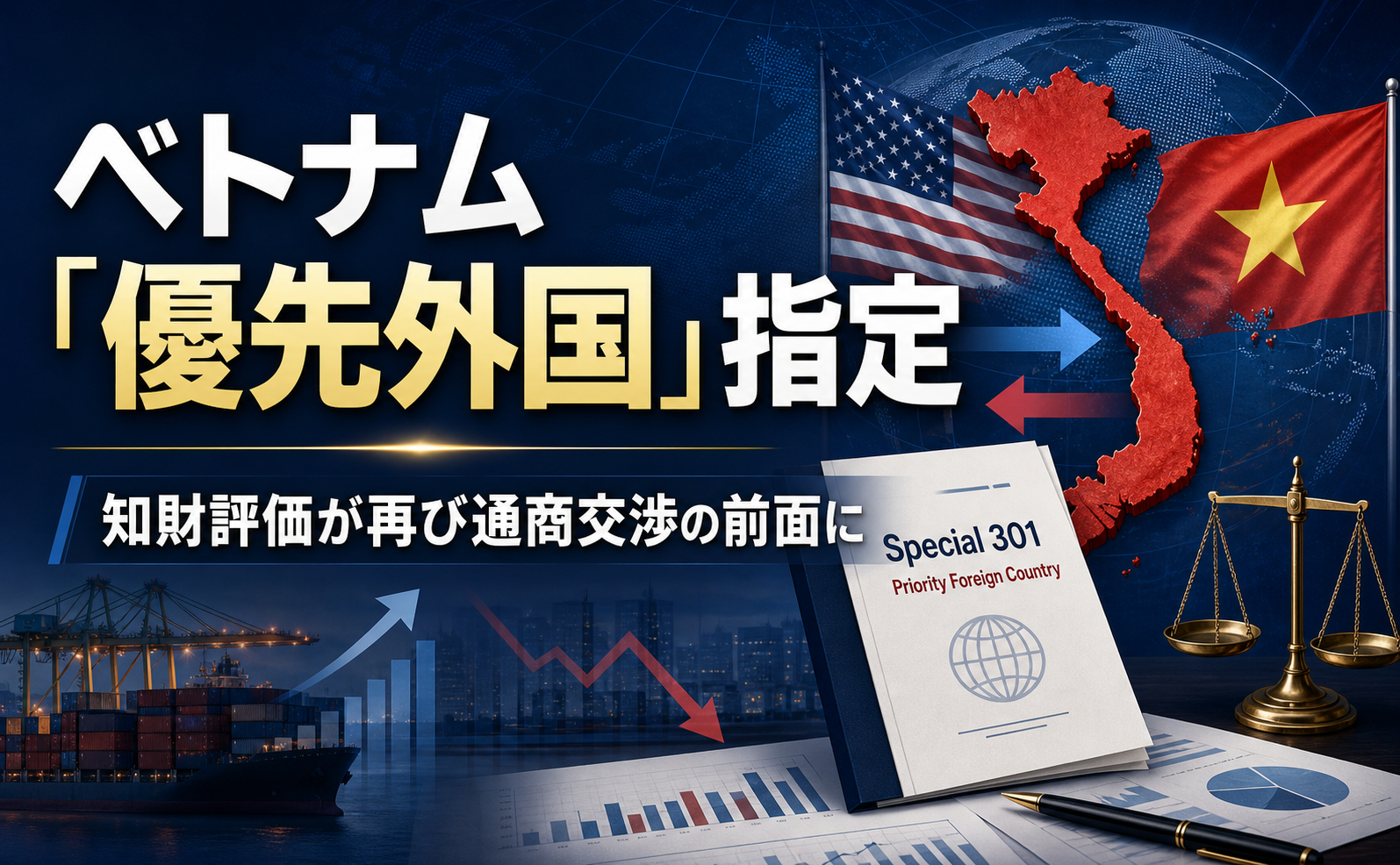
In its 2026 Special 301 Report, published on April 30, 2026, the Office of the United States Trade Representative (USTR) designated Vietnam as the sole “Priority Foreign Country.” USTR also stated that, in light of this designation, it would decide within 30 days whether to initiate an investigation under Section 301 of the Trade Act of 1974. In response, on May 1, Foreign Ministry spokesperson Pham Thu Hang said that Vietnam had been working to protect intellectual property through improvements to its legal framework, greater public awareness, stronger international cooperation, and strict action against infringement. She also called on the United States to make an “objective and balanced assessment” and stated that the two countries should continue to work closely together to handle their differences appropriately. This development should be read not merely as an update to an annual report, but as an event showing that intellectual property issues are once again being used as a strong means of pressure in U.S.-Vietnam trade relations.
What Is a “Priority Foreign Country”?
The Special 301 Report is USTR’s annual assessment of the state of intellectual property protection and enforcement in other countries. Within that framework, “Priority Foreign Country” is the most severe classification, used for countries whose acts, policies, or practices relating to intellectual property are considered especially serious, have a major adverse impact on U.S. products, and have not been meaningfully addressed through improvement-oriented negotiations. USTR itself explained that Vietnam’s designation is the first time in 13 years that this category has been used, and in the 2026 edition Vietnam was the only country placed in it. Accordingly, this designation is qualitatively different from ordinary placement on a watch list.
The Points the United States Identified as Problematic
USTR cited five specific issues in explaining why it designated Vietnam as a Priority Foreign Country. These were: the lack of sustained and effective enforcement against online piracy; insufficient enforcement against widespread counterfeiting; ineffective border measures; weak enforcement against the use of unlicensed software; and the absence of criminal measures against cable and satellite signal piracy. Moreover, USTR stated that although the United States had proposed an intellectual property work plan to Vietnam since 2020, no meaningful progress had been seen. What this shows is that the United States is concerned not only with shortcomings in the wording of the legal system, but with both the effectiveness of enforcement and the speed of improvement through bilateral consultations.
The Meaning of Vietnam’s Response
Vietnam’s response was not one of outright denial or confrontation. While emphasizing that Vietnam had pursued intellectual property protection as a top-priority and consistent policy, spokesperson Pham Thu Hang called on the United States to make an “objective and balanced assessment” and further stated that Vietnam was prepared to engage in information-sharing and in clarifying policies and regulations. She also said that the two countries needed to resolve their differences appropriately in order to build a stable, balanced, and sustainable framework for economic and trade cooperation. It is natural to interpret this as a message that, while Vietnam wants its own efforts to be fairly recognized, it does not want this issue to escalate into a conflict that would damage the broader bilateral relationship.
How This Development Should Be Read
What I consider important is that this matter does not stop at a debate over “intellectual property protection itself.” USTR explicitly stated that it would decide within 30 days whether to begin a Section 301 investigation in connection with the Priority Foreign Country designation. Section 301 is both a symbolic and practical instrument used by the United States to apply pressure against trade practices it considers unfair. In other words, this designation should be understood not simply as an evaluation of intellectual property as an independent field of law and policy, but as a move to bring it back to the forefront as leverage in trade negotiations. This clearly reflects the fact that intellectual property issues have become inseparable from supply chains, exports to the United States, the digital economy, and the investment environment.
Why This Is Difficult for Vietnam
Vietnam currently emphasizes not only its attractiveness as a manufacturing base, but also its position as a country that places science and technology, innovation, and digital transformation at the core of its growth model. For such a country to receive the most severe designation from the United States over intellectual property protection is not merely a reputational issue; it could also affect perceptions of its institutional reliability as an investment destination. This is especially true in digital and content-related sectors, where responses to online piracy and the use of unlicensed software are readily seen as tests of the credibility of industrial policy itself. Vietnam’s decision this time to foreground “an explanation of its efforts” and “the continuation of consultations,” rather than strong backlash, appears to reflect its understanding of that point.
Implications for Japanese Companies and IP Practice
For Japanese companies and intellectual property practitioners, this development is not someone else’s problem. First, there is now an even greater need to review in concrete terms the effectiveness of anti-counterfeit measures, customs seizures, software management, and responses to online infringement in Vietnam, which is one of ASEAN’s major production hubs. Second, if the United States is once again reusing intellectual property as a core instrument of trade pressure, then going forward the focus is likely to shift from the mere existence of legal制度 to actual enforcement results, the continuity of crackdowns, and the concreteness of cooperation among authorities. Third, although Vietnam has clearly expressed its intention to continue consultations, and an immediate slide into full-scale confrontation is therefore not inevitable, USTR’s decision within the next 30 days will be a key development to watch in assessing the risks of doing business in Vietnam.
Conclusion
The essence of this news lies in the gap between Vietnam’s claim that it is making serious efforts to protect intellectual property and the United States’ view that those efforts remain insufficient. However, from a broader perspective, it is more appropriate to understand this as a moment in which the United States has begun once again to use intellectual property issues as a strong means of pressure in trade negotiations. Vietnam has chosen coordination rather than confrontation, but that does not mean the issue is minor. On the contrary, this episode clearly shows that the effectiveness of intellectual property enforcement has now become an indicator by which the reliability of the investment environment, the digital economy, and trade relations as a whole is measured. The focus going forward will be on whether USTR actually proceeds to a Section 301 investigation, and on how far Vietnam can demonstrate a concrete willingness to improve before that happens.