
Introduction
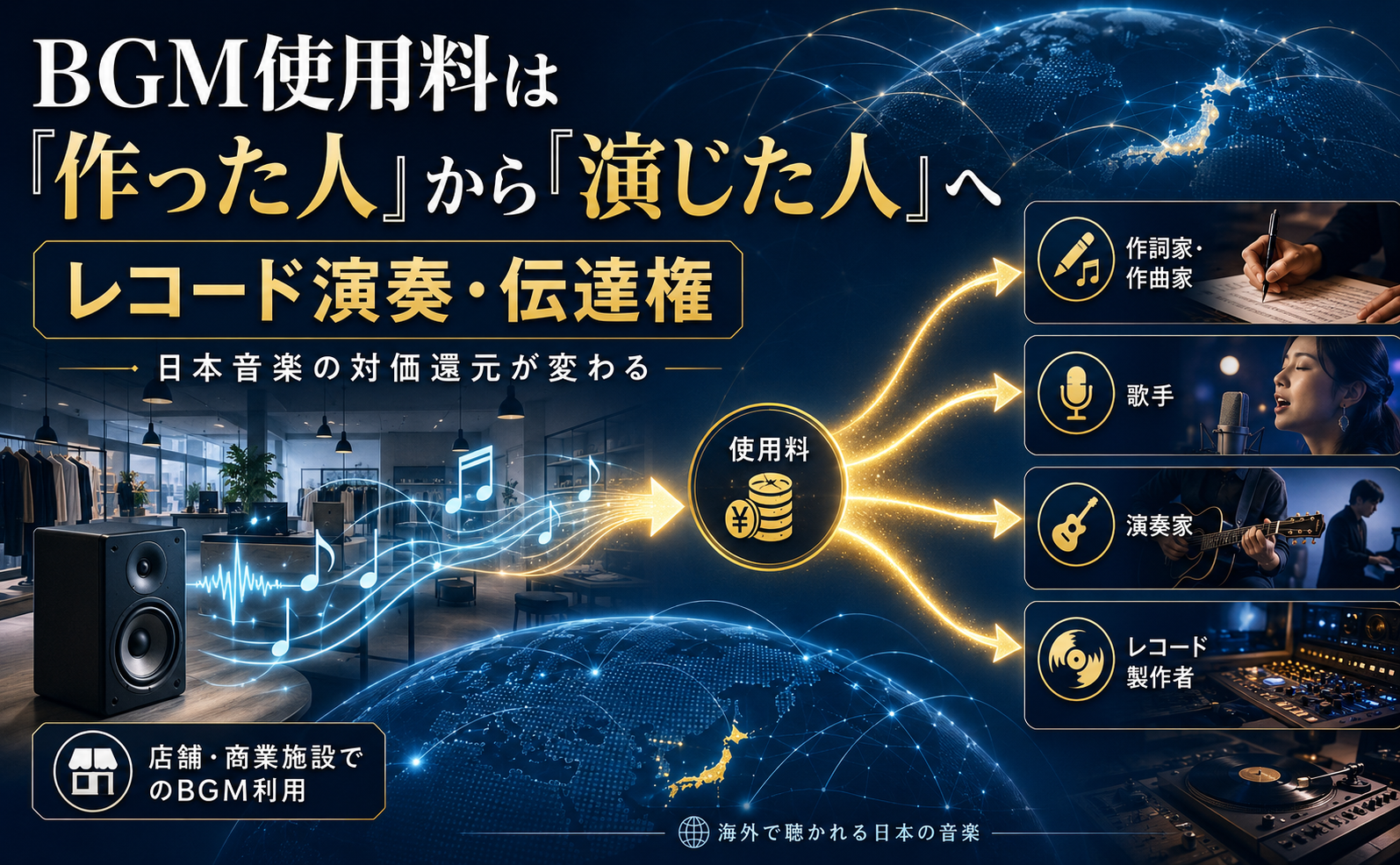
On May 15, 2026, the Japanese government approved a bill to partially amend the Copyright Act. The central feature of this amendment is the introduction of a new framework, commonly referred to as the “right of performance and communication of phonograms,” under which remuneration will also be returned to singers, musicians, record producers, and others when music CDs or distributed sound recordings are used as background music in restaurants, stores, commercial facilities, and similar venues. Until now, remuneration for BGM use has mainly been understood as flowing to lyricists and composers. This amendment aims to establish a legal foundation for distributing revenue also to those who actually sing, perform, record, and produce the sound recordings. The Ministry of Education, Culture, Sports, Science and Technology has also explained that, while such systems are widely adopted overseas, Japan had not yet developed a sufficient framework, creating a problem in which Japanese artists and others had difficulty receiving appropriate remuneration even when their music was used abroad.
An Amendment That Recognizes the Value of “Sound Recordings,” Not Just “Songs”
The significance of this amendment is not limited to the fact that the recipients of BGM usage fees will increase. More fundamentally, it represents a move toward clearly recognizing, as a matter of legal system design, that not only the creation of a musical work itself, but also the performance and production involved in creating a “recorded sound source,” have independent economic value.
Even with the same musical work, its commercial value can change greatly depending on who sings it, what kind of performance is recorded, and how the sound is produced. When BGM played in a store creates the atmosphere of that space, what is being consumed is not only the “melody” or “lyrics.” It is the sound recording itself, formed by the combination of vocals, performance, arrangement, recording, mixing, and investment in production by the record company.
In this sense, the creation of the right of performance and communication of phonograms can be understood as an amendment that broadens the way value is recognized in the music industry, moving from a lyricist- and composer-centered model to a sound recording-centered model that includes performance, recording, and production.
A Legal Foundation to Prevent Lost Returns in Overseas Expansion
This legal reform is particularly important because it concerns not only BGM usage fees within Japan, but also the return of remuneration when Japanese music is used overseas. The Ministry of Education, Culture, Sports, Science and Technology has explained that because Japan lacked a sufficient legal framework, Japanese artists and others faced the problem of being unable to receive appropriate remuneration even when their music was used abroad.
This is an issue that cannot be overlooked now that Japanese music is increasingly being heard overseas. Music content originating in Japan, including anime music, game music, idol music, J-pop, and city pop, is consumed across national borders. However, if music is being used overseas but domestic systems are not sufficiently developed, and returns to performers and record producers do not function adequately, the cycle by which the results of overseas expansion flow back into the industry as a whole becomes weaker.
Gaining popularity overseas is important, but popularity alone does not lead to sustainable industrial growth. Only when the cycle of popularity, use, collection, distribution, and reinvestment is properly established can it strengthen artistic activities and production environments. This amendment should therefore be positioned as infrastructure development to support that cycle.
Significance for Supporting Musicians as Well
This amendment is meaningful not only for front-facing singers and main artists, but also for musicians who participate in performances and performers who support studio work.
In the music field, performances and vocals that define the impression of a work have not always led to substantial royalty income. In particular, support musicians and session musicians often receive compensation at the time of recording, but then find it difficult to receive continuing returns even when the sound recording is used over a long period.
Of course, the actual method of receiving remuneration will vary depending on the specific distribution system and contractual relationships. At the very least, however, as a matter of institutional direction, returning value generated from the use of recorded works to performers is important for supporting the broader base of music production. Behind a flashy hit song are many musicians, production staff, and investments by record companies. Establishing a mechanism through which remuneration returns to those contributors helps enrich the soil from which the next works will be created.
The Issue of Increased Burden on Stores
On the other hand, restaurants, retail stores, and other businesses that use BGM may face an increased burden. Reports have also pointed out that while singers and others will be able to receive remuneration when popular Japanese songs are played in overseas commercial facilities and similar places, restaurants and other businesses that use BGM may face higher costs.
This makes public awareness and operational design important. Returning remuneration for music use is necessary, but if the system appears overly complex from the user’s perspective or is perceived as a sudden new burden, it may invite resistance. In particular, small and medium-sized stores may not fully understand the legal meaning of BGM use.
Accordingly, when introducing the system, it will be necessary to clearly explain who bears what level of burden and for what kind of use. To strengthen the legitimacy of remuneration returns, the rationality of collection and the transparency of distribution are indispensable.
Merely “Increasing Rights” Is Not Enough
This amendment is a step forward, but merely creating a new right is not sufficient. What matters is whether that right actually functions in practice.
For the system to be effective, many practical issues must be addressed, including understanding actual usage, operating collection organizations, reciprocal distribution with overseas organizations, management of rights-holder information, and methods of distribution to support musicians. Particularly with respect to overseas use, the creation of a system on the Japanese side will not automatically result in sufficient returns. The effects of the system will appear only when cooperation with overseas management organizations and the development of rights information are also in place.
Transparency in distribution is also important. If artists and musicians cannot understand how remuneration based on the use of their sound recordings was calculated and distributed, trust in the system will not increase. This amendment is not the goal, but the starting line for developing practical operations.
Meaning for Japan’s Music Industry
This legal reform can be understood as a systemic amendment that enables Japan’s music industry to respond to an era in which Japanese music is heard overseas.
Until now, Japanese music has been supported by the size of the domestic market. However, with the expansion of streaming, social media, video distribution, and anime distribution, music distribution now crosses national borders. As Japanese songs are increasingly used in overseas stores, events, videos, and commercial spaces, the development of international rights clearance systems becomes unavoidable.
When discussing overseas expansion of content, attention tends to focus on promotion, translation, marketing, and live performances. However, if systems for rights clearance and remuneration returns are weak, overseas success will not sufficiently flow back to production sites in Japan. Although it may be less visible, this amendment has the significance of foundational work that supports the international competitiveness of Japan’s music industry.
Conclusion
The creation of the right of performance and communication of phonograms is not merely an amendment that expands the recipients of BGM usage fees. It is an amendment that reaffirms, as a legal system, that value exists not only in “those who created the song,” but also in “those who performed it,” “those who recorded it,” and “those who released it to the world as a sound recording.”
As Japanese music is increasingly heard overseas, establishing a mechanism through which remuneration returns to performers and record producers is also important as industrial policy. Of course, practical issues remain, including the burden on stores, transparency in collection and distribution, and cooperation with overseas organizations. Even so, this amendment bill is an important step toward transforming Japan’s music industry from an industry that “sells domestically” into one whose works are used overseas and whose results are returned to Japan.