
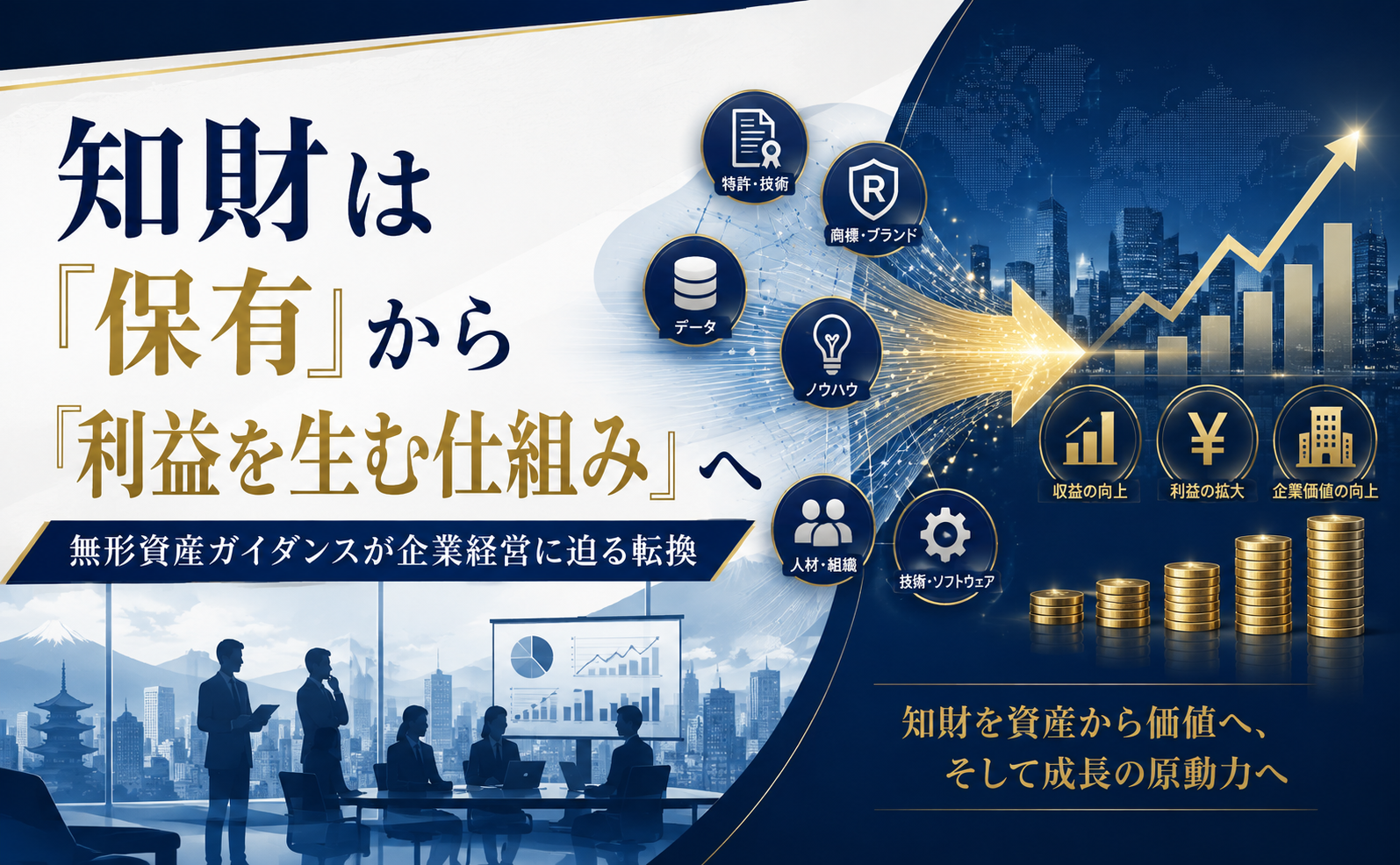
On August 3, 2026, the Intellectual Property Strategy Headquarters of Japan’s Cabinet Office published the Guidelines for Investment in and Utilization of Intellectual Property and Intangible Assets to Accelerate Value Creation. The Guidelines call on companies to take a broad view of intangible assets—not only patents, trademarks, and copyrights, but also technologies, brands, data, know-how, and organizational capabilities—and to explain to investors both the status of their investments in these assets and their contribution to medium- and long-term earnings. They also identify the principal bottlenecks hindering corporate initiatives and indicate potential responses through specific company case studies.
What the Guidelines call for is more than enhanced disclosure. They represent a transformation in corporate management: repositioning intellectual property and intangible assets from things a company merely “owns” to assets in which it invests to generate future profits.
Treating Intangible Assets as Growth Investments Rather Than Expenses
Much of the money companies spend on research and development, human resource development, brand building, and data infrastructure is accounted for as an expense in the current fiscal period. As a result, such spending tends to appear as a factor that reduces short-term profits and is often targeted for cuts when business performance deteriorates.
However, the technologies, customer trust, data, operational know-how, and organizational capabilities accumulated through such expenditure form the foundation for future product development, pricing power, barriers to market entry, and recurring revenue. If a company reduces investment in intangible assets to protect near-term profits, it may lose its competitiveness several years later.
The Guidelines encourage companies to make visible the investments in the future that have previously been buried within expenses and require management itself to explain what the company is investing in, why it is doing so, and to what extent.
What Matters Is Not the Number of Patents, but the Causal Link to Value Creation
Disclosure of intellectual property information is often understood as simply presenting figures such as the number of patents held, research and development expenditure, and the number of registered trademarks. Merely listing such figures, however, does not communicate a company’s future potential to investors.
What matters is demonstrating the causal relationship between corporate strategy and investment in intangible assets.
A company must explain, as a coherent narrative, which markets it intends to grow in, what technologies and brands are required to establish a competitive advantage in those markets, how much it will invest to acquire or strengthen those assets, and how that investment will lead to commercialization, sales, profit margins, licensing income, and other business outcomes.
The value of patents cannot be determined solely by their number. They should be assessed according to their business functions, such as whether they protect technologies essential to the company’s operations, make market entry more difficult for competitors, or can be used in negotiations and licensing arrangements with other companies.
In other words, companies are being asked to shift from explaining “how much intellectual property they own” to explaining “how they will use intellectual property to generate profits.”
Alignment with Corporate Governance Reform
The Guidelines should not be viewed as a stand-alone intellectual property policy. They must be understood as part of broader corporate governance reform and measures to promote investment in growth.
The Corporate Governance Code, revised in July 2026, expressly states that, given that investment in intangible assets such as intellectual property is a source of competitiveness and increased corporate value, companies should take a strategic approach to the creation, acquisition, enhancement, protection, and monetization of such assets.
In light of this development, investment in intangible assets is no longer a specialized function handled exclusively by intellectual property departments. Decisions concerning which technological fields should receive funding, which brands should be strengthened, which businesses should be discontinued, which technologies should be developed internally, and which should be acquired through partnerships or acquisitions have become management issues requiring board-level attention.
Intellectual property strategy must therefore be discussed as a means of implementing corporate strategy.
“Selection and Concentration” Through Collaboration with Other Companies
A pharmaceutical company case study introduced in the supplementary materials illustrates an initiative to concentrate management resources on priority fields through collaboration with other companies.
This case suggests that intangible asset management does not necessarily require a commitment to developing everything in-house. Developing every technology internally and owning every piece of intellectual property is not always the most rational approach.
A company may retain ownership of technologies at the core of its competitiveness while using joint research, licensing, business alliances, investments in start-ups, and mergers and acquisitions for peripheral technologies, thereby improving investment efficiency. Conversely, licensing intellectual property that the company is not effectively utilizing or transferring it together with the relevant business may also be viable options.
The key question is not merely “what should be protected,” but how to design a structure defining what the company should own internally, what it should share with external parties, and what it should obtain from outside. Intellectual property strategy is expanding from a strategy for acquiring rights into a strategy for optimizing the combination of management resources.
The Changing Role of Intellectual Property Departments
The Guidelines also require a change in the role of corporate intellectual property departments.
Traditionally, intellectual property departments have focused on identifying inventions, filing patent applications, maintaining rights, investigating third-party rights, and responding to infringement. These functions will remain important, but they alone are insufficient to support intangible asset management.
Intellectual property departments will increasingly be expected to analyze how their companies’ technologies and brands contribute to business profitability and to translate those findings into language that can be understood by management, finance departments, investor relations departments, and investors.
They must collaborate with research and development, business, corporate planning, finance, and investor relations departments and connect intellectual property information with market, competitive, and financial information. IP landscape analysis and intellectual property portfolio analysis should be used not merely to investigate technological trends, but also as inputs for decisions concerning research and development investment and business portfolios.
Intellectual property departments are expected to evolve from back-office functions that administer rights into strategic functions that support management decision-making.
Valuing Intangible Assets Cannot Be Solved Through Quantification Alone
Nevertheless, making the value of intangible assets visible is not an easy task.
An increase in research and development expenditure does not necessarily result in a successful new product. Even a large patent portfolio will not generate profits if the patents are not used in the business. Nor is there a simple proportional relationship between advertising expenditure and brand value.
Intangible asset management therefore requires companies to combine multiple forms of information rather than attempting to evaluate everything through a single monetary amount or indicator.
In addition to the amount invested, it is useful to present the pathway to value creation in stages by using indicators such as development progress, commercialization rates, target markets, licensing results, customer retention rates, price premiums, and differences from competitors.
At the same time, it would be counterproductive if prioritizing disclosure resulted in trade secrets, research and development policies, or inventions not yet covered by patent applications becoming known to competitors. Companies must carefully design their disclosures by distinguishing between strategies and causal relationships that should be explained to investors and specific technical information that should remain confidential for competitive reasons.
Three Initiatives Companies Should Begin With
The first step companies should take is to inventory the intangible assets they possess. In addition to patents and trademarks, companies must identify their technologies, data, software, customer bases, brands, know-how, human resources, and organizational capabilities and determine which businesses and competitive strengths those assets support.
The next step is to organize and clarify the relationship between investment in intangible assets and future profits. By showing the timeline from investment through commercialization and revenue recognition to profit recovery, and by establishing intermediate objectives and key performance indicators, companies can enable management and investors to assess progress.
Companies must also establish an internal structure that does not leave intangible asset management solely to the intellectual property department. Corporate planning, finance, investor relations, research and development, business, and intellectual property departments should discuss matters on the basis of shared information, with the board of directors overseeing the process.
Companies That Can Explain and Companies That Can Execute
The Guidelines require companies to explain their investments in intangible assets. What truly matters, however, is not the production of an attractive integrated report.
The value lies in using the process of organizing intangible assets for disclosure to expose weaknesses in corporate strategy, insufficient investment, underutilized intellectual property, and inadequate collaboration between departments. Disclosure is not an end in itself, but a means of improving the quality of management.
In the future, a gap will also emerge between companies that can explain the value of their intellectual property and intangible assets and those that can actually convert those assets into profits. Companies that offer a compelling narrative without corresponding execution will eventually be recognized as such by investors. Conversely, companies that possess excellent technologies but cannot explain their value may be unable to attract the growth capital they need.
The era in which intellectual property and intangible assets are treated merely as matters of rights administration or expenses is drawing to a close. What will increasingly be tested is a company’s managerial ability to identify its invisible assets, invest in them, protect them, combine them, and convert them into profits.
The Guidelines may therefore be understood as calling on Japanese companies to shift from management focused on “acquiring intellectual property” to management focused on “creating value through intellectual property.”