
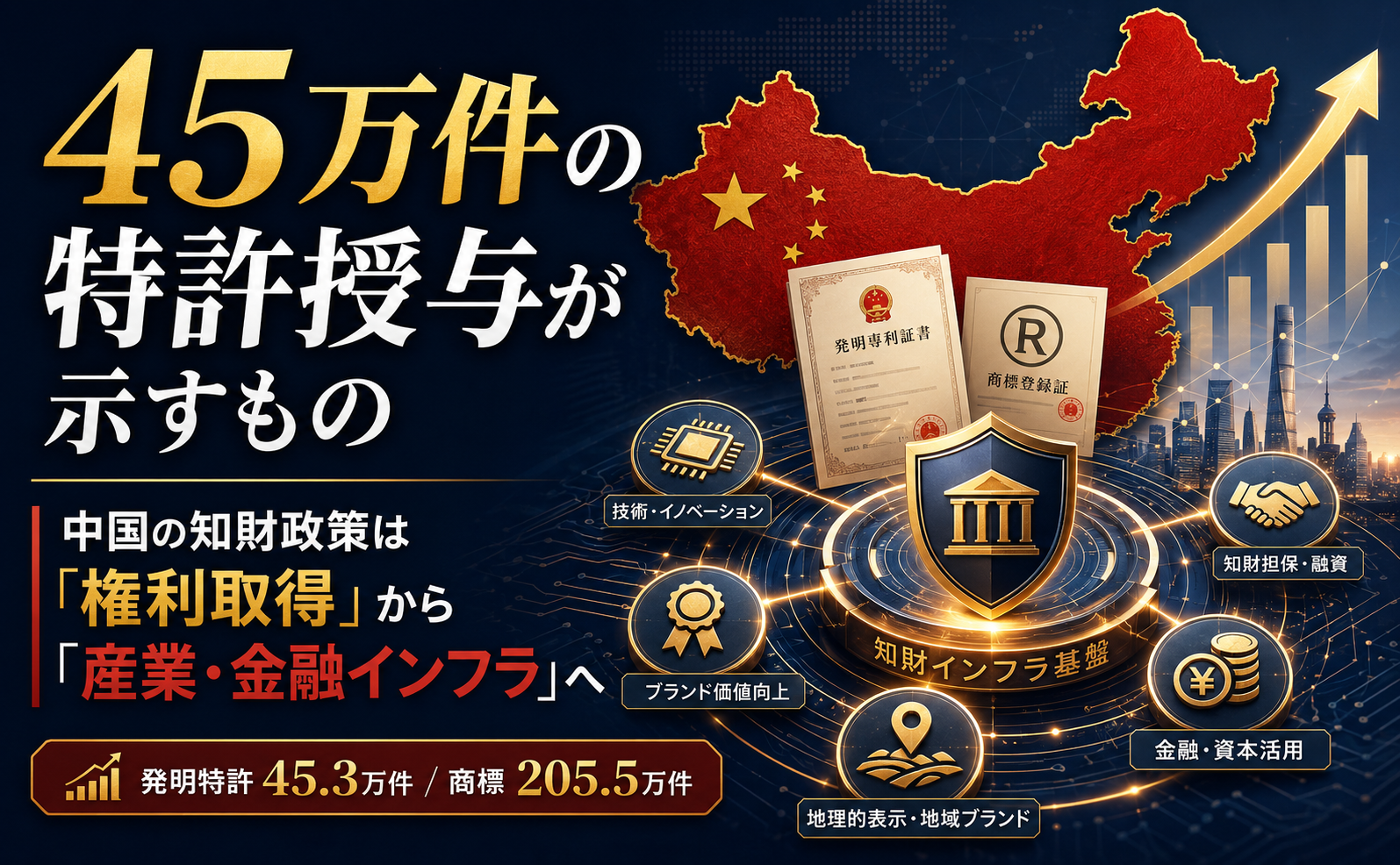
On July 29, 2026, the China National Intellectual Property Administration announced that 453,000 invention patents had been granted in China during the first half of the year, while 2.055 million trademarks had been registered. A further 64 geographical indication, or GI, products were newly recognized, and 5,061 registration certificates were issued for integrated circuit layout designs. In addition, the establishment of two national-level intellectual property protection centers and six rapid intellectual property protection centers was approved. More than 19,000 companies nationwide had also used financing secured by patents or trademarks.
These figures show that China is not merely an “intellectual property powerhouse” that produces vast numbers of patents and trademarks. It is also developing intellectual property as a form of social infrastructure connecting industrial policy, corporate finance, regional branding, and dispute resolution.
The Focus Should Not Be Only on the “Quantity” of 453,000 Patents
The grant of 453,000 invention patents in the first half of the year demonstrates the scale of research and development activity and rights-acquisition efforts in China. However, it would be inappropriate to evaluate China’s technological capabilities solely on the basis of patent numbers.
More important are the substance of those rights and the composition of their owners.
As of the end of June 2026, the number of high-value invention patents held domestically in China had reached 2.36 million, equivalent to 16.8 patents per 10,000 people. In addition, 574,000 Chinese companies held valid invention patents. Together, they owned 4.254 million such patents, accounting for 74.8% of the domestic total. This demonstrates that companies have become the principal actors in China’s patent creation.
Furthermore, valid invention patents in next-generation information technology fields—including artificial intelligence, the internet, cloud computing, and big data—accounted for 16.5% of the total. This figure indicates that China’s patent portfolio is expanding beyond manufacturing technologies into foundational fields for digital industries and data-driven business.
Accordingly, an analysis of China’s IP trends should consider not only the number of patents granted in a single year, but also the proportion of high-value patents, corporate ownership, the technological fields covered, and the extent to which those patents are implemented in actual products and services.
An IP Policy That Integrates Patents, Trademarks, GIs, and Semiconductors
The statistics announced this time include not only invention patents, but also trademarks, geographical indications, and integrated circuit layout designs.
This illustrates that China’s IP policy is not designed solely to protect advanced technologies. It is structured as a comprehensive policy covering products, services, regional industries, agricultural, forestry and fishery products, and the semiconductor industry.
In particular, the registration of 2.055 million trademarks in the first half of the year reflects the intensity of brand competition in the Chinese market. In China, it is increasingly important not only to protect technological advantages through patents, but also to secure trademarks for product names, service names, logos, series names, and other branding elements at an early stage.
Geographical indications are not only a system for protecting the names of regional products. They are also a branding policy instrument connecting local economies, export promotion, tourism, and agricultural policy. Actively protecting geographical indications within the IP system helps develop regional products not merely as commodities, but as brand assets that are difficult to imitate.
The issuance of 5,061 integrated circuit layout-design registration certificates in the first half of the year is also noteworthy in the context of China’s industrial policy emphasis on semiconductors. China appears to be seeking to establish comprehensive protection by combining patent rights with a specialized rights system for semiconductor circuit layouts, which may be difficult to protect adequately through patents alone.
Expanding Protection Centers Reflects a Greater Focus on the Period After Rights Are Granted
Another important aspect of the announcement is the approval of two new national-level intellectual property protection centers and six new rapid intellectual property protection centers.
Intellectual property rights do not acquire sufficient value merely because they have been registered. They become effective business assets only when infringement can be identified early and injunctions or dispute resolution can be pursued swiftly.
China is not only increasing its capacity to process examinations and registrations. It is also establishing regional and industry-specific hubs for rapid rights protection. This indicates that the emphasis of its IP policy is shifting from “how many rights have been obtained” to “how quickly and effectively acquired rights can be enforced.”
Faster protection procedures will make it easier for Chinese companies to respond to counterfeit and infringing products. For foreign companies entering the Chinese market, however, infringement of third-party rights may lead to sales suspensions or business restrictions at an earlier stage than before.
For Japanese companies, prior patent and trademark searches are therefore becoming more important not only when selling products in China, but also when manufacturing, procuring, exhibiting, conducting demonstration tests, or distributing content online in the country.
Intellectual Property Is Becoming Collateral for Financing
One of the most notable points in the announcement is that more than 19,000 companies had used financing secured by patents or trademarks.
Startups and research-oriented small and medium-sized enterprises often have relatively few tangible assets, such as manufacturing equipment or real estate. As a result, they may find it difficult to obtain loans from financial institutions even when they possess excellent technologies. Intellectual property pledge financing addresses this issue by valuing patents and trademarks held by a company as collateral and using them to support lending.
China has promoted intellectual property pledge financing as a policy tool to support funding for technology-oriented small and medium-sized enterprises. The China National Intellectual Property Administration and other authorities have developed mechanisms for IP-backed financing by coordinating financial institutions, insurance companies, valuation organizations, and local governments.
This development means that patents and trademarks are no longer being treated solely as rights that prevent imitation by competitors. They are beginning to be regarded as assets that supplement a company’s creditworthiness and enable it to raise funds.
For companies, this also changes the way intellectual property acquisition strategies should be designed. Simply holding a large number of patents unrelated to the actual business will not necessarily result in a high valuation by financial institutions or investors. Factors such as the market potential of the technology, the breadth of the claims, resistance to invalidation, remaining term, relevance to overseas expansion, and potential for licensing revenue will all be examined.
IP departments will therefore be expected not only to manage the number of applications filed, but also to explain how each right contributes to business value and corporate value.
From “Mass Production of IP” to an “IP Cycle”
China has long attracted attention for the enormous number of patent and trademark applications filed in the country. At the same time, concerns have repeatedly been raised about the quality of rights, dormant patents, and applications filed primarily to obtain subsidies.
Current policy appears to be shifting away from this stage of quantitative expansion and toward improving quality, facilitating commercialization, promoting financial use, and accelerating rights protection.
China has also been reviewing the large number of patents held by universities and research institutions nationwide, with the aim of transferring or licensing them to companies. By 2025, approximately 1.349 million existing patents held by more than 2,700 universities and research institutions had been inventoried. The nationwide number of recorded patent assignments and licenses also increased compared with the period before the policy was implemented.
China’s next objective in IP policy appears to be the creation of a cycle in which inventions are generated and patented, those patents are transferred to companies and commercialized, financing and investment are attracted, and the resulting funds are reinvested in further research and development.
Three Responses Required of Japanese Companies
First, Japanese companies need to monitor Chinese patents continuously.
The number of valid invention patents held by Chinese companies continues to increase. Rights are also accumulating in foundational technologies used across industries, including artificial intelligence, cloud computing, and data processing. Chinese companies should therefore be evaluated not merely as contract manufacturers or customers, but also as important patent owners.
Second, an IP strategy that does not separate patents from trademarks is essential.
Even when a technology is protected by patents, a company may be unable to use the same brand in the Chinese market if a third party has registered the product or service name first. Product development, patent filing, trademark filing, and the selection of Chinese-language brand names should therefore be conducted in parallel.
Third, the asset value of intellectual property must be examined when dealing with Chinese companies.
Even when a potential business partner or investment target holds a large number of patents, those patents do not necessarily protect its actual business. In joint development, investment, acquisition, and licensing transactions, it is necessary to examine the validity and ownership of the rights, the existence of security interests, the presence of joint applicants or co-owners, and the status of licenses.
In particular, where patents or trademarks have been pledged as collateral for financing, restrictions may arise in relation to business alliances or transfers of rights. IP due diligence in China should therefore examine not only the registration status of rights, but also encumbrances such as pledges.
Scale Alone Is Not Enough to Assess Success
Nevertheless, the success or failure of the policy cannot be determined solely from the grant of 453,000 patents or the participation of 19,000 companies in IP-backed financing.
It is also necessary to examine the proportion of patents actually used in products and services, licensing revenue, collateral valuations, corporate growth after financing, and the practical effectiveness of enforcement. Even when the number of registrations increases, patents with narrow claims or weak connections to the underlying business may not translate directly into greater corporate competitiveness.
IP-backed financing also presents challenges, including technological obsolescence, patent invalidation, inconsistencies in valuation, and the lack of a sufficiently developed market for disposing of intellectual property collateral. Growth in the number of participating companies demonstrates the spread of the system, but it does not mean that the IP valuation and financing ecosystem is complete.
Even so, the direction of China’s policy is clear: the country is developing an integrated system for the creation, protection, circulation, and financial utilization of intellectual property.
China’s IP Policy Is Becoming Industrial Policy Itself
The grant of 453,000 invention patents is an easily understood indicator of the scale of China’s intellectual property activity. However, the essence of this news lies in more than the size of that number.
China’s objective can be seen in the overall system: trademarks protect corporate and service brands; geographical indications foster regional industries; integrated circuit layout-design rights support the semiconductor industry; protection centers accelerate enforcement; and patents and trademarks are used as collateral to supply companies with capital.
In China, intellectual property is no longer a category of rights handled exclusively by legal departments. It is becoming economic infrastructure that connects research and development, industrial development, regional revitalization, corporate finance, and international competition.
Japanese companies should therefore view China’s patent statistics not merely as numerical data, but as management information that may affect their own technological development, brand strategy, supply chains, financing, alliances, and acquisitions.
Understanding China’s IP policy is not only a matter of assessing the technological capabilities of Chinese companies. It also means identifying which industries China intends to develop, which companies it intends to finance, and in which markets it seeks to strengthen its competitiveness.