
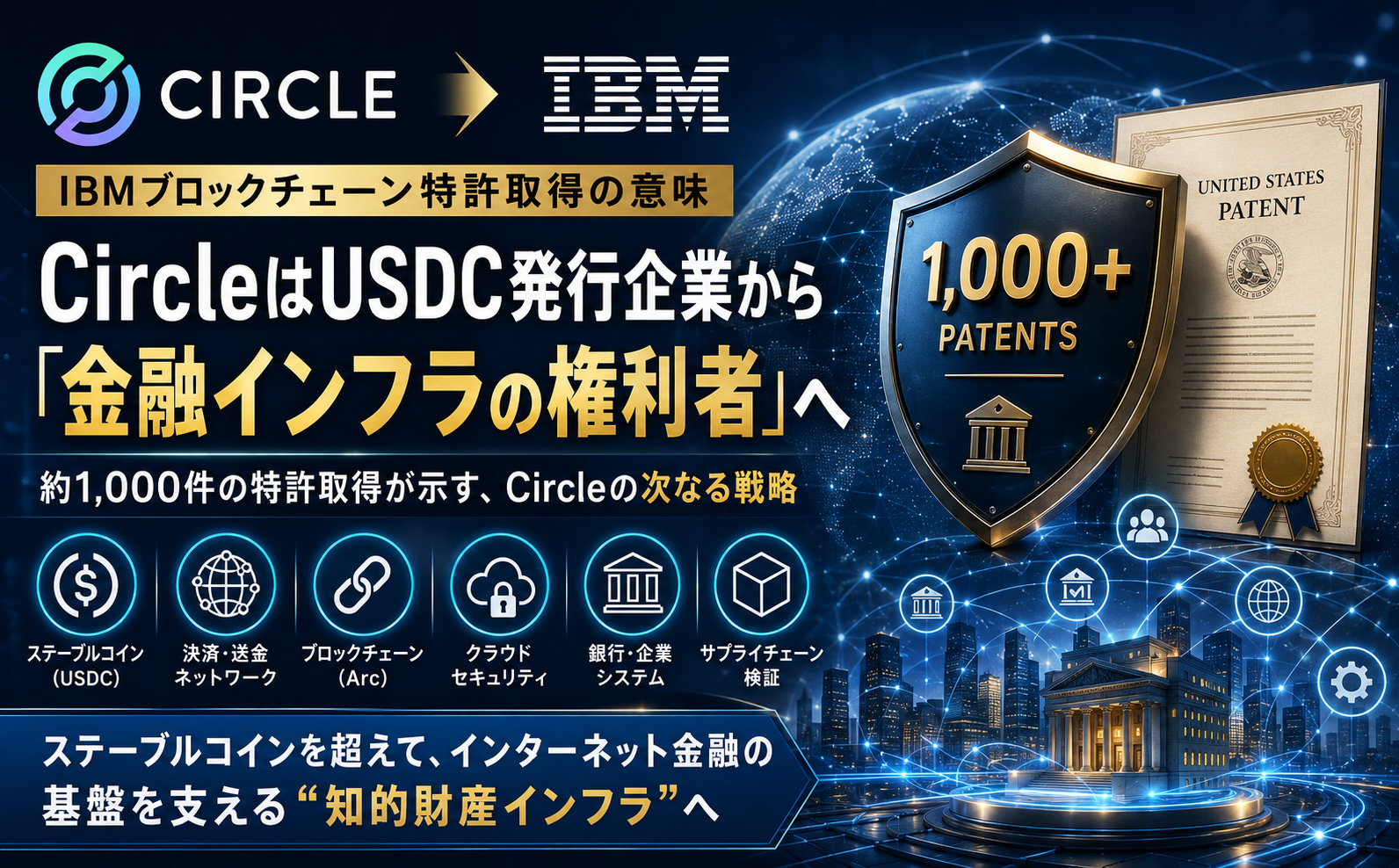
On July 27, 2026, Circle Internet Group announced that it had acquired key assets from IBM’s blockchain patent portfolio. The acquisition covers more than 680 patent families and approximately 1,000 granted patents worldwide. The technologies involved extend beyond foundational blockchain technology to a broad range of fields, including banking, financial services, insurance, enterprise systems, supply chain verification, and secure cloud operations. Circle states that the acquisition has made it one of the largest holders of blockchain patents in the United States.
This move is not merely an expansion of the patent holdings of the company that issues the USDC crypto asset. It signals that Circle is seeking to move beyond its role as a stablecoin issuer and become a financial infrastructure company that provides integrated payment, remittance, blockchain, cloud, and enterprise-system solutions.
The Breadth of the Patents Matters More Than Their Number
The approximately 1,000 granted patents involved in the acquisition naturally attract attention. From a business-strategy perspective, however, what matters more than the sheer number of patents is the breadth of the technological fields covered by the acquired rights.
A patent family generally refers to a group of patent applications filed in multiple countries or regions for the same or related inventions. Acquiring more than 680 patent families therefore suggests that Circle has not merely acquired a large number of national patents, but may have incorporated a substantial number of distinct groups of inventions into its business foundation.
Moreover, the portfolio is not limited to stablecoin issuance or blockchain-based fund transfers. It also covers banking operations, insurance, enterprise infrastructure, supply chain verification, and cloud security. This means that Circle has secured rights across a broad range of technologies that may become necessary when providing services to financial institutions and general business enterprises in the future.
Acquiring Patents Is Not an Announcement of New Services
Nevertheless, the acquisition of patents does not mean that every technology described in those patents will be implemented in Circle’s services.
Companies acquire patent portfolios for many purposes other than using the technologies in their own products. These include preparing for the risk of patent enforcement by third parties, conducting licensing negotiations with other companies, strengthening their bargaining position in joint development projects, and preserving opportunities to enter future business fields.
It would therefore be premature to interpret this acquisition as meaning that Circle will immediately launch new financial services. Rather, the acquisition should be viewed as Circle securing a broad range of technological and legal options so that it can respond flexibly regardless of the direction in which its business expands.
Circle’s announcement does not provide details such as which individual patents will be used in which products, how much Circle paid for the portfolio, or how third-party licensing will be handled. Circle and IBM have, however, stated that they will also explore additional commercial opportunities.
An Intellectual Property Strategy That Goes Beyond Protecting USDC
Circle explains that the intellectual property foundation acquired through this transaction will directly support USDC, the Circle Payments Network, Arc, and its other on-chain products and financial tools.
USDC is a stablecoin backed by fiat currencies such as the U.S. dollar. However, the mere existence of the USDC token is not enough to create a global financial infrastructure.
For companies and financial institutions to use it in practice, numerous supporting technologies are required. These include fiat currency conversion, identity verification, fraud prevention, wallet management, transfers between different blockchains, transaction-record verification, and integration with existing banking systems.
The Circle Payments Network is positioned as a network that connects participating financial institutions and enables international payments and settlements using stablecoins. Arc, meanwhile, is offered as a Layer 1 blockchain designed to meet the needs of the global internet economy.
In other words, the market in which Circle intends to compete is not merely the market for issuing stablecoins. It is the broader infrastructure market for enabling business-to-business payments, international remittances, asset transfers, financial-product transactions, and programmable payments using stablecoins.
The patent acquisition can therefore be understood as strengthening Circle’s defensive position and negotiating leverage as it continues to develop technologies and provide services in this infrastructure market.
Compatibility with IBM’s Enterprise Technologies
IBM has developed systems based on Hyperledger Fabric, a permissioned blockchain platform designed for enterprise use. Unlike blockchain systems in which an anonymous and unrestricted group of users may participate, permissioned blockchains manage the identities and access rights of participants and allow transaction information to be shared between enterprises. IBM has promoted the use of such enterprise blockchains in areas including finance, supply chains, and credential management.
This accumulated expertise is highly compatible with Circle’s efforts to expand its connections with financial institutions and large corporations.
The technologies required for a service used by individuals to send and receive crypto assets differ from those required for a payment infrastructure involving multiple banks and companies. In the latter case, matters such as participant access control, protection of confidential information, auditability, system-failure response, and explainability to regulators become particularly important.
IBM’s enterprise blockchain patents, accumulated over many years, may include technologies addressing these practical challenges. For Circle, acquiring an existing large-scale portfolio may reduce both the time required and the uncertainty involved compared with building an enterprise-focused intellectual property portfolio from scratch.
Stablecoin Competition Is Moving from “Circulation” to the “Technology Layer”
Until now, major competitive indicators in the stablecoin market have included circulating supply, transaction volume, and the number of supported exchanges and blockchains.
As enterprise adoption expands, however, the focus of competition is shifting away from stablecoins themselves and toward the surrounding technology layers.
Service adoption will increasingly depend on questions such as who provides connectivity with financial institutions, who controls mechanisms for securely transferring funds across multiple blockchains, how stablecoins are integrated with corporate accounting and treasury systems, and how regulatory compliance is implemented at the system level.
In addition to USDC, Circle already provides the Circle Payments Network for international payments, its proprietary Arc blockchain, cross-chain transfer technologies, wallets, and smart-contract-related services.
In light of this business structure, the acquisition can be evaluated not as a measure intended to directly increase USDC’s market share, but as one designed to strengthen the competitiveness of the overall financial infrastructure in which USDC is used.
Patents Are Not Used Solely to Create Monopolies
Open-source software plays an important role in the blockchain sector. Large-scale patent acquisitions may therefore raise concerns that companies are attempting to enclose or restrict access to technology.
Open source and patents, however, are not necessarily incompatible. Even when software source code is publicly available, patents may still exist for surrounding system architectures, authentication methods, transaction-processing techniques, security measures, and inter-company integration mechanisms.
Nor do companies hold patents solely to exclude competitors. Patents can be held defensively to protect a company’s own services, used in cross-licensing arrangements with other companies, licensed to business partners, or used to clarify rights in standardization activities.
The key issue going forward is therefore not simply how many patents Circle owns, but how it chooses to manage and use them.
The market impact will differ significantly depending on whether Circle uses the acquired patents primarily for defensive purposes, licenses them to partner companies, or enforces them against competitors.
Four Points to Watch Going Forward
Following the announcement, one of the most important matters to examine will be how the acquired patents correspond to Circle’s individual services.
First, it will be necessary to determine which patents are actually used in existing services such as USDC, the Circle Payments Network, and Arc.
Second, attention should be paid to how many patents in the acquired portfolio still have substantial remaining terms and remain valid in countries that are commercially important to Circle.
Third, it will be important to observe how Circle establishes its policies regarding third-party licensing and patent enforcement.
Fourth, it remains to be seen whether the additional commercial opportunities being explored by Circle and IBM will lead to joint development, technology provision, cloud services, licensing arrangements, or some combination of these activities.
A patent portfolio does not generate business value merely by being owned. It becomes a source of competitive advantage only when it is linked to a company’s products, research and development activities, and partnership strategy.
Circle’s Vision of an “Internet Financial System”
What this acquisition indicates is that Circle does not view itself simply as a crypto-asset company.
Circle’s objective is not merely to issue a digital currency called USDC. It also aims to build the mechanisms that allow that currency to move across national borders, financial institutions, corporate systems, and multiple blockchains.
The broad patent portfolio acquired from IBM will become an asset that supports this vision from both technological and intellectual property perspectives.
The acquisition alone does not guarantee that Circle will gain an advantage in the future financial infrastructure market. The value of patents varies greatly depending on their validity, remaining term, scope of protection, countries covered, and relationship to actual products.
Even so, the fact that Circle has acquired an entire portfolio containing approximately 1,000 granted patents demonstrates that the company is looking beyond competition over stablecoin adoption and toward the long-term competition to control the foundations of on-chain finance.
Competition in the stablecoin market may therefore be entering a new phase—one in which the decisive question is no longer simply which currency is used most widely, but who controls the technologies, networks, regulatory capabilities, and intellectual property required to make that currency function.