
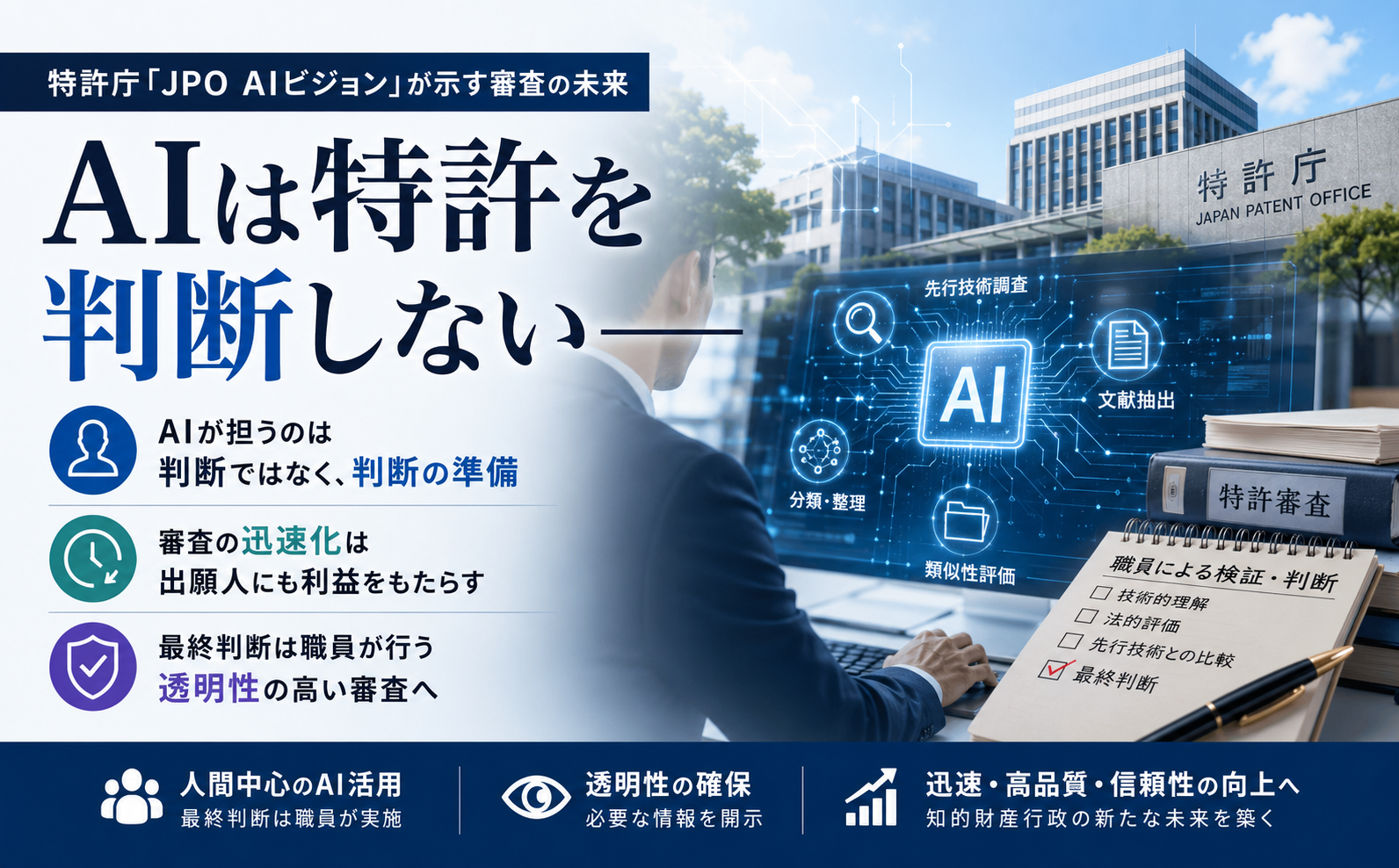
On July 27, 2026, the Japan Patent Office (JPO) formulated and published the “JPO AI Vision,” which sets out its fundamental approach to the use of artificial intelligence (AI) in its operations. The JPO made clear that it would actively use AI in patent examination and other operations to deliver faster and more advanced administrative services, while adhering to a human-centered approach under which JPO personnel verify AI-generated outputs and retain responsibility for all final decisions. The JPO also stated that it would improve transparency by disclosing, to the extent necessary and feasible, information about the business processes in which AI is used.
What is particularly noteworthy about this announcement is that the JPO has not merely introduced a new search tool. It has formally articulated the principles governing the use of AI. The application of AI to patent examination is moving beyond the experimental stage and becoming part of the permanent infrastructure supporting intellectual property administration.
AI’s Role Is Not to Make Decisions, but to Prepare the Ground for Them
A prior art search is a critical part of patent examination. Its purpose is to determine whether technology identical or similar to the claimed invention already existed before the patent application was filed. The volume of patent documents and technical literature published in Japan and abroad continues to grow. At the same time, as technologies such as AI become more advanced and complex, the range of information that patent examiners must review is also expanding.
The JPO has already been conducting trials and introducing AI technologies for tasks such as patent-document classification and prior art searches. If AI can identify highly relevant documents or estimate the technical field to which a claimed invention belongs, it can reduce the burden on examiners of reviewing enormous quantities of information one document at a time.
However, patentability is not determined solely by reviewing the documents presented by AI. Understanding the technical significance of an invention, identifying its differences from the prior art, and determining whether those differences would have been obvious to a person skilled in the art require both legal and technical evaluation.
AI is therefore expected not to replace patent examiners, but to help them collect the materials needed to make decisions more quickly and comprehensively.
Faster Examination Also Benefits Applicants
The time required to obtain a patent can create significant business uncertainty for companies. For startups and new business ventures in particular, whether a patent can be secured may affect financing, business partnerships, licensing negotiations, and measures against imitation or infringement.
If AI makes prior art searches and classification work more efficient, examiners will be able to spend more time evaluating the substance of inventions and reviewing arguments submitted by applicants. This may not only shorten examination periods but also improve the quality of examination decisions.
AI may also help reduce oversights by identifying documents from other technical fields that would be difficult for humans to discover, or documents that use different terminology but disclose similar technical subject matter. High-quality prior art searches reduce the risk that patents containing grounds for invalidation will be granted and increase the confidence that companies and the public can place in issued patents.
In other words, examination speed and quality are not necessarily in conflict. If AI is appropriately integrated into the examination process, it may be possible to improve both simultaneously.
Saying That “Personnel Will Verify the Results” Is Not Enough
At the same time, merely adopting the principle that JPO personnel will verify AI-generated outputs does not eliminate all risks.
When AI ranks a particular document highly, users may unconsciously assume that the document is important. Conversely, a document that the AI does not identify may be excluded from the search, even when it should have been reviewed. This is the problem of “automation bias,” in which humans place excessive trust in recommendations made by automated systems.
For human verification to be effective, personnel must do more than formally review AI-generated results. They must use conventional search methods in parallel, confirm the scope of the search, and assess the validity of the outputs. It is also important to establish mechanisms that make it possible to determine, after the fact, which documents were identified by AI and why an examiner decided to rely on or disregard them.
Designating a human as the final decision-maker is only the starting point. Human-centered AI will function effectively only when personnel are given both the ability and the time needed to critically evaluate AI-generated outputs.
Transparency Supports Trust in Patent Examination
Another important aspect of the JPO AI Vision is its commitment to disclosing information about the business processes in which AI is used. The JPO has stated that, to the extent necessary and feasible, it will disclose how and at what stages AI is being used in order to improve transparency.
For applicants, it is not enough simply to be told that AI is being used. They need to understand at which stages of the examination process AI is involved—such as prior art searches, classification, translation, or document-drafting assistance—and the extent to which AI-generated outputs influence an examiner’s decision.
Greater transparency does not, however, mean that all AI software and training data must be made public. System security, the prevention of misuse, and the protection of third-party rights must also be taken into account.
What is required is a level of transparency sufficient for applicants to understand examination results and, where necessary, challenge them. Existing procedural safeguards—under which a notification of reasons for refusal identifies specific cited documents and explains the examiner’s reasoning, allowing the applicant to submit a written argument or amendment in response—must be preserved even when AI is used.
Patent Drafting Will Shift from “Keywords” to “Technical Meaning”
The JPO’s growing use of AI may also affect the filing strategies of companies and patent practitioners.
In conventional document searches, whether a document contains particular keywords has been an important clue. However, as the accuracy of AI-based semantic searches and similarity assessments improves, inventions described using different terminology may still be identified as relevant prior art when their technical content is similar.
As a result, attempts to distinguish an invention from the prior art merely by rephrasing its description are likely to become less effective. When filing a patent application, applicants will need to clearly explain how the invention differs structurally and functionally from the prior art and what technical effects arise from those differences.
When drafting a patent specification, it will also become increasingly important to explain the essence of the invention from multiple perspectives and to provide both appropriate generalized concepts and specific examples. The more sophisticated AI-based prior art searches become, the more patent applications will be required to demonstrate technical persuasiveness rather than verbal ingenuity.
The Key Question Is Not AI Performance, but Operational Design
The JPO AI Vision is not a declaration that patent examination will be automated by AI. Rather, it expresses a fundamental approach to intellectual property administration under which the capabilities of AI are utilized while humans retain responsibility for all decisions.
Patent rights are powerful rights that can significantly affect companies’ business activities and market competition. Procedures for determining whether those rights should be granted require not only efficiency, but also accuracy, fairness, explainability, and clear accountability.
The central question going forward is no longer whether AI should be introduced. It is how the system should be designed in practice: which tasks should be entrusted to AI, at what stages humans should intervene, and how errors should be examined and corrected when they occur.
AI should not decide patentability in place of patent examiners. Patent examiners should use AI to make better decisions. If that principle can be consistently implemented in practice, the JPO’s new policy will represent an important step toward patent examination that is faster, higher in quality, and more trustworthy.