
Apple’s lawsuit against OpenAI and two former Apple employees has highlighted both the fierce competition for talent in the AI industry and the difficulty of protecting trade secrets.
According to a complaint filed by Apple on July 10, OpenAI allegedly attempted to obtain confidential information from an Apple engineer who was interviewing for a position at the company. Apple also alleges that one of its former employees continued to access highly confidential Apple information even after joining OpenAI.
At this stage, these are allegations made by Apple and have not been established as facts in court. Nevertheless, the issues raised by the lawsuit extend far beyond a dispute between particular companies. It raises a fundamental question accompanying today’s increasingly fluid labor market: when a highly skilled professional changes jobs, where does that person’s own knowledge and experience end, and where do the former employer’s trade secrets begin?
Can Talent and Trade Secrets Be Separated?
Companies hire experienced professionals because they want them to apply the knowledge, technical expertise, judgment, professional networks, and other capabilities they have developed throughout their careers. Employees who change jobs are likewise expected to draw on their past experience and deliver results in their new positions.
However, this does not mean that they are free to use every piece of information acquired at their previous workplace.
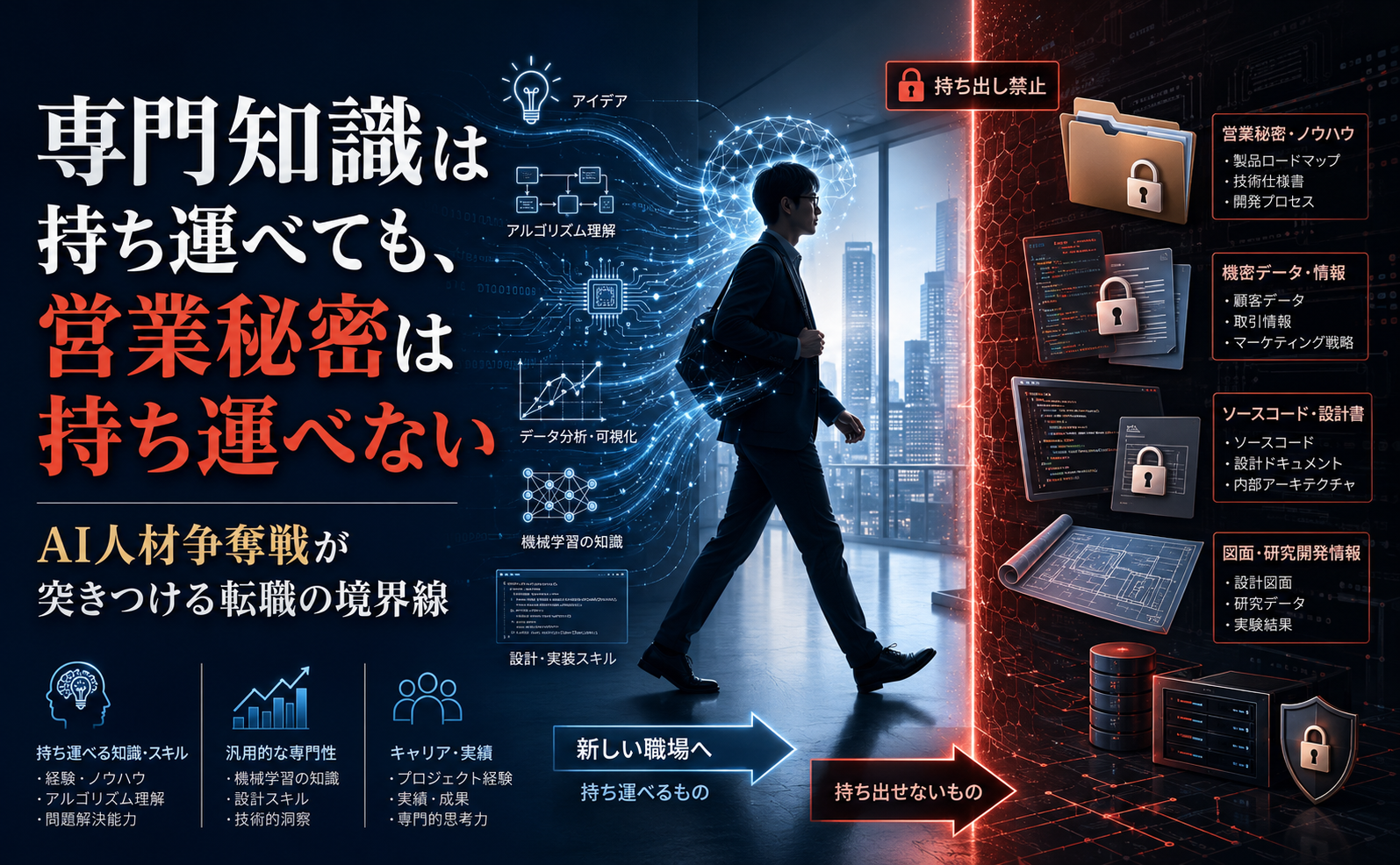
General technical knowledge, industry trends, and the skills and problem-solving abilities developed through professional experience are, in principle, regarded as part of an individual’s accumulated expertise. By contrast, nonpublic research and development information, product plans, design data, source code, customer information, pricing strategies, experimental results, and internal documents may constitute trade secrets or confidential information belonging to the former employer.
In other words, employees may bring their abilities to a new workplace, but they may not bring the former employer’s information assets with them.
In practice, however, the boundary between knowledge and information is not always clear. The more specialized the profession, the more closely an individual’s experience and judgment may be intertwined with proprietary technical information belonging to the former employer. Disputes over this boundary are particularly likely in fields where technological competition is intense, such as AI, semiconductors, drug discovery, and autonomous driving.
“I Created the Document, So I Can Take It With Me” Is Not a Valid Argument
One important point raised by this news is that the removal of trade secrets is not necessarily driven by malicious intent.
Employees sometimes assume that documents they created themselves are also their own personal work product. However, materials prepared as part of one’s employment are ordinarily business work products belonging to the company and are not something the individual creator is free to take away.
Even if an employee personally designed a system specification, compiled a customer list, or prepared an analytical report, the information remains the former employer’s property after the employee leaves if it was created in the course of the company’s business.
Nor is the removal of such materials necessarily justified by explanations such as “I only want to use it as a future reference,” “I only want to study it at home,” or “I need it so I can contribute immediately at my new company.” Forwarding files to a personal email account, saving them to cloud storage, copying them to a USB drive, or downloading them to a personal device can develop into a serious problem even when the employee has no malicious intent.
When an employee changes jobs, the issue is not limited to the employee’s subjective intentions. Objective conduct—what information was transferred, how it was transferred, and where it was sent—is also closely examined.
Job Interviews Can Become an Entry Point for Trade Secret Leakage
Trade secret risks do not arise only after a person joins a new company. They begin during the recruitment and interview process.
When hiring specialists, interviewers often ask detailed questions about a candidate’s previous projects, technical contributions, problem-solving methods, and development achievements in order to assess the candidate’s capabilities. Candidates, in turn, may try to describe their accomplishments in concrete terms so that their abilities will be evaluated favorably.
However, when an explanation becomes too detailed, it may cross into nonpublic information belonging to the candidate’s former employer.
For example, explaining that one participated in the development of a large-scale AI model is different from disclosing the model’s confidential architecture, the composition of its training data, performance-improvement techniques, or development roadmap.
Similarly, describing experience contributing to customer acquisition is different from revealing customer names, contract values, pricing terms, or the status of ongoing negotiations.
A candidate may believe that discussing trade secrets during an interview will help prove past achievements. From the hiring company’s perspective, however, a person who is willing to reveal a former employer’s secrets may also be viewed as someone who could eventually reveal the hiring company’s secrets.
The standard cited in the news—that candidates should not say anything in an interview that they could not say in front of their former employer’s chief legal officer—is an exceptionally practical and easy-to-understand rule.
Hiring Companies Also Have a Responsibility Not to Ask
The responsibility for preventing the disclosure of trade secrets does not rest solely with employees changing jobs.
If a hiring company deliberately asks a candidate about a competitor’s nonpublic technology, customer information, pricing strategies, or research and development plans, the hiring company itself assumes substantial risk. It must also avoid asking a new employee to bring materials from a former workplace or assigning work on the assumption that the employee will use information obtained from the former employer.
Even if the hiring company argues that the employee brought the information without authorization, the company may still become the target of litigation if it uses that information in its business. If the dispute results in an injunction against the sale of products developed using trade secrets or in an award of damages, the resulting losses may greatly exceed any benefit gained from hiring the employee.
Public allegations that a company has used another company’s trade secrets can also damage its reputation. What was intended to be the recruitment of exceptional talent may instead lead to litigation costs, suspended development, distrust among business partners, and deterioration of the company’s brand image.
Companies therefore need to do more than simply ask new employees to confirm that they have not brought confidential information from their former employers. They must also train interviewers and managers in the employee’s new department regarding what information may and may not be requested.
Why Trade Secret Disputes Are Especially Likely in the AI Industry
Trade secret disputes may be particularly likely to increase in the AI industry.
First, the number of professionals capable of working on advanced AI development remains limited, causing talent movements to be concentrated among major companies. It is not unusual for the same engineer to move between competing companies within a relatively short period.
Second, much of the information supporting an AI company’s competitiveness is not necessarily disclosed in patents. Model-training methods, data-selection techniques, inference-efficiency technologies, evaluation metrics, operational know-how, and methods for allocating computing resources may all be managed as trade secrets.
A patent system grants an exclusive right for a limited period in exchange for public disclosure of the technology. Trade secret protection, by contrast, preserves competitiveness by keeping information undisclosed. Because technological progress is rapid in the AI field, companies may sometimes find it more effective to retain know-how as confidential information rather than wait for a patent application to proceed to grant.
Third, AI development makes it particularly difficult to distinguish an individual’s professional expertise from company-specific know-how. Even engineers themselves may be unable to determine precisely whether a method they used routinely is a generally known technique or a proprietary method unique to their former employer.
As competition for talent intensifies, companies naturally seek to put newly hired employees’ knowledge to commercial use as quickly as possible. That urgency, however, may also create pressure to cross the boundary protecting trade secrets.
Protecting Trade Secrets Only at the Time of Departure Is Not Enough
A company cannot adequately protect its trade secrets merely by reminding departing employees of their confidentiality obligations.
First, companies need to clearly classify confidential information while employees are still working for them. Confidentiality markings, access controls, activity logs, and restrictions on external transmissions should be used to continuously maintain information in a properly protected state.
Next, access rights for departing employees must be terminated at an appropriate time, and companies should check for unusual activity, such as mass downloads or external transfers before or after departure. The current lawsuit includes an allegation that a former employee continued accessing the former employer’s confidential information after joining another company. If true, the incident would raise questions not only about the individual’s conduct but also about the adequacy of the former employer’s access controls.
Hiring companies must also take measures to prevent the commingling of information when placing a new employee immediately into work that is identical or similar to that performed for the former employer. They should confirm that no materials from the former employer have been brought in and ensure that all information required for the employee’s work is obtained through the hiring company’s legitimate internal channels.
Depending on the circumstances, companies may also consider temporarily separating the employee from certain development areas, recording the sources of information used, and documenting the history of independent development.
Balancing the Mobility of Skilled Professionals with Intellectual Property Protection
Placing excessive emphasis on trade secret protection could unduly restrict employees’ ability to change jobs and inhibit the circulation of knowledge. Conversely, focusing exclusively on freedom of movement could leave companies unable to protect information assets accumulated through years of investment.
The objective should not be to prevent employees from changing jobs, but to draw an appropriate distinction between an individual’s expertise and a company’s confidential information.
Employees changing jobs should be permitted to apply the abilities they developed at their former workplace, while refraining from removing documents, data, source code, customer information, or nonpublic development details. Hiring companies must clearly commit not to receive, use, or request competitors’ confidential information. Former employers, for their part, must specifically identify their confidential information and implement appropriate protective measures.
When any one of these three parties leaves the boundary unclear, disputes become more likely.
An Era in Which How Information Is Handled Matters More Than What a Person Knows
The outcome of the lawsuit involving Apple and OpenAI will be determined through future court proceedings. The lesson offered by the case, however, is already clear.
The more advanced a professional’s expertise, the more opportunities that person will have to encounter confidential information. Accordingly, sound judgment in handling information has become an essential professional capability alongside technical excellence and extensive experience.
For companies, hiring a person means assuming not only the value of that individual’s knowledge but also the associated information-management risks. A company that treats someone capable of providing a former employer’s confidential information as an immediately productive hire may be accepting substantial long-term legal risk in exchange for short-term gains.
Professional expertise can be fully applied in a new workplace. A former employer’s trade secrets, however, cannot be transferred along with it.
As competition for AI talent becomes more intense, both companies and professionals will increasingly be judged not only by what they know, but also by how they handle the information they possess.