
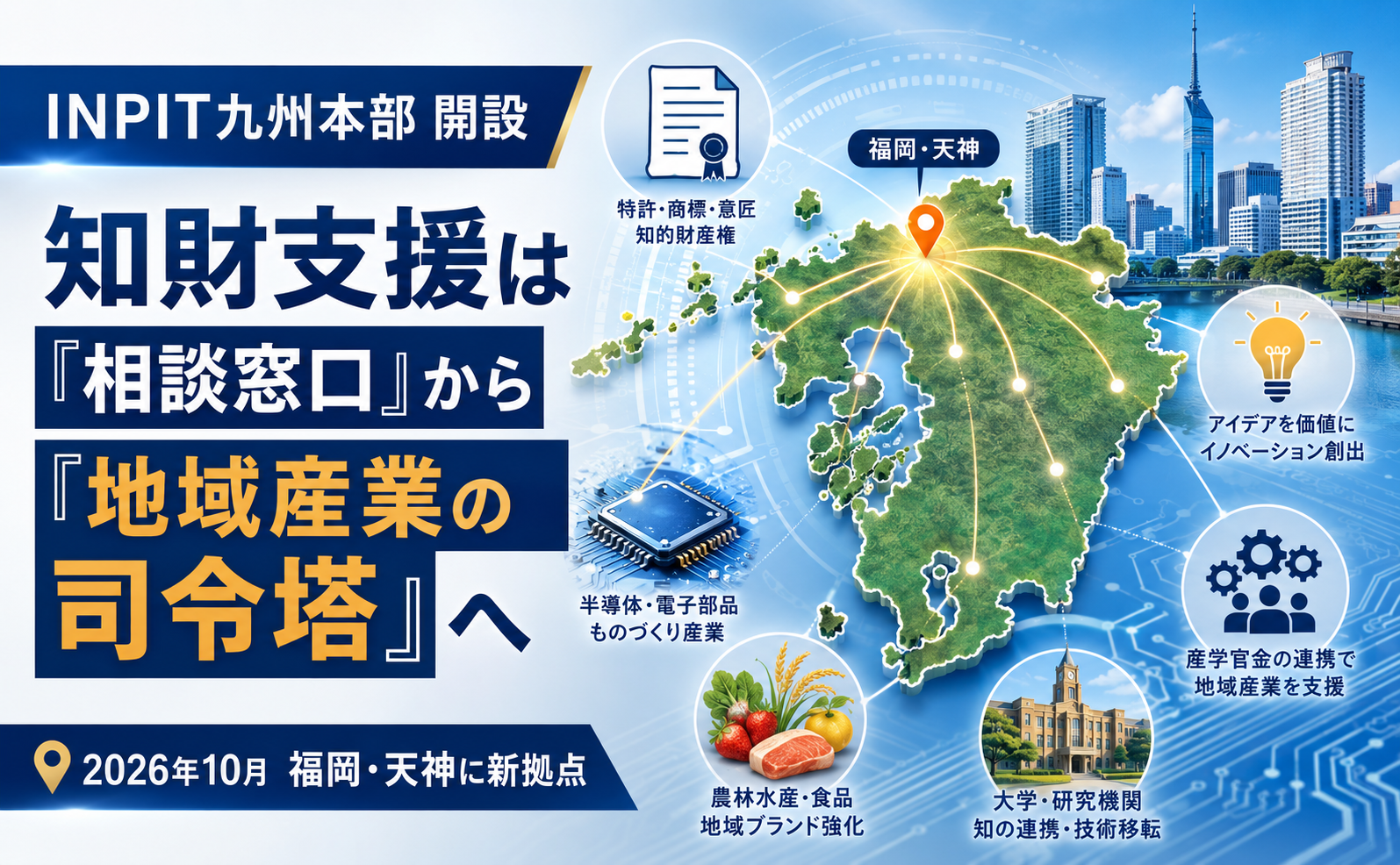
On July 22, 2026, the National Center for Industrial Property Information and Training (INPIT), an independent administrative agency under the jurisdiction of Japan’s Ministry of Economy, Trade and Industry and the Japan Patent Office, announced that it would establish a new regional office in Fukuoka City: INPIT-KYUSHU, or the INPIT Kyushu Headquarters. The office is scheduled to open on October 1, 2026, in Tenjin Business Center II in the Tenjin district of Fukuoka City. Following INPIT-KANSAI in Osaka, it will be INPIT’s second regional office in Japan.
According to news reports, the office will be staffed by seven permanent employees, including two intellectual property strategy specialists, and will respond to inquiries from companies, startups, universities, research institutions, and other organizations throughout Kyushu and Okinawa. INPIT has identified three principal areas of activity: hands-on support by specialists, the development of networks with regional support organizations, and assistance with the use of intellectual property at universities and research institutions.
The establishment of this office should not be understood merely as making intellectual property consultation services previously available in Tokyo and Osaka accessible in Fukuoka as well. Rather, it should be viewed as an effort to align intellectual property policy with the structural transformation currently taking place in Kyushu’s economy.
New Intellectual Property Challenges Created by the Growth of the Semiconductor Industry
One of the major factors behind the establishment of INPIT-KYUSHU is the concentration of semiconductor-related industries, particularly in Kumamoto Prefecture.
Following Taiwan Semiconductor Manufacturing Company’s expansion into Kumamoto, Kyushu has been developing a broad semiconductor supply chain encompassing not only semiconductor manufacturers but also companies involved in manufacturing equipment, materials, components, logistics, facility maintenance, and human-resource development. In this process, regional medium-sized enterprises, small and medium-sized enterprises, and universities will have increasing opportunities to participate in joint research, prototype development, contract manufacturing, technology provision, and other projects with major Japanese and overseas companies.
In these transactions, the key issue is not simply how many patent applications should be filed.
A wide range of questions may arise: Who will own inventions created through joint development? How much of a company’s existing technology should be disclosed to the other party? How should manufacturing conditions and inspection methods be managed as trade secrets? To what extent should the other party be permitted to use the technology after the joint research project has ended?
Small and medium-sized enterprises may possess considerable technical expertise but have no dedicated intellectual property personnel. Such companies risk discovering only after signing an agreement that they are no longer free to use their own technology, or that they have disclosed important know-how to the other party without adequate safeguards.
INPIT-KYUSHU will therefore be expected to do more than explain procedures for obtaining intellectual property rights. It must become involved before companies begin negotiations or enter into agreements and help them consider their technology, contracts, and business strategies as an integrated whole. INPIT itself has cited the prevention of technical know-how leakage, advice on intellectual property agreements, and the creation of barriers to entry for startups as specific examples of the support it intends to provide.
Intellectual Property Can Also Become a Source of Earning Power in Agriculture, Forestry, and Fisheries
Any consideration of intellectual property strategy in Kyushu and Okinawa that focuses solely on manufacturing industries such as semiconductors and automobiles would be incomplete.
Kyushu is home to numerous products and businesses with strong regional identities, including agricultural products, seafood, processed foods, alcoholic beverages, traditional crafts, and tourism services. In these sectors, trademarks, designs, brands, manufacturing know-how, and quality-control methods may be more important sources of competitiveness than patents.
Even when a company develops an outstanding product, failure to register its product name or logo as a trademark may allow others to use a similar name after the business has grown. If distinctive packaging or containers are not protected, their appearance may be copied. If processing methods or formulations are stored in a manner that allows unrestricted access, it may also become difficult to protect them as trade secrets.
When entering overseas markets, businesses may face additional problems. A trademark they have long used in Japan may already be registered in the target country, or they may lose control of their technology or brand through agreements with local distributors or contract manufacturers.
To increase the added value of regional products and expand their distribution channels, businesses need more than advertising and promotion. They require an intellectual property strategy that determines how names, designs, quality, technology, and customer trust should be protected, combined, and utilized. This is presumably why INPIT has identified support for regional product branding as one of its specific areas of assistance.
How Will It Differ from Existing Intellectual Property Consultation Desks?
INPIT Intellectual Property Comprehensive Support Desks have already been established in every prefecture in Japan, including Fukuoka Prefecture. Within Fukuoka Prefecture, consultation offices are available in Tenjin, Yoshizuka, Kitakyushu, and Kurume, where they provide free consultations to small and medium-sized enterprises and other organizations. When necessary, they work with patent attorneys, lawyers, and other professionals and provide follow-up assistance after consultations.
What, then, is the significance of establishing the new INPIT-KYUSHU office?
The important point is not to replace the existing prefectural consultation desks. Rather, the new office is intended to support wide-ranging, specialized, and policy-oriented projects that may be difficult for individual prefectural offices to handle on their own.
For example, matters such as developing supply chains across multiple prefectures, commercializing university-developed technologies, conducting joint research with overseas companies, and building intellectual property portfolios with startup financing in mind cannot be resolved through consultations concerning a single patent or trademark.
They require cross-functional consideration of business strategy, research and development strategy, standardization, contracts, trade secrets, overseas expansion, and financing. INPIT-KYUSHU is therefore expected to function not merely as a contact point connecting regional companies with specialists, but as a coordinator capable of mobilizing multiple support organizations.
INPIT has explained that the new office will build relationships in which regional governments, financial institutions, corporate support organizations, and other stakeholders know one another personally. Rather than treating intellectual property as an isolated subject, it intends to provide support by linking it to the industrial policies and regional challenges of Kyushu and Okinawa.
Turning University Patents from “Intellectual Property That Is Owned” into “Intellectual Property That Is Used”
Kyushu is home to universities and research institutions engaged in fields including semiconductors, space, biotechnology, medicine, energy, agriculture, forestry, and fisheries. However, even excellent research results will not contribute to the growth of regional industries unless they are properly protected and commercialized.
University intellectual property activities require more than simply increasing the number of patent applications. Universities must decide which research results should be disclosed and protected through patents and which technologies should instead be managed as confidential know-how. After obtaining patents, they also need mechanisms for putting those technologies into practical use, such as licensing them to companies, conducting joint research, or establishing university-launched startups.
Regional universities, however, may lack sufficient personnel responsible for intellectual property and technology transfer. INPIT has also pointed out that shortages of personnel capable of supporting intellectual property utilization at regional universities may impede both the practical implementation of research results and the creation of startups.
The impact of the new office will be limited if it merely encourages university researchers to file patent applications. The real test will be whether it can help assess the market potential of research projects, examine possibilities for collaboration with companies, and design the necessary scope of rights and contractual terms.
Three Challenges That Will Determine Its Success
The establishment of INPIT-KYUSHU is highly significant, but simply opening an office will not automatically lead to greater use of intellectual property by regional companies.
The first challenge is whether the office can deliver support throughout Kyushu and Okinawa while being physically located in Fukuoka City.
Although companies in Fukuoka City will find it easier to seek consultations, Fukuoka is not necessarily a convenient location for companies in Miyazaki, Kagoshima, Okinawa, and other distant areas. The office will need to coordinate with the Intellectual Property Comprehensive Support Desks in each prefecture and combine online consultations with systems under which specialists visit companies and universities directly.
The second challenge is to evaluate the office’s activities based on business outcomes rather than the number of consultations.
The number of consultations and seminar participants is easy to measure, but such figures alone do not indicate whether the competitiveness of regional companies has improved. It will be necessary to examine how intellectual property support has changed business performance, including improvements in joint research agreements, reductions in the risk of technology leakage, the generation of licensing revenue, successful fundraising, and the expansion of overseas sales channels.
The third challenge is to develop intellectual property professionals within the region.
It will be difficult for the specialists permanently stationed at the office to provide continuous support to every company and university throughout Kyushu and Okinawa. The office will need to cooperate with patent attorneys, lawyers, financial institutions, chambers of commerce and industry, local governments, university research-support personnel, and other stakeholders while strengthening the support capabilities of each organization.
Rather than attempting to handle every consultation itself, the new office must establish a system under which regional professionals and support organizations can appropriately take over and continue individual cases.
Can Intellectual Property Policy Be Integrated with Regional Industrial Policy?
The establishment of INPIT-KYUSHU demonstrates that intellectual property is no longer an issue relevant only to major corporations and specialists. It is increasingly becoming an integral part of regional industrial policy itself.
Even if a region attracts semiconductor factories, supports research and development, and increases the number of startups, the added value retained within the region will remain limited unless regional companies can properly manage the resulting technologies, know-how, brands, data, and other assets and convert them into revenue.
For technologies and products created in Kyushu to expand throughout Japan and ultimately into overseas markets, intellectual property strategy must be incorporated from the same stage as research and development and capital investment.
The establishment of the new office will be especially meaningful if INPIT-KYUSHU does not remain a passive consultation desk that merely waits for companies to approach it, but instead monitors regional industrial trends and proactively engages with companies, universities, financial institutions, and local governments before problems become apparent.
The real question is not whether the office can provide information about intellectual property. It is whether it can transform the technologies and brands found throughout Kyushu and Okinawa into businesses that generate actual profits. The key point to watch will be whether INPIT-KYUSHU can move beyond being a “regional intellectual property consultation office” and become a “command center that drives the intellectual property strategies of regional industries.”