
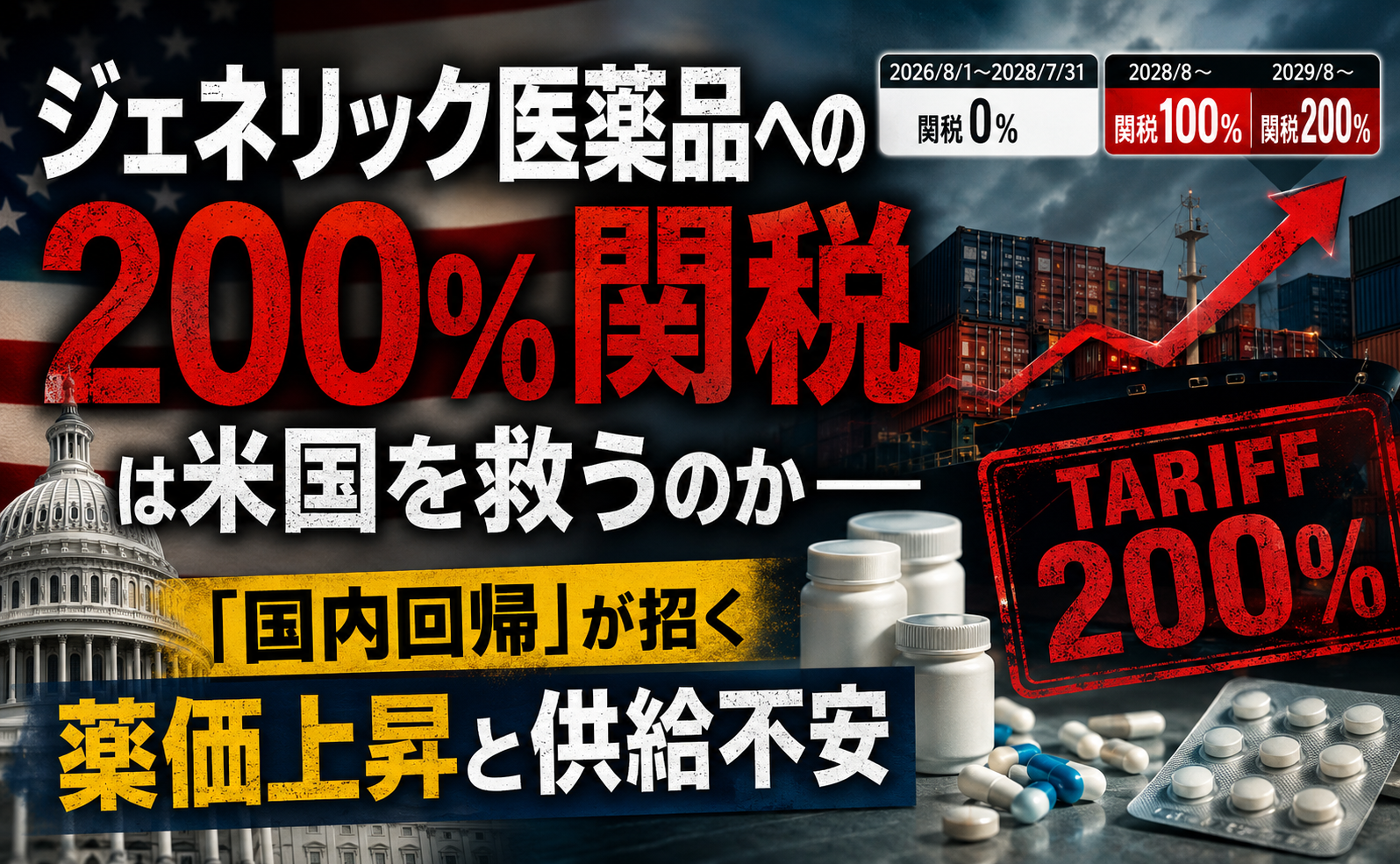
On July 21, 2026, U.S. President Donald Trump announced a plan under which generic drugs imported into the United States would remain tariff-free for two years beginning August 1, 2026, after which the tariff rate would rise to 100% in August 2028 and then to 200% in August 2029.
The objective of this policy is to pressure pharmaceutical companies into manufacturing generic drugs in the United States rather than overseas. However, an extraordinarily high tariff of 200% is not merely an import-adjustment measure. In practical terms, it would come close to excluding generic drugs manufactured outside the United States from the U.S. market. At present, the policy has only been announced by the president on social media. The details of the formal framework—including the specific products covered, country-specific exemptions, and exemption requirements for companies currently building manufacturing facilities in the United States—will need to be closely examined as they emerge.
The Two-Year Tariff-Free Period Is an Ultimatum, Not a Grace Period
A notable feature of the proposal is that the 200% tariff would not take effect immediately. Instead, it provides for a two-year tariff-free period.
This two-year window would serve both as a transition period intended to avoid an abrupt impact on drug prices and as a deadline for pharmaceutical companies to invest in manufacturing facilities in the United States. President Trump’s statement that companies failing to build plants and facilities in the United States within the allotted period would be penalized also indicates that the proposal is primarily an industrial policy designed to relocate manufacturing, rather than a measure intended to generate tariff revenue.
Once tariff rates reach 100% or 200%, it would be difficult for overseas manufacturers to continue exporting to the United States at existing prices. Companies would be left with only a limited set of options: manufacture in the United States, pass the tariff costs on through higher sales prices, continue exporting while accepting reduced profits, or withdraw from the U.S. market.
In other words, this is not a policy that would merely make imported products somewhat more expensive. It is effectively an ultimatum forcing pharmaceutical companies to choose where they will manufacture their products.
Generic Drugs Cannot Absorb High Tariffs
The effects of imposing the same tariff differ significantly between brand-name drugs and generic drugs.
New drugs protected by patents can generally be priced relatively high to allow their developers to recover research and development costs, because competing products containing the same active ingredient cannot easily enter the market during the period of exclusivity. As a result, manufacturers of patented drugs may have some room to absorb higher tariffs or manufacturing costs.
Generic drugs, by contrast, enter the market after patent protection expires. Multiple companies then compete on price, thereby lowering the cost of medicines. Generic drugs account for more than 90% of prescriptions filled in the United States. However, according to industry data, generic drugs and biosimilars together account for only about 12% of total prescription drug spending.
This means that generic drugs are used in very large volumes but generate relatively low prices and profit margins per product.
Companies operating on thin margins cannot absorb tariffs of 100% or 200% through internal cost-cutting efforts alone. The consequences are likely to take the form of higher import prices, increased U.S. sales prices, and the withdrawal of manufacturers from unprofitable product lines. Ultimately, patients and the health insurance system may bear the burden.
Can Production Be Shifted to the United States Within Two Years?
The Trump administration’s objective is clear. The question is whether generic drug manufacturing can realistically be brought back to the United States within such a short period.
According to the FDA, approximately 69% of generic drugs intended for the U.S. market were manufactured outside the United States as of 2025. In addition, only about 9% of manufacturing sites for active pharmaceutical ingredients were located in the United States, compared with 44% in India and 22% in China.
A pharmaceutical plant cannot begin operating as soon as a building and manufacturing equipment are in place. Manufacturers must establish production processes, develop quality-control systems, secure raw materials, train personnel, and obtain FDA approvals and inspections. Procedures may also be required for each product when changing its manufacturing location or production method.
Moreover, even if final dosage-form manufacturing plants are constructed in the United States, the entire supply chain cannot be considered domestic if active ingredients and intermediates continue to be imported from overseas.
A two-year period may be manageable for major companies that already have investment plans in the United States. For small and medium-sized generic manufacturers handling large numbers of low-priced products, however, it may be too short to justify the massive capital investment required.
The Paradox of Tariffs Intended to Protect Medicines Causing Drug Shortages
Drug shortages have long been a problem in the United States.
In particular, long-established products such as injectable drugs are often priced so low that manufacturers struggle to earn sufficient profits to maintain multiple production sites or backup capacity. The U.S. Department of Health and Human Services has also noted that excessively low generic drug prices can weaken supply chains by reducing incentives to invest in manufacturing capacity and supply redundancy.
If a 200% tariff is added to this environment, overseas manufacturers may withdraw from products that are no longer economically viable. If domestic production capacity is not yet ready to replace them, a supply gap could emerge during the transition.
The result would be a paradox: a policy intended to protect Americans from dependence on foreign suppliers could, at least in the short term, raise drug prices, worsen shortages, and increase the burden on patients.
For antibiotics, injectable drugs, emergency medicines, and similar products, reliable availability when needed is just as important as price. Pharmaceutical policy must therefore do more than increase the domestic share of production. It must also provide a transition plan that prevents interruptions in supply.
Tariffs Could Undermine the Price Reductions Created by the Patent System
The proposed policy is also noteworthy when considered in relation to the patent system.
Under the pharmaceutical patent system, companies that develop new drugs receive exclusive rights for a limited period, allowing them an opportunity to recover their research and development investments. Once the patent expires, generic manufacturers are permitted to enter the market. Competition then lowers prices and allows society as a whole to benefit more broadly from the invention.
The system therefore combines exclusivity and competition over time.
However, imposing a 200% tariff on imported products after patent protection has expired and competition has begun would partially offset the price-reducing effects of generic entry. After the legal monopoly created by the patent has ended, the tariff would create a de facto barrier to market entry.
If a sufficient number of manufacturers enter the U.S. market and compete with one another, prices could stabilize over the long term. If domestic production remains concentrated among only a few manufacturers, however, dependence on foreign suppliers may simply be replaced by a domestic oligopoly.
The critical question is not merely whether factories are located in the United States. It is whether the market provides an environment in which multiple companies can continue manufacturing medicines over the long term.
Tariffs Must Be Combined with Other Forms of Support
The policy objective of increasing domestic production of generic drugs has a reasonable basis.
The COVID-19 pandemic and international conflicts have exposed the risks of relying heavily on specific countries for medicines and active pharmaceutical ingredients. From the perspectives of national security and public health, the need to maintain a certain level of domestic production capacity cannot be dismissed.
Nevertheless, tariffs alone have clear limitations as a means of achieving that objective.
They should be combined with subsidies and tax credits for constructing U.S. manufacturing facilities, accelerated FDA reviews, long-term government purchasing contracts, procurement systems that reward companies for maintaining stable supplies, and strategic stockpiles of essential medicines.
The FDA has, in fact, launched a pilot program that gives review priority to applications for generic drugs manufactured and tested in the United States.
A sustainable reshoring strategy requires more than the “punishment” of excluding foreign products through high tariffs. It must also provide “rewards” that enable companies manufacturing continuously in the United States to remain profitable.
Success Will Be Determined by Drug Prices and Supply, Not the Number of Factories
President Trump’s proposed 200% tariff could fundamentally transform the global manufacturing system for generic drugs.
During the two-year tariff-free period, many companies may announce plans to construct manufacturing facilities in the United States. However, the success of the policy cannot be judged solely by the number of investment announcements or factories built.
The real questions are whether patients will continue to obtain necessary medicines at prices comparable to current levels, whether supplies of essential but unprofitable medicines will be maintained, and whether sufficient competition will exist in the domestic market.
Generic drugs are a vital part of the social infrastructure that keeps U.S. healthcare costs under control. Imposing a 200% tariff on them would affect people’s daily lives far more directly than imposing tariffs on ordinary industrial goods.
Even if manufacturing is successfully brought back to the United States, the policy cannot be said to have achieved its objective of protecting Americans if the price of that reshoring is higher drug costs and more severe shortages.
The proposal is therefore about more than whether tariffs can bring factories back to the United States. It is likely to become a major policy experiment testing how the country can simultaneously achieve three objectives: affordability, stable supply, and economic security.