
Introduction
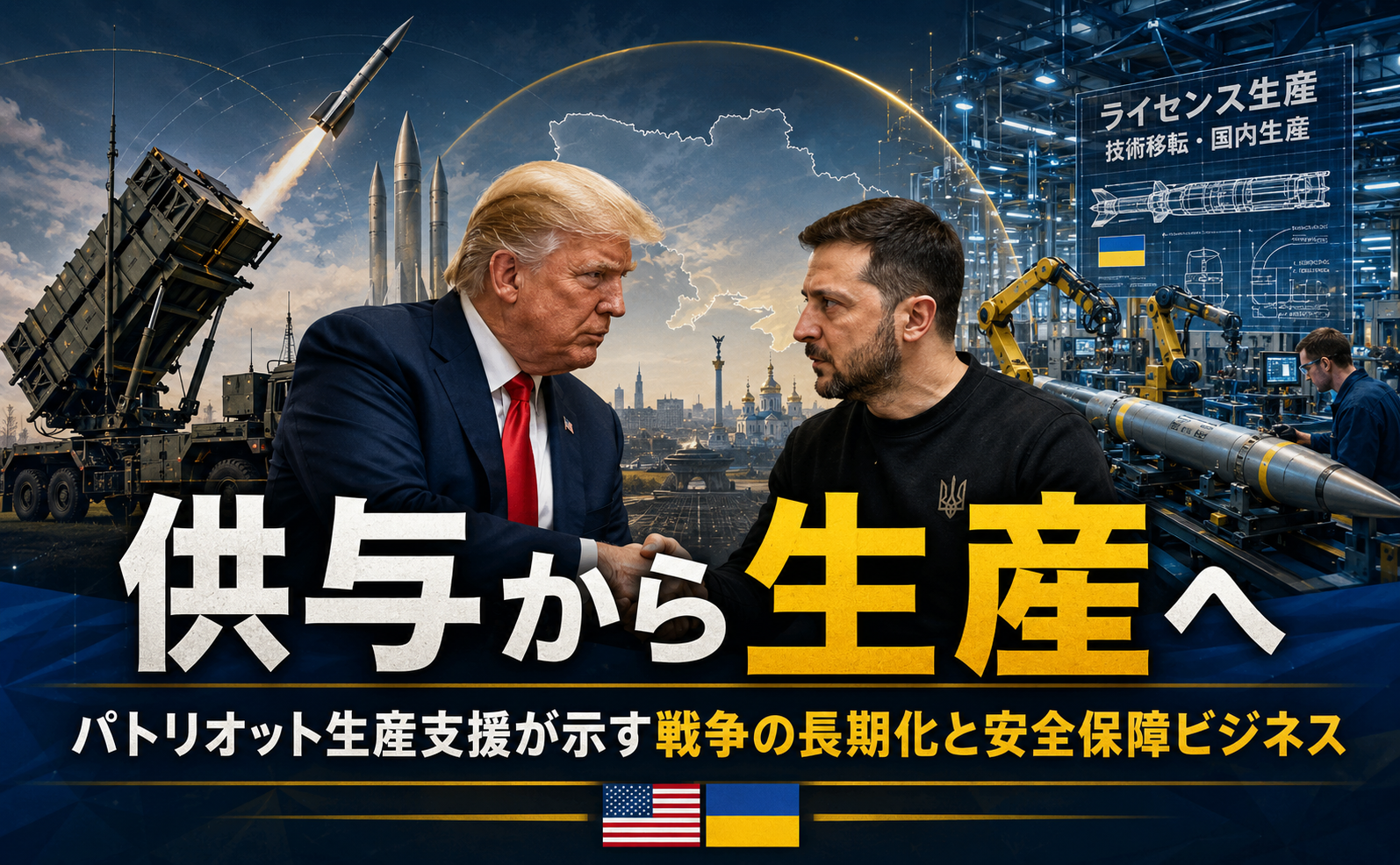
In a meeting with Ukrainian President Volodymyr Zelenskyy, whose country continues to face Russia’s invasion, U.S. President Donald Trump indicated his intention to grant Ukraine a license to produce, within Ukraine, interceptor missiles used in the U.S.-made Patriot surface-to-air missile system. Ukraine has made the strengthening of its air defense capabilities one of its highest priorities in response to Russian missile and drone attacks. At the same time, shortages of U.S. inventories and limits on production capacity have become major constraints on the supply of interceptor missiles. This latest move suggests a possible shift away from the mere provision of weapons toward a framework in which Ukraine itself can continuously secure air defense equipment. According to reports, the United States and Ukraine are said to have reached a political-level agreement on the licensed production of Patriot interceptor missiles, with Ukraine placing emphasis on an early start to domestic production.
Ukraine Support Has Entered a Stage Where Provision Alone Is No Longer Enough
The most important point in this news is that the focus of support is expanding from “handing over finished products” to “transferring the right and ability to produce.”
In the war in Ukraine, a wide variety of attack methods continue to be used, including drones, cruise missiles, ballistic missiles, and glide bombs. Countering these threats requires not only one-off large-scale assistance, but also a system that can continuously replenish interceptor missiles. The Patriot is a highly capable air defense system, but its interceptor missiles are expensive and take time to produce. If demand surges, the inventories of the United States and its allies alone cannot fully meet the need. President Zelenskyy has also indicated his view that the current level of Patriot production is insufficient to meet demand for ballistic missile defense.
In that sense, licensed production carries great significance for Ukraine. If Ukraine becomes able to manufacture interceptor missiles domestically, it can reduce the time spent waiting for supplies and, in the long term, enhance the sustainability of its air defense network. This can also be seen as a move that brings Ukraine closer to becoming an active participant in defense production, rather than merely a recipient of support.
Licensed Production Is Not a “Magic Solution”
However, even if licensed production is approved, this does not mean that the missile shortage will be resolved immediately. Rather, the difficult stage begins from here.
Patriot interceptor missiles are weapons that integrate advanced guidance systems, propulsion systems, sensors, electronic components, quality control, and testing facilities. They cannot be mass-produced immediately simply by obtaining blueprints and manufacturing rights. A large number of conditions must be met, including the establishment of production lines, the securing of parts supply chains, the training of engineers, quality assurance, the management of classified information, and protective measures to defend factories against Russian attacks. Reports have also suggested that it will take time before actual production begins in Ukraine.
In other words, this agreement should be viewed not as an immediate remedy for short-term ammunition shortages, but as a strategic step toward building a medium- to long-term defense industrial base. For the time being, the problem of how to make up for the current shortage of interceptor missiles will inevitably depend on supplies from the United States and Europe.
Where Intellectual Property and Security Overlap
This news also shows that patents and licenses are at the heart of security policy.
Military technology has value not only in the “weapon itself,” but also in design concepts, manufacturing know-how, component structures, software, testing methods, and maintenance procedures. Licensed production is a framework under which intellectual property and manufacturing know-how held by U.S. companies are made available to Ukraine under certain conditions. Unlike ordinary commercial licenses, export controls, confidentiality, restrictions on transfers to third countries, control of parts suppliers, and restrictions on the use of manufactured missiles become especially important.
In the case of an advanced air defense system such as the Patriot, the issue is not simply one of paying patent royalties. Questions such as which technologies will be disclosed, which processes will be carried out inside Ukraine, which parts will be supplied by the United States or allied countries, and who will bear responsibility for the management of finished products are all major security concerns.
In this sense, the licensed production now under discussion is both an “use of intellectual property” and a strategic decision about how far military technology should be transferred to allies and friendly countries.
The Political Meaning for the Trump Administration
President Trump’s remarks also carry political significance for a domestic U.S. audience.
If the United States continues to provide large quantities of finished missiles, criticism over the fiscal burden on the United States and shortages in its own inventories is likely to grow. By contrast, if Ukraine is given production rights, it becomes possible to explain the policy not as “the United States bearing everything,” but as “enabling Ukraine itself to acquire production capacity.”
Trump’s statement that the United States would “give them the right to produce” and “teach them how to do it” can also be read as a political message regarding the burden of support. It is likely intended to show U.S. public opinion, which is cautious about support for Ukraine, that the policy is not one of unlimited provision, but of helping Ukraine build self-sustaining defense capabilities.
From Ukraine’s perspective, meanwhile, this statement is also a diplomatic achievement that draws out continued U.S. involvement. In particular, amid concerns that U.S. support for Ukraine may become unstable under the Trump administration, obtaining an institutional framework in the form of licensed production has significance in enhancing the continuity of support.
Ripple Effects on Europe’s Defense Industry
This move will also affect Europe. Ukraine is not only relying on U.S.-made Patriots, but is also asking Europe to develop and produce low-cost air defense systems capable of mass production. According to reports, Ukraine has indicated its intention to pursue discussions on alternative anti-missile systems that can be mass-produced in Europe.
For Europe as well, the shortage of air defense missiles is not only Ukraine’s problem. As the Russian threat becomes prolonged, NATO countries themselves also need to strengthen their air defense capabilities. To balance supplies to Ukraine with the securing of inventories for their own defense, European countries need to expand production capacity within Europe.
Therefore, the United States’ acceptance of licensed production may also put pressure on Europe to raise defense production from a peacetime standard to a wartime standard.
Impact on Peace Negotiations
This announcement is not unrelated to diplomacy aimed at ending the fighting. President Trump has indicated his intention to hold a telephone call with President Putin after his meeting with President Zelenskyy, and has also referred to efforts to arrange direct talks between the two leaders. Reports have also conveyed that, while peace talks remain stalled, Trump continues diplomatic contacts with both Russia and Ukraine.
However, from Russia’s perspective, the licensed production of air defense missiles will appear to be a move that increases Ukraine’s ability to continue fighting. As a result, it may provoke a Russian backlash in the short term. On the other hand, if Ukraine’s air defense capabilities improve, the effectiveness of Russia’s strategy of exhausting Ukrainian society through missile attacks will be weakened. This may, in turn, have the effect of increasing negotiation pressure on Russia.
In the reality of security policy, diplomacy and military assistance often proceed simultaneously. Even when the goal is a ceasefire or peace, entering negotiations from a weak position can force a country to accept unfavorable terms. For Ukraine, strengthening air defense capabilities is important not only to protect its cities, but also to maintain its negotiating position.
The Key Question Is “When and How Much Can Be Produced?”
Symbolically, this announcement is a major step. In practical terms, however, the key question is “when and how much can be produced?”
Air defense missiles are meaningful only if they are available in the necessary quantities when they are needed. If it takes months or years to begin production, the question becomes how to fill the air defense gap during that period. In addition, because factories inside Ukraine may become targets of Russian attacks, it will also be important to decide whether production sites should be located inside Ukraine or dispersed abroad, including in Europe.
Furthermore, the question of who will bear the costs of missiles manufactured through licensed production is also a major issue. The actual scale of production will vary greatly depending on how contracts involving the Ukrainian government, the United States, Europe, international support frameworks, and private companies are combined.
Conclusion
The latest move concerning the licensed production of Patriot interceptor missiles shows that support for Ukraine has entered a new phase. Merely providing finished products cannot fully address a prolonged war and mass consumption of weapons. What is needed is to raise the defense production capacity of Ukraine itself, and of the West as a whole.
At the same time, licensed production is not a short-term cure-all. It involves many challenges, including advanced technology, parts supply, quality control, factory protection, cost sharing, and export controls. To make this announcement effective, political agreement must be translated into concrete contracts, capital investment, human-resource development, and parts supply chains.
What this news demonstrates is the reality that, in modern warfare, the decisive issue is not only whether a country possesses weapons, but whether it can continue producing them. The licensed production of Patriot missiles can be seen not only as a measure to support Ukraine’s air defense, but also as a symbolic event in an era when intellectual property, the defense industry, alliance politics, and peace negotiations are increasingly intertwined.