
Introduction
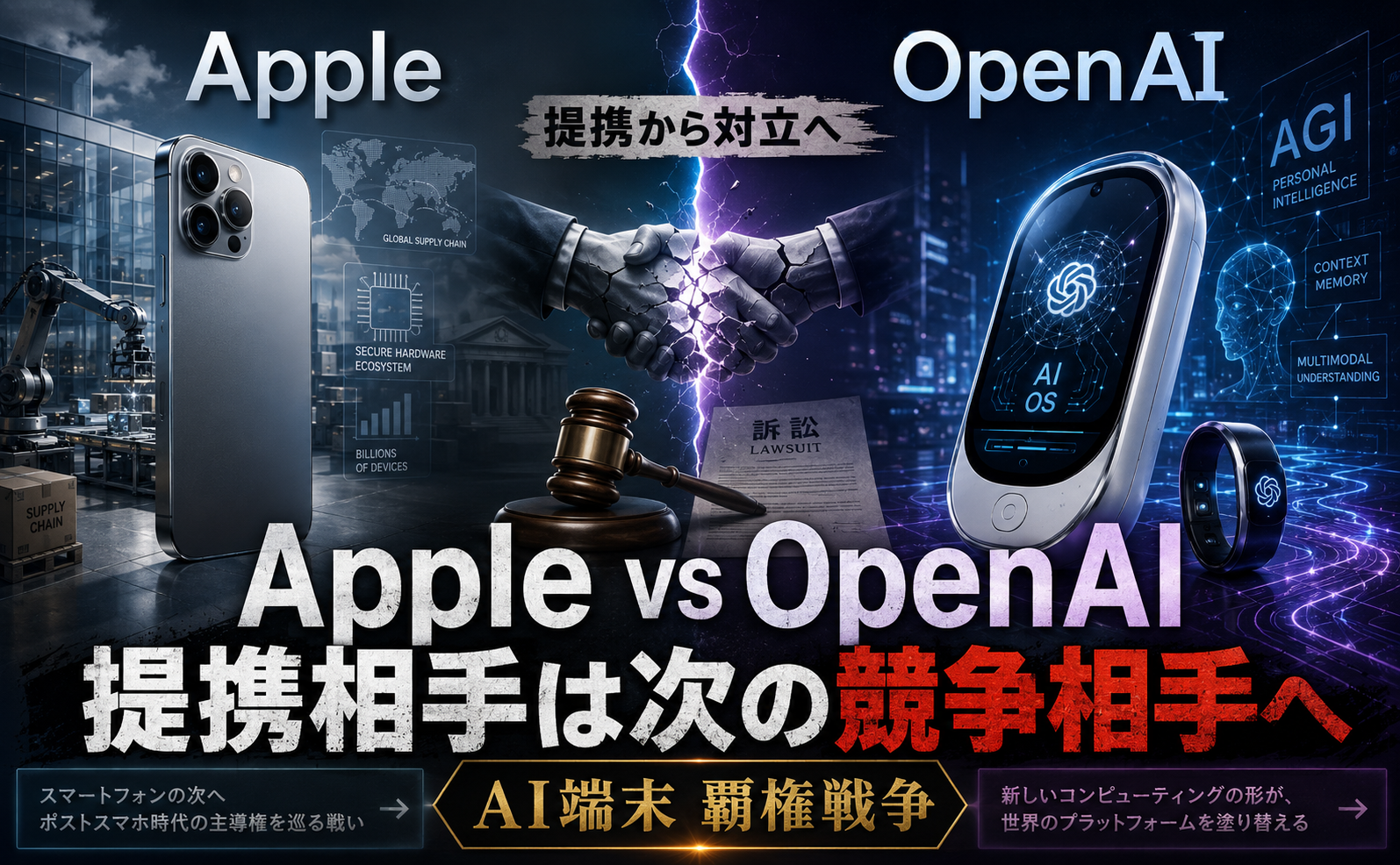
On July 10, 2026, Apple filed a lawsuit in the U.S. District Court for the Northern District of California against OpenAI, its subsidiary io Products, OpenAI Chief Hardware Officer Tang Yu Tang, and former Apple employee Chang Liu.
Apple alleges that OpenAI systematically obtained trade secrets concerning unreleased products—including information about designs, manufacturing processes, components, and suppliers—by recruiting former Apple employees and contacting Apple’s business partners, and that it intended to use this information in developing its own consumer hardware. OpenAI has responded that it has no interest in other companies’ trade secrets and is focused on developing its own innovative technologies. At this stage, these remain allegations made by Apple and have not been established as facts by a court.
Apple and OpenAI have built a cooperative relationship that enables users to access ChatGPT through Apple Intelligence and Siri. Behind the scenes, however, OpenAI has been developing its own AI devices and moving closer to the hardware market at the core of Apple’s business.
This lawsuit is more than a dispute over the alleged misappropriation of trade secrets. It can be seen as the beginning of a competition over the next-generation platform: will leadership in the AI era belong to the company that controls the smartphone, or to the company that controls the AI itself?
A Relationship in Which Cooperation and Competition Advance Simultaneously
In 2024, Apple announced that it would integrate ChatGPT into Apple Intelligence, allowing Siri to use ChatGPT’s responses when appropriate. For Apple, this arrangement offered the advantage of gaining access to OpenAI’s high-performance models while its own generative AI technology remained under development. For OpenAI, gaining access to iPhones and Macs used around the world appeared to represent a major business opportunity.
However, the benefits expected by the two companies do not appear to have been fully aligned. According to reports, OpenAI expected its partnership with Apple to increase paid ChatGPT subscriptions and deepen integration with Apple applications. When those expectations were not met and negotiations to revise the agreement failed to progress, OpenAI reportedly considered legal options, including asserting that Apple had breached the agreement.
From Apple’s perspective, OpenAI is an AI service provider that supplements the functionality of Apple products. From OpenAI’s perspective, however, the iPhone is merely a distribution channel it borrows to reach users.
As long as OpenAI depends on Apple’s platform, matters such as access to users, payment methods, and the extent of integration with default applications remain subject to Apple’s decisions. To escape those restrictions, OpenAI needs a device of its own through which it can connect directly with users.
The partnership between the two companies therefore contained, from the outset, a structural tension that could ultimately lead to competition.
The Real Issue Is Not Changing Jobs, but Taking Information
Apple claims that more than 400 former Apple employees now work for OpenAI. However, the mere fact that a competing company recruits talented engineers is not, in itself, unlawful.
In Silicon Valley in particular, new industries have grown as engineers moved between companies and brought their knowledge and experience with them. Excessively restricting employee mobility may protect trade secrets, but it may also hinder technological innovation and free competition.
The important question in this lawsuit is not whether former Apple employees used general knowledge and skills acquired at Apple in their work for OpenAI. The question is whether specific Apple design documents, technical specifications, information about unreleased products, supplier information, or similar materials were improperly removed and then used by OpenAI.
Apple alleges that Liu failed to return a company-issued laptop after leaving Apple, exploited an authentication problem to access Apple’s systems, and obtained dozens of files, including documents concerning unreleased products. Apple also alleges that, before leaving the company, Tang sent supplier information and other materials to himself and later attempted, during OpenAI recruitment interviews, to persuade Apple employees to bring design documents and prototypes.
If these allegations are proven, the matter would go beyond ordinary competition for talent and raise issues of unlawful acquisition and use of trade secrets. Conversely, unless Apple can demonstrate precisely which information qualified as a trade secret, how it was transferred to OpenAI, and how it was used in OpenAI’s development activities, it may be difficult to establish that broad-based recruitment amounted to “systematic theft.”
Apple Is Protecting More Than Its Products
Apple’s competitiveness does not rest solely on the appearance of the iPhone or on individual components.
Apple’s strength lies in its ability to manage design, materials, manufacturing equipment, surface treatment, quality control, component procurement, and mass-production processes as an integrated system, enabling it to supply hundreds of millions of products at a consistent level of quality. Producing one excellent prototype and manufacturing the same product at scale and with consistent quality are entirely different challenges.
In the present case, Apple also alleges that OpenAI contacted Apple’s business partners and attempted to make use of Apple’s proprietary metalworking and surface-treatment technologies. If true, the dispute would extend beyond the removal of drawings or data. Apple’s supply chain itself, built over many years, could become the subject of a trade-secret dispute.
OpenAI possesses the ability to develop some of the world’s leading AI models. However, it is not a company with extensive experience in every stage of the consumer-device business, from design and manufacturing to certification, procurement, repair, and sales.
Accordingly, if OpenAI seeks to establish a hardware business within a short period, the knowledge held by former Apple employees and Apple’s suppliers would be extremely valuable. At the same time, this creates a difficult boundary question: how much of that knowledge belongs to an individual’s experience, and at what point does it become an Apple trade secret?
OpenAI’s Vision for the Post-Smartphone Era
In 2025, OpenAI brought io Products, a company involving former Apple Chief Design Officer Jonathan Ive, under its corporate umbrella. Ive and OpenAI CEO Sam Altman have been working to develop a new type of computer and a broader family of products suited to the AI era.
OpenAI’s objective is unlikely to be limited to selling a small device dedicated exclusively to ChatGPT.
With today’s smartphones, users select applications, operate screens, and call up the services they need. By contrast, an AI device is expected to understand the user’s circumstances and objectives and perform tasks across multiple services.
As such devices become widespread, users may become less conscious of individual applications. Because AI would control the gateway to search, shopping, reservations, payments, communications, and other services, the relative importance of operating systems and app stores could decline.
There have also been reports that OpenAI is considering processors optimized for AI smartphones and an “AI-first” smartphone. Whether these plans will be realized remains uncertain, but it is clear that OpenAI intends to move beyond the conventional boundaries of a software company and take direct ownership of its relationship with users.
For Apple, an OpenAI device would not merely represent one additional competing product. It could alter the structure of digital life currently centered on the iPhone.
Litigation Can Also Be Used to Slow Development
Apple is seeking not only damages but also orders requiring OpenAI and the other defendants to stop using Apple’s trade secrets and return related materials.
If Apple obtains an injunction, OpenAI may be required to reexamine the design, components, manufacturing processes, supplier communications, and other aspects of the devices it is developing. Design changes or changes in suppliers may become necessary to confirm that no Apple information has been used.
The litigation may also subject emails, internal messages, design records, recruitment-interview materials, and other documents to discovery. For OpenAI, this creates a risk that details about unreleased products and internal decision-making processes may be disclosed.
Therefore, even if Apple does not ultimately prevail on every claim, the continuation of the litigation itself could impose a substantial burden on OpenAI’s hardware development.
However, Apple’s lawsuit should not automatically be dismissed as an attempt to obstruct a competitor. If a company discovers specific unauthorized access or the removal of confidential documents, it is entirely reasonable for that company to take legal action to protect its intellectual property.
The critical issue is whether Apple can specifically identify the trade secrets entitled to protection and establish a causal connection between their unlawful acquisition and their use by OpenAI.
Will the Apple–OpenAI Partnership Continue?
Although the two companies are now set to confront each other in court, this does not necessarily mean that the integration of ChatGPT with Apple products will immediately end.
Apple needs to use external models to expand its generative AI capabilities. OpenAI, for its part, is unlikely to relinquish lightly an environment that gives it access to the enormous number of people who use Apple products.
The two companies may therefore continue cooperating in one area, compete in another, and attack each other in court at the same time.
This phenomenon is not limited to the AI industry. Modern technology giants may be customers in cloud computing, partners in AI, and competitors in devices, with their relationships varying from one field to another.
What this lawsuit has revealed is that the partnership between Apple and OpenAI was not a long-term alliance founded on mutual trust, but a pragmatic transaction in which each side temporarily compensated for the other’s weaknesses.
If OpenAI’s own devices begin to compete directly with Apple products, the conflict of interest between the two companies will become even more pronounced.
In the AI Era, Talent Management Is Also an Intellectual Property Strategy
This case also demonstrates the importance of managing departing employees and controlling access privileges.
In an environment where design materials are stored in the cloud and can be accessed from outside the company, merely recovering company-issued devices is not enough to prevent information leaks. Companies need systems that deactivate authentication credentials as soon as employment ends, monitor access logs, and detect unusual downloading activity.
The hiring company also has responsibilities. When recruiting engineers from competitors, it must clearly instruct them not to bring materials from their former employers and establish procedures that prevent interviewers from asking for confidential information during recruitment.
In fields such as AI and hardware, where competition for talent is particularly intense, companies must manage at an organizational level the boundary between recruiting talented employees and obtaining the trade secrets of their former employers.
A system designed to prevent incoming employees from bringing trade secrets is not merely an ethical precaution. It has become an important business strategy for preventing new ventures from being halted by litigation.
Conclusion
The Apple–OpenAI lawsuit concerns whether trade secrets were actually acquired unlawfully. At this stage, Apple’s allegations cannot be treated as established facts.
Nevertheless, the lawsuit reflects a much larger transformation in the industrial structure.
Until now, OpenAI has provided AI services on devices and operating systems built by other companies, including the iPhone and Windows. It is now attempting to develop hardware of its own and take direct control of its relationship with users.
For Apple, this movement is not simply the entry of a new competitor. It could change the smartphone usage model centered on applications, screens, and operating systems, thereby diminishing the relative importance of the iPhone.
For that reason, the lawsuit is both an attempt to address the alleged misappropriation of information in the past and, potentially, a preemptive strike in the race to develop the next generation of devices.
The winner in the AI era will not necessarily be the company with the most powerful AI model. It will be the company that also controls the devices through which people use that AI every day, together with the associated design capabilities, manufacturing networks, and distribution channels.
The conflict between Apple and OpenAI shows that the competition to determine who will create “what comes after the smartphone” has already moved beyond laboratories and product launches. It is now unfolding in the recruitment market, throughout the supply chain, and in the courtroom.