
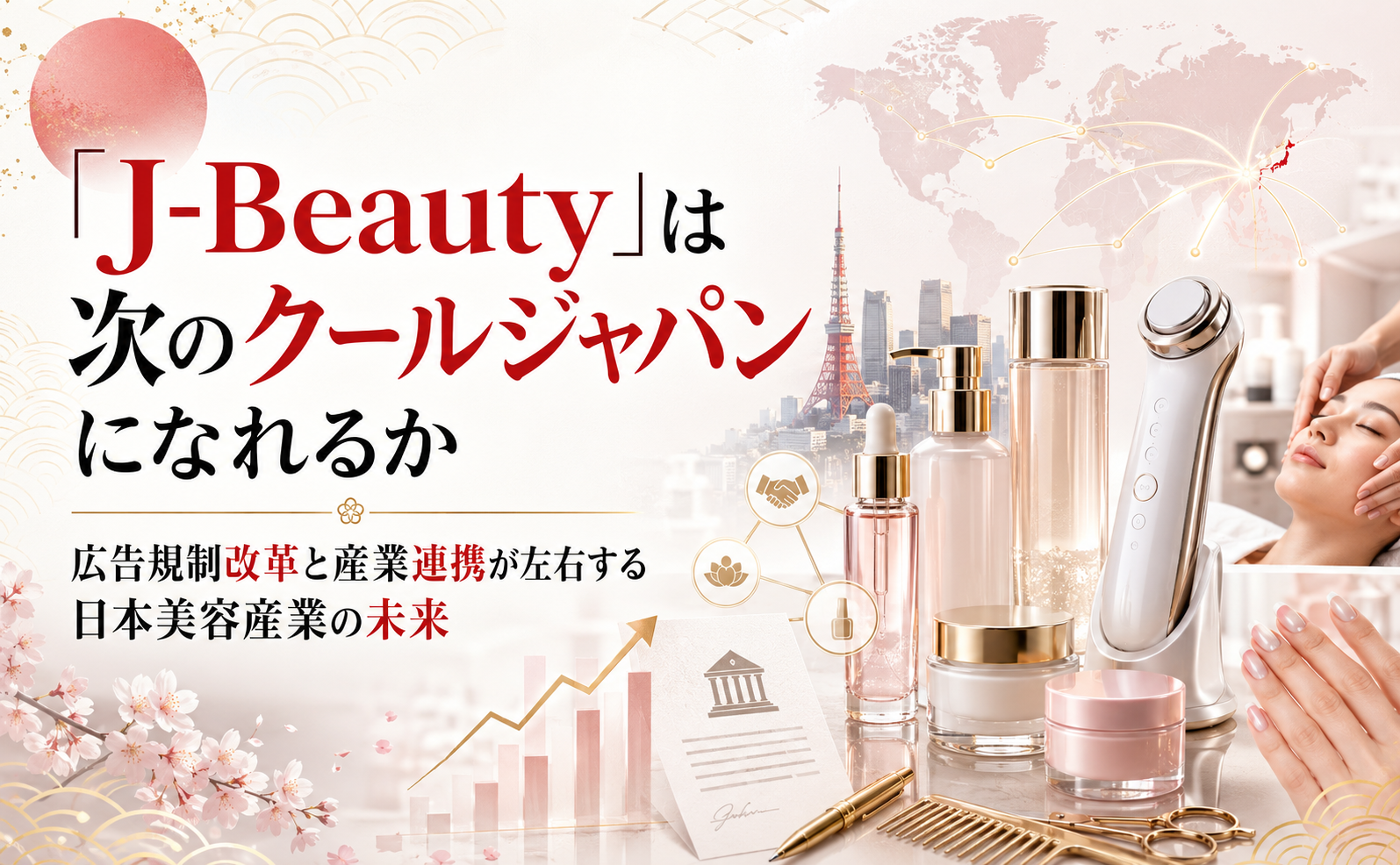
“J-Beauty” Becomes Part of the Government’s Growth Strategy
On July 13, 2026, the J-Beauty Industry Study Group, composed of lawmakers from Japan’s Liberal Democratic Party and chaired by Internal Affairs and Communications Minister Yoshimasa Hayashi, held its eighth meeting at the House of Councillors Members’ Office Building and reported on the progress of the recommendations it had submitted to the government in May.
At the meeting, participants reported that “J-Beauty” had been incorporated into three of the government’s key policy documents: the Basic Policy on Economic and Fiscal Management and Reform, the Action Plan for a New Form of Capitalism, and the Intellectual Property Strategic Program 2026. They also discussed preparations to establish a provisional “J-Beauty Industry Consortium” by the end of the year, bringing together not only cosmetics manufacturers but also businesses involved in beauty devices, hair and beauty services, nail care, esthetics, and OEM and ODM manufacturing. The review of cosmetics advertising regulations was another major topic.
The Japanese government has set a target of expanding Cool Japan-related industries to ¥50 trillion by 2033. As part of this strategy, efforts are accelerating to promote the beauty industry overseas under the unified “J-Beauty” brand.
Until now, initiatives in Japan’s beauty sector have often been undertaken by individual companies or separate industries. The fact that the government has now positioned the sector as a single industrial cluster within its national growth strategy marks a significant turning point.
Expanding from Cosmetics to the Entire Beauty Industry
One of the most noteworthy aspects of the current initiative is that J-Beauty is not being limited to cosmetics alone.
In addition to cosmetics manufacturers, the consortium is expected to include a broad range of businesses involved in beauty devices, beauty appliances, OEM and ODM manufacturing, hair and beauty services, nail care, and esthetics. Working groups are also expected to be established to examine overseas strategies, brand certification systems, and measures against illegal advertising.
Japanese beauty-related companies have strengths in areas such as rigorous quality control, safety, refined product textures and user experiences, and attentive customer service. In overseas markets, however, these qualities are not necessarily recognized as part of a single, coherent value proposition representing Japan’s beauty industry.
By promoting cosmetics, beauty devices, salon techniques, customer service, research and development, and manufacturing expertise as an integrated package, Japan may be able to transform its distinctive beauty culture into greater economic value.
The defining feature of this policy is that it seeks not merely to export cosmetics made in Japan, but to establish a comprehensive industry brand encompassing beauty-related products, technologies, services, and experiences.
Will Advertising Reform Strengthen Competitiveness?
Any discussion of J-Beauty’s overseas expansion must address the issue of cosmetics advertising regulations.
Japan’s Ministry of Health, Labour and Welfare is considering revising the Standards for Fair Advertising Practices of Pharmaceuticals and Related Products during fiscal 2027 so that numerical data and user testimonials can be used in advertisements for medicated cosmetics.
The government has also indicated that it may shift the regulation of cosmetic efficacy claims from the current whitelist system, under which only 56 specified types of claims are permitted, to a blacklist system that identifies expressions that are prohibited.
Under Japan’s current framework, companies may find it difficult to communicate research data or test results to consumers through advertising, even when they possess sufficient supporting evidence. Overseas brands, by contrast, make extensive use of numerical data, comparative testing, and user evaluations to communicate product characteristics in an accessible manner.
This disparity is not merely a matter of advertising language. It also affects whether companies can recover their investments in research and development and how they plan new products.
Even when a company develops an outstanding technology, its economic incentive to invest in that technology is weakened if it cannot explain its value to consumers. Reforming advertising regulations therefore has implications not only for sales promotion but also for industrial policy aimed at encouraging research and development by Japanese companies.
A transition to a blacklist system, however, would require amendments to the Pharmaceuticals and Medical Devices Act. Given the time required for institutional design and parliamentary deliberations, discussions need to begin at an early stage if Japan is to avoid falling further behind overseas competitors.
Deregulation and Measures Against Illegal Advertising Must Go Hand in Hand
While companies should be given greater freedom in how they communicate product benefits, stronger measures against false and exaggerated advertising are also essential.
Japan’s Ministry of Internal Affairs and Communications is revising its Guidelines on Illegal Information to clarify how illegal advertisements on social media and websites should be handled. The aim is to encourage platform operators to remove false or exaggerated advertisements concerning pharmaceuticals and cosmetics.
In recent years, information channels have become increasingly complex. Consumers now encounter not only official corporate advertising but also influencer promotions, affiliate advertisements, online reviews, and advertisements on cross-border e-commerce platforms. The respective responsibilities of advertisers, advertising agencies, sellers, content creators, and platform operators have consequently become less clear.
Japan needs a system that gives companies with legitimate supporting evidence greater freedom of expression while responding firmly to unsupported advertising and claims that mislead consumers.
Deregulation alone could lead to an increase in exaggerated advertising and damage confidence in the J-Beauty brand as a whole. Conversely, maintaining excessively strict regulations could place companies that conduct responsible research and development at a competitive disadvantage.
The success of regulatory reform will depend on whether Japan can strike an appropriate balance between freedom of expression and the credibility of advertising.
The Difference with South Korea Is Not Limited to Advertising Rules
The meeting also addressed competition with South Korea’s beauty industry.
K-Beauty has increased the speed with which products move from development to market not only through effective social media communication and branding strategies, but also through a specialized division of labor centered on ODM and OEM companies.
Brand companies with strong planning capabilities work efficiently with ODM and OEM companies responsible for formulation development and manufacturing. This structure enables them to commercialize new ingredients and trends within a short period of time. Products can initially be introduced on a small scale to assess market reactions, and successful products can then be rapidly expanded.
Japanese companies, by comparison, tend to place greater emphasis on quality, safety, and long-term brand development. These are important strengths, but they can also lengthen decision-making and product-development processes, making it more difficult to respond quickly to changes in the market.
Revising advertising regulations alone will therefore not be sufficient to strengthen the competitiveness of Japanese companies. Japan must also reform its industrial structure by improving coordination among research and development, manufacturing, sales, logistics, and marketing and by shortening the time required to bring products to market.
“Made in Japan” Alone Does Not Create a Brand
A brand certification system will be an important element in the future development of J-Beauty.
Simply indicating that a product comes from a Japanese company or was manufactured in Japan will not, by itself, create internationally recognized brand value.
Japan must clearly define what the J-Beauty brand guarantees.
Possible shared values could include safety, quality control, scientific evidence, environmental responsibility, transparency in manufacturing processes, refined product textures and user experiences, and services tailored to individual users.
If the number of participating companies is increased while certification standards remain vague, the brand name may spread while product quality becomes inconsistent. On the other hand, if the standards are excessively strict, small and medium-sized enterprises and emerging companies may find it difficult to participate.
The challenge will be to design a system that maintains confidence in J-Beauty as a unified brand while remaining accessible to a diverse range of businesses.
Preventing the Consortium from Becoming Just Another Discussion Forum
The J-Beauty Industry Consortium aims to launch a preparatory committee in September and establish a general incorporated association in December.
An organization involving a broad range of industries can play an important role in policy advocacy and information sharing. The greater the number of participants, however, the more time consensus-building may require because of differences in the interests and priorities of each sector.
To become an effective organization, the consortium must quickly launch initiatives that provide businesses with tangible benefits. These could include supplying information on regulations in individual overseas markets, organizing joint participation in trade exhibitions, protecting intellectual property, combating counterfeit products, operating a brand certification system, and supporting cross-border e-commerce.
For small and medium-sized enterprises in particular, complying with foreign regulations, securing trademarks, finding local distributors, and verifying permissible advertising claims can impose substantial burdens. If the consortium can provide shared support in these areas, it could open overseas opportunities to companies that would otherwise find international expansion difficult on their own.
The important objective is not the establishment of the organization itself, but the achievement of concrete results, such as increased overseas sales and greater market entry by Japanese companies.
The Success of J-Beauty Will Depend on the Speed of Execution
The inclusion of J-Beauty in the government’s key policy documents is an important step for Japan’s beauty industry.
However, international competitiveness will not improve merely because J-Beauty has been mentioned in government documents or because a consortium has been established.
Multiple measures must be advanced simultaneously, including advertising reform, action against illegal advertising, the development of information on overseas regulations, industry collaboration involving ODM and OEM companies, a brand certification system, and intellectual property protection.
Consumer interests and sales channels in overseas markets are also changing rapidly. While Japan spends time revising regulations and establishing organizations, companies in South Korea, Europe, the United States, and China continue to introduce new products and acquire new customers.
Japan’s beauty industry has significant strengths, including high quality, safety, research and development capabilities, and attentive service. The question is whether Japan can translate those strengths into forms that resonate with overseas consumers and build a system capable of delivering them to the market quickly.
Whether J-Beauty ends as a temporary policy slogan or develops into a major new export industry representing Japan will depend on regulatory reform and the speed with which the public and private sectors act over the next several years.