
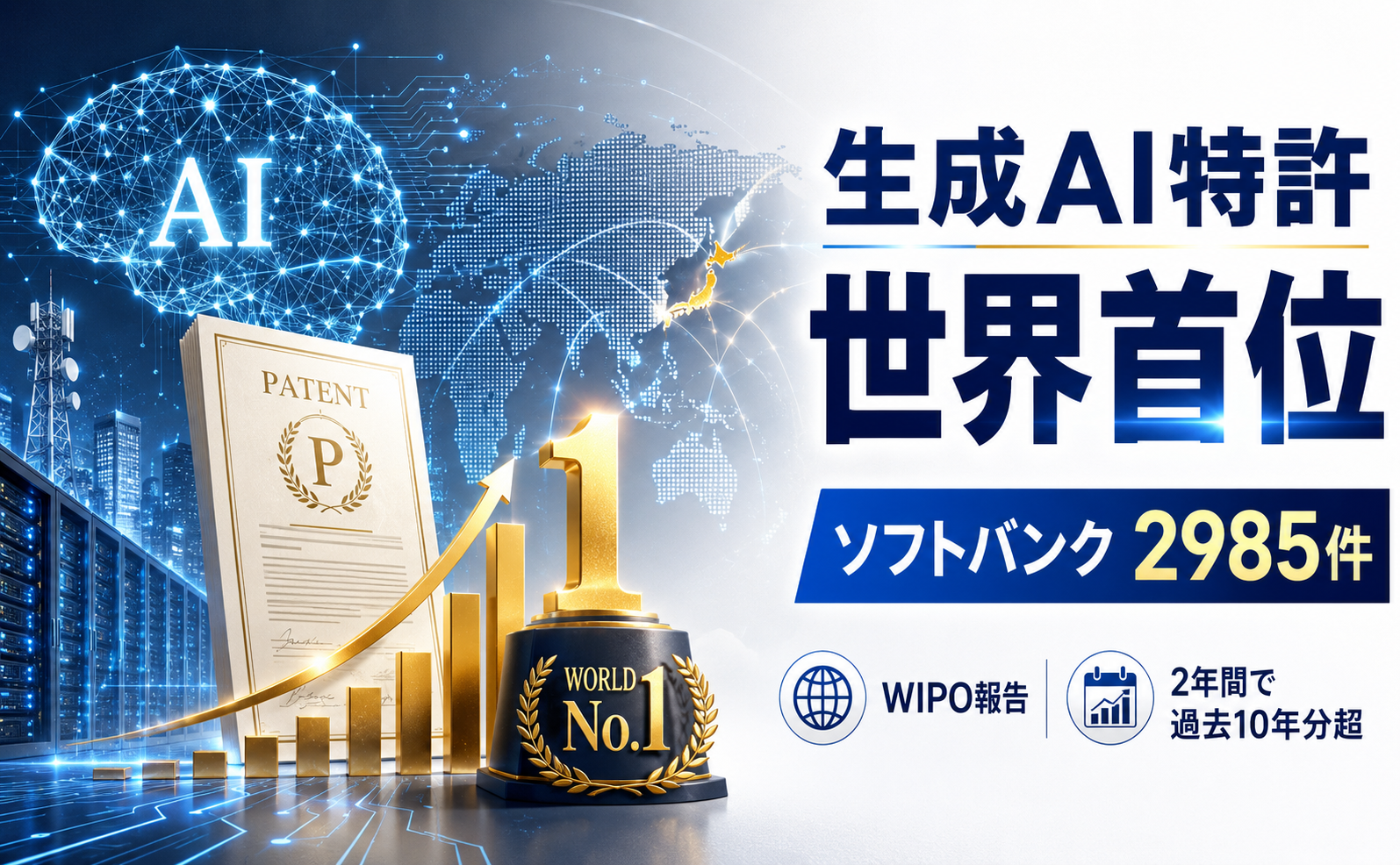
Generative AI Patent Filings in Two Years Exceed the Previous Decade’s Total
On July 14, 2026, the World Intellectual Property Organization (WIPO) published a report examining global patent trends in generative artificial intelligence. SoftBank ranked first worldwide with 2,985 generative AI-related patent families published between 2014 and 2025, surpassing Chinese companies and organizations such as Tencent, Ping An Insurance, and Baidu.
The number of generative AI-related patent publications has also surged worldwide. There were 18,862 publications in 2024 and 37,808 in 2025, bringing the two-year total to more than 56,000. This exceeds the cumulative number recorded over the ten-year period from 2014 through 2023. Patent data is beginning to reflect the fact that generative AI has moved beyond the research and proof-of-concept stage and is now being fully integrated into products, services, and business systems.
The significance of the latest ranking lies in more than the fact that SoftBank filed a large number of patent applications. It indicates that competition among companies in the generative AI sector is shifting beyond model performance and user numbers toward a race to secure future business domains through intellectual property rights.
What the Figure of 2,985 Actually Means
WIPO’s figures do not simply add together the number of patent applications filed in individual countries. Instead, they count “patent families,” which group together applications filed in multiple countries on the basis of the same invention. The figures also cover published patent applications and do not mean that every application has undergone examination and resulted in an enforceable patent right.
Of SoftBank’s 2,985 patent families, 2,978 were published in 2024 and 2025. WIPO has concluded that almost all of them were filed in 2023 and published in 2025. Because patent applications are generally published approximately 18 months after filing, research and development activities and internal idea generation that began following the launch of ChatGPT appear to have emerged in patent statistics after a time lag.
SoftBank’s top ranking should therefore be viewed not as the result of gradual accumulation over many years, but as a concentrated patent portfolio built within a short period in response to the arrival of the generative AI era. It also reflects SoftBank’s positioning of generative AI not as a temporary business theme, but as a foundational technology that will shape the future of the group.
A Vertically Integrated Strategy Spanning Infrastructure and Business Applications
SoftBank Group’s AI strategy is not limited to developing a particular generative AI model. Its initiatives span the entire AI value chain, from infrastructure to models and services. These include participation in the Stargate Project to build AI infrastructure in the United States, large-scale investment in OpenAI, development of the Japanese-language large language model Sarashina, and the construction of GPU computing infrastructure and data centers.
WIPO has described SoftBank as a “new type of generative AI patent owner”: a corporate group previously centered on telecommunications and investment that is now pursuing a vertically integrated AI strategy spanning infrastructure, models, and applications.
The initiatives undertaken by telecommunications subsidiary SoftBank Corp.—including AI-RAN, AI-enabled call centers, and enterprise AI agents—can also be understood as extensions of this vertically integrated strategy. For a company that possesses telecommunications networks, computing resources, AI models, and direct relationships with corporate customers within the same group, patenting technologies created at each layer has considerable strategic value.
Competition does not have to focus exclusively on the performance of foundation models. By obtaining rights covering the control mechanisms, operations, security systems, user interfaces, and other technologies required to integrate AI into telecommunications equipment and business systems, a company may increase the value of its patent portfolio as AI becomes more widely deployed throughout society.
A System That Makes Every Employee a Starting Point for Invention
SoftBank’s rapid increase in patent filings has not been driven solely by its research and development divisions. Since 2023, the group has held generative AI utilization contests for employees, attracting more than 260,000 ideas in total by January 2026. It has also established mechanisms through which promising proposals can lead not only to commercialization or internal implementation, but also to patent applications.
This initiative illustrates how the process of creating inventions is changing in the generative AI era. Traditionally, corporate patents were generated primarily by research laboratories and technology development departments. Generative AI and AI agents, however, are entering the work of virtually every profession, including sales, customer service, human resources, accounting, legal services, and network operations.
When frontline employees identify problems in their daily work and devise methods of solving them with AI, those mechanisms may become the basis for inventions. In other words, increasing the number of employees who use AI contributes not only to operational efficiency but also to the continuous generation of potential inventions.
SoftBank’s strength lies in more than simply providing employees with AI tools. It has created an internal process covering idea solicitation, selection, verification, commercialization, and patent protection. The figure of 2,985 can therefore be interpreted as demonstrating not only SoftBank’s research and development capabilities, but also the scale of its system for converting internal ideas into intellectual property.
OpenAI Is Not Falling Behind Simply Because It Has Only 35 Patents
By contrast, according to WIPO’s report, OpenAI—the developer of ChatGPT—had filed only 35 patent applications worldwide as of the end of 2025. OpenAI’s applications primarily cover specific product functions, such as multimodal interfaces, code generation, image generation, and text editing. The company is reportedly not pursuing a strategy of broadly patenting the architecture of its foundation models.
WIPO has suggested that OpenAI may regard trade secrets and the speed of development and implementation as its primary sources of competitiveness, while using patents only as a complementary form of protection.
This difference demonstrates that patent counts do not directly represent rankings in AI technological capability. Obtaining a patent requires the disclosure of technical information to a certain extent. In a field where innovation proceeds extremely rapidly and models and implementation methods may be updated within a matter of months, it can sometimes be more advantageous to keep technology confidential and bring it to market quickly than to pursue patents, which require considerable time from filing to grant.
By contrast, companies providing telecommunications equipment, data centers, enterprise systems, and other facilities or services used over long periods have a stronger incentive to secure future business domains through patents. The gap between OpenAI’s and SoftBank’s patent counts should therefore be understood as a difference in business structures and intellectual property strategies rather than as a difference in technological capability.
China’s Strength and Japan’s Rapid Rise
Six of the top ten organizations were Chinese companies or research institutions. In addition to digital enterprises such as Tencent, Ping An Insurance, and Baidu, the ranking included the Chinese Academy of Sciences, Zhejiang University, and the State Grid Corporation of China.
The fact that State Grid holds 1,144 patent families is particularly significant. It shows that the use of generative AI is expanding beyond text and image generation into areas such as power-grid optimization, predictive equipment maintenance, and infrastructure planning. More than 43,000 generative AI-related patent families originating from Chinese inventors were recorded in 2024 and 2025 alone.
Japan overtook South Korea to become the world’s third-largest source of generative AI inventions. The number of patent families increased from 398 in 2023 to 3,835 in 2025, representing an average annual growth rate of 210 percent. WIPO has noted, however, that most of this rapid rise was attributable to SoftBank’s filings and that Japan’s growth would have been substantially smaller without them.
The results are encouraging for Japan’s AI competitiveness, but they do not mean that Japanese companies as a whole are advancing at the same pace. Rather, they demonstrate how widely intellectual property strategies differ among companies, with one company’s large-scale filing activity having a substantial impact on the ranking of an entire country.
After the Race for Numbers Comes the Question of Patent Quality
Large-scale patent filing also presents challenges. The value of patents cannot be determined by numbers alone. Their commercial value varies considerably depending on factors such as the breadth of their claims, the clarity and validity of the rights, their correspondence with actual products and services, the difficulty competitors face in designing around them, and the extent to which protection has been obtained overseas.
According to WIPO, only approximately 9 percent of the generative AI patent families published in 2025 were international patent families published in more than one country or region. Many generative AI-related applications therefore appear to be directed primarily toward domestic markets or to be relatively recent filings for which decisions regarding overseas expansion have not yet been made.
SoftBank will also need to determine which of its numerous applications should be pursued outside Japan and which rights should be used to protect core businesses or support licensing negotiations. Rather than maintaining all 2,985 patent families equally, it will be necessary to select and reorganize them into a strong portfolio based on commercial potential, technological importance, and the competitive landscape.
Intellectual Property Management for Japanese Companies in the AI Era
The lesson Japanese companies should draw from WIPO’s report is not simply that they should increase the number of generative AI patent applications they file. What matters is operating AI utilization, technology development, commercialization, and intellectual property creation as a single integrated process.
Companies need systems that go beyond using generative AI solely to improve operational efficiency. They must collect new use cases identified in the workplace and evaluate them as potential inventions. At the same time, not every technology should be patented. Companies must select the appropriate method of protection: patents for technologies whose imitation by others can be readily detected, trade secrets for technologies whose disclosure would cause substantial disadvantages, and standardization for technologies whose widespread adoption across an industry is particularly important.
It is also important to look beyond the model itself and determine where the competitive advantage of an AI service lies across the entire system, including data collection, training, inference, user interaction, external-system integration, security, and operational monitoring. As the value of generative AI increasingly shifts toward real-world implementation, these peripheral and operational technologies will become even more important.
The Changing Basis of Competition Revealed by 2,985 Patent Families
SoftBank’s first-place ranking does not mean that it has developed the world’s most advanced generative AI model. Nevertheless, it has become a globally exceptional company in its ability to use generative AI to generate inventions and accumulate them as intellectual property within a short period.
Competition in generative AI is expanding beyond the race to develop high-performance models. It is becoming a competition to integrate AI into every aspect of corporate activity and continuously protect the technologies and businesses that emerge from that process.
A company’s future value will not be determined solely by whether it owns AI technology. What will matter is whether its employees can use AI to create new systems and whether the company can accumulate the resulting value in the form of businesses, data, know-how, and patents.
SoftBank’s 2,985 patent families symbolize how intellectual property in the generative AI era is becoming a management resource generated through the activities of the entire company, rather than merely an output of the research and development division.