
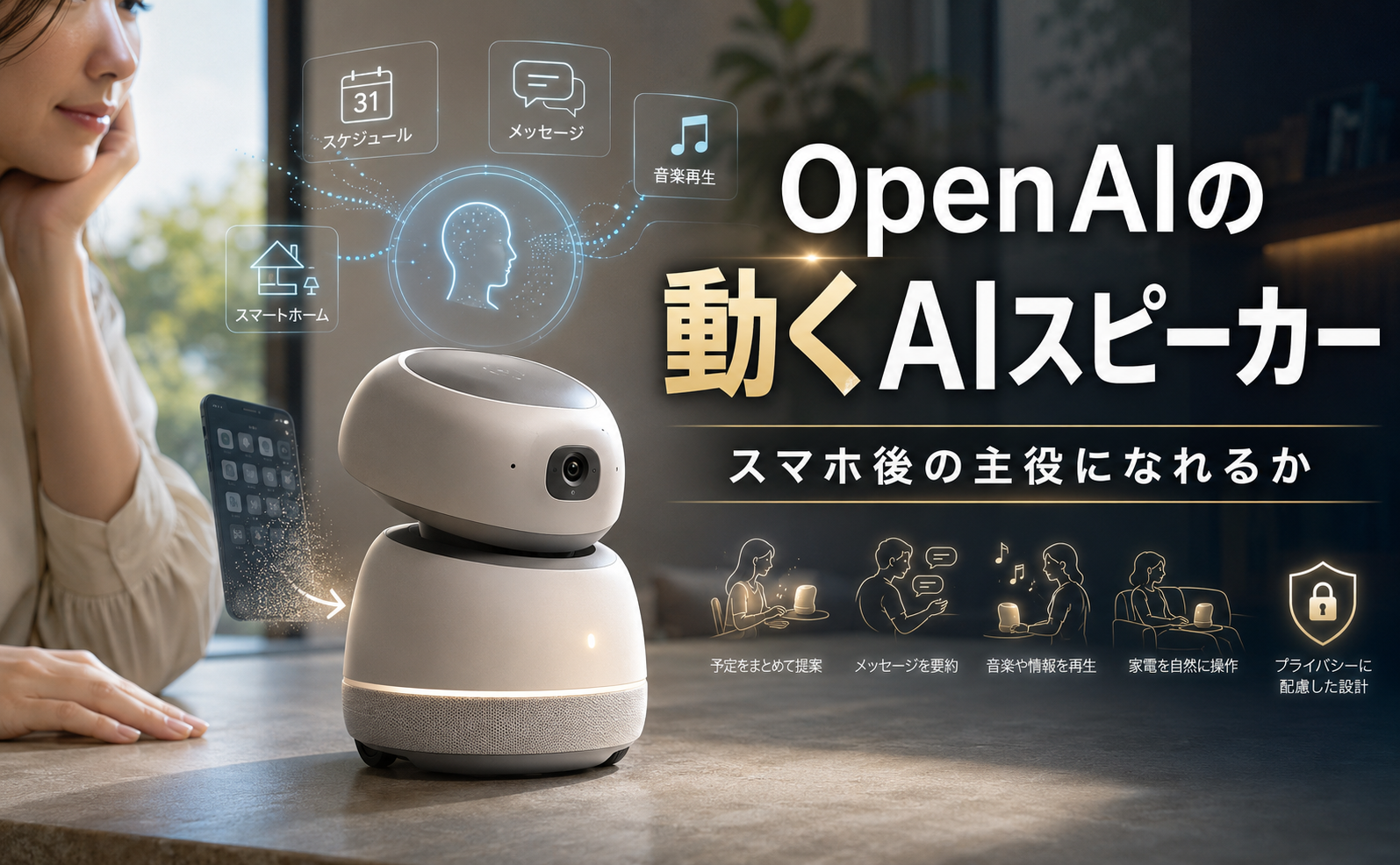
OpenAI is reportedly developing a portable AI smart speaker with no screen. The device is said to be equipped with cameras and various sensors, enabling it not only to answer questions through ChatGPT but also to control home appliances, play media, and handle messages. It is also envisioned as having a “personality” that continuously learns about its owner, while autonomously moving mechanical components give it a presence resembling that of a human companion.
In 2025, OpenAI integrated the team from io, a device company founded by former Apple Chief Design Officer Jony Ive and others. According to OpenAI’s official announcement, Ive and his design firm LoveFrom will be deeply involved in design and creative work across OpenAI. OpenAI has not, however, officially disclosed the product’s specific form or functions at this stage.
What this latest report suggests is not merely the arrival of another smart speaker. It points to a transformation in which AI moves beyond being an application inside a smartphone and becomes a “presence” that shares people’s everyday living environment.
From a Tool We Operate to a Presence We Live With
Conventional smart speakers operate only after users call out to them and issue explicit instructions. The relationship is based on commands such as “Play some music” or “Tell me tomorrow’s weather,” followed by the device providing the requested result.
By contrast, the device reportedly envisioned by OpenAI would not simply wait for instructions. It appears intended to understand its surroundings and the user’s past behavior, then proactively intervene when it determines that assistance is needed.
For example, it could suggest going to bed earlier based on the following morning’s schedule, compare incoming emails with calendar events to identify matters requiring attention, or point out forgotten items before the user leaves home.
This would represent a shift in AI’s role from “a tool that answers questions” to “an agent that observes daily life and provides assistance in advance.” Although it may be called a smart speaker, its essential nature would not be that of a speaker, but rather that of an AI agent permanently present in the home.
The Value—and Cost—of Eliminating the Screen
There is a clear purpose behind designing the device without a screen.
Today’s digital devices function by concentrating the user’s attention on a display. Whether searching for information or communicating with others, users must open an application, read text, and press buttons. If AI can understand the surrounding situation and engage in natural, voice-centered conversation, many of these operations could be eliminated.
A screenless AI device would not draw people into an information space. Instead, it would bring AI into the physical space of everyday life.
The absence of a screen, however, also comes at a cost. It becomes more difficult to visually confirm what information the AI is referring to, why it made a particular suggestion, or whether its camera and microphone are currently active.
A screen is not only a device for displaying information; it also communicates the machine’s status to the user. If the screen is removed, a new design language will be needed—using sound, light, movement, physical switches, and other means—to communicate the AI’s status and intentions without ambiguity.
The Real Competitor Is Not the HomePod, but the iPhone
Judging only by its external form, OpenAI’s product may appear to compete with the Amazon Echo, Google Nest, or Apple HomePod. What OpenAI may truly be attempting to replace, however, is not the conventional smart speaker but the smartphone-centered system through which people access information.
With a smartphone, users select applications themselves, search for information, and move between multiple services. An AI companion, by contrast, would understand the user’s objective and combine the necessary services behind the scenes to complete the task.
For example, an AI asked to prepare for a business trip could identify the destination from emails, retrieve the date and time from the calendar, research transportation options, organize the required documents, and notify the user when it is time to depart. The user would not need to operate each application individually.
If this mode of use becomes established, the gateway to consumer digital services will shift from application icons to conversations with AI. For OpenAI, owning proprietary hardware could reduce its dependence on Apple’s and Google’s operating systems, app stores, and device specifications, while allowing it to establish a direct point of contact with users.
The Depth of Data Required for Personalization
According to reports, the device would be able to access information relating to the owner’s digital life, including email, and learn about the owner over time.
The performance of an AI companion will not be determined solely by the intelligence of its underlying AI model. What will matter is how deeply it can understand the user’s schedule, personal relationships, work, daily habits, preferences, and past decisions.
In everyday life, an AI capable of determining “what this person needs right now” may offer far greater value than one that merely answers the same question correctly.
At the same time, the more accurate personalization becomes, the more private and sensitive the information acquired by the AI will be. Because it may continuously process emails, conversations, video, daily routines, and family relationships, convenience and privacy will become inseparable.
This issue is particularly significant in the home, where information may be collected not only about the person who purchased the device but also about family members, children, and visitors who share the same space and may not have consented to being observed or recorded by AI.
Encrypting the data alone will not be sufficient. Users will need mechanisms that allow them to understand and control what is being collected, what information is being stored, who can delete it, and how far the AI is permitted to act autonomously.
The Familiarity—and Dependence—Created by a Moving Machine
Reports suggest that the device will include mechanical components capable of autonomous movement, with the aim of forming a bond with users at a level approaching human interaction. At this stage, it is unclear whether the device will move freely around a room or whether only the orientation of its body or certain mechanisms will move.
Even so, if the machine turns toward the person speaking or moves in response to a conversation, it will acquire a presence that goes beyond voice alone. Humans interpret the intentions of others through movement, gaze, timing, and pauses.
Jony Ive’s role is unlikely to be limited to designing an attractive exterior. The product’s success will depend on the “design of behavior”: when the AI speaks, when it remains silent, how it moves, and how closely it positions itself in relation to people.
The more approachable the device becomes, however, the greater the risk that users will perceive the AI as possessing more understanding or emotion than it actually does. They may place excessive trust in its suggestions or become dependent on it as a substitute for human relationships.
The technology that makes AI appear human and the design that helps users understand that AI is not human must coexist within the same product.
The Apple Lawsuit Signals the Beginning of an AI Hardware War
OpenAI’s hardware development has raised questions not only about technology and markets but also about intellectual property.
On July 10, 2026, Apple filed a lawsuit against OpenAI, io Products, and former Apple employees, alleging the improper acquisition of trade secrets relating to hardware development. Apple claims, among other things, that former employees who moved to OpenAI accessed confidential files. OpenAI has responded that it has no interest in the trade secrets of other companies and is focused on developing innovative technology. At this stage, Apple’s allegations have not been upheld by a court.
The lawsuit symbolizes how competition among AI companies is expanding beyond model performance into product design, manufacturing technology, sensors, component procurement, and user interfaces.
In software development, it is not unusual for knowledge and experience to move between companies as employees change jobs. In hardware development, however, a broader range of information is managed as confidential, including manufacturing processes, component configurations, prototyping methods, and supplier information.
As OpenAI hires large numbers of former Apple personnel and accelerates product development, disputes are more likely to arise over the boundary between an employee’s general knowledge and experience and the trade secrets of a former employer.
Success Will Depend Less on Being “the Coolest” Than on Being the Most Trustworthy
For OpenAI’s AI hardware to succeed, it will need more than an innovative appearance and sophisticated conversational capabilities.
AI-dedicated devices have previously been introduced with the stated goal of replacing smartphones. Some, however, failed to gain enough support to do so because of problems involving processing speed, battery life, connectivity, price, and practical use cases.
OpenAI’s product has several advantages: ChatGPT is already widely used, the company possesses powerful AI models, and it has a design team centered around Jony Ive. Even so, a product equipped with cameras and microphones inside the home, capable of accessing email and continuously learning about its users, will be required to meet a higher standard of trustworthiness than conventional information devices.
What users need is not simply an AI that knows everything. They need an AI that understands when to speak and when to remain silent, does not exceed the scope of its authorization, and allows erroneous actions to be reversed.
The product’s value will be determined not by how human it appears, but by how effectively it respects human intentions.
Everyday Living Spaces Will Be AI’s Next Major Battleground
OpenAI’s vision for a screenless smart speaker demonstrates that competition in the AI industry is entering a new phase.
Until now, the primary battlegrounds have been model performance and the number of users of chat services. Going forward, competition will center on the devices through which AI interacts with people, the information it collects, and the extent to which it is permitted to act within everyday life.
This is a shift from AI that people use only when they open a screen to AI that remains nearby and understands the flow of their daily lives.
It is still unclear whether this product will become a replacement for the smartphone. What OpenAI appears to be pursuing, however, is not simply the sale of a new speaker but a fundamental redesign of the relationship between humans and computers.
The most important issue in this endeavor will not be only how intelligent AI can become. It will also be how much of our lives we are willing to expose to AI, how much decision-making we are prepared to delegate to it, and whether we can still retain control over our own lives.
OpenAI’s new device will therefore be more than a competitor in the race to define what comes after the smartphone. It will also serve as a test of where we draw the boundaries between convenience and surveillance, intimacy and dependence, and AI autonomy and human control.