
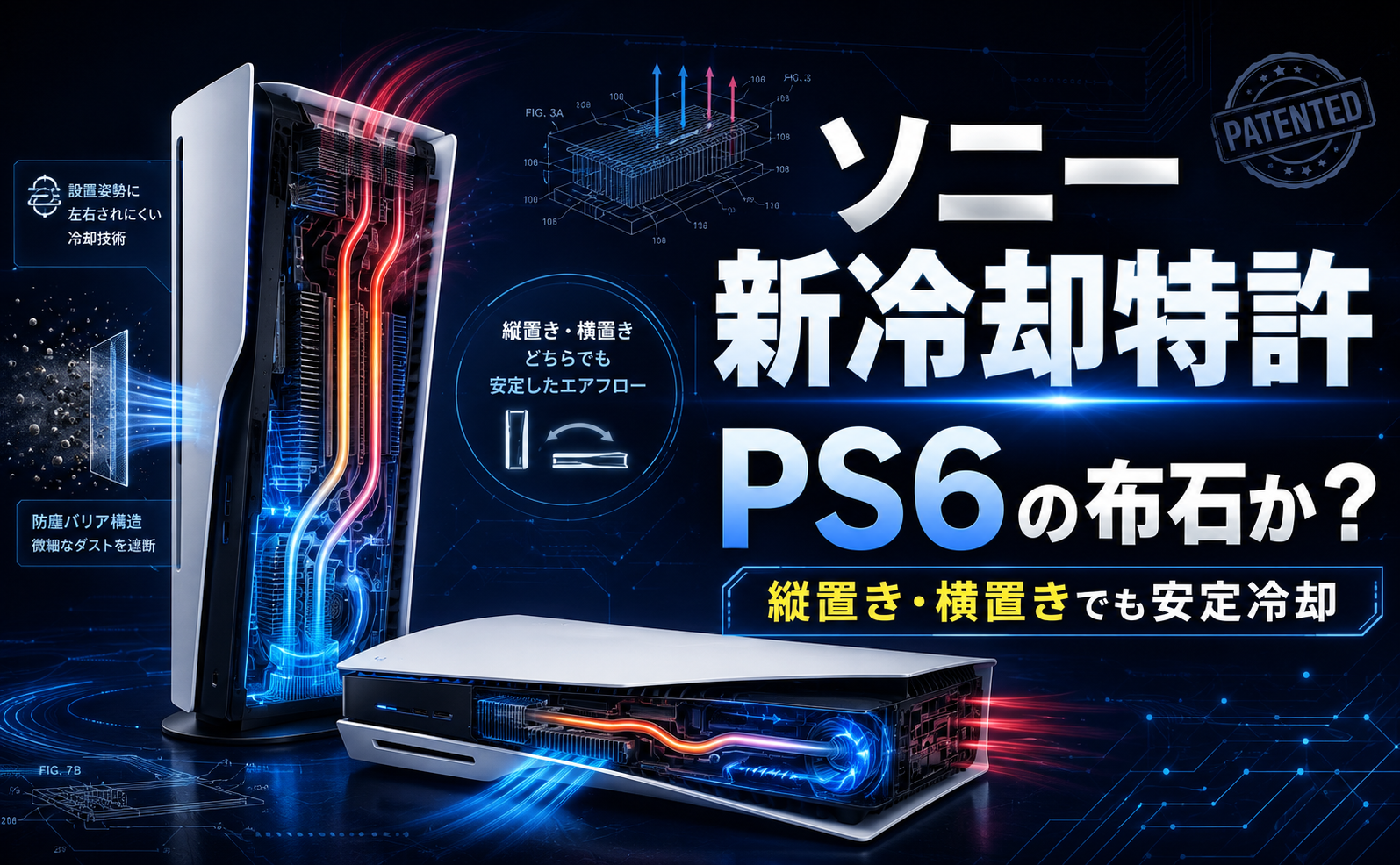
Sony Interactive Entertainment has filed a patent for a new cooling technology designed to be less affected by the orientation in which an electronic device is placed. According to patent information published in the United States in June 2026, the technology is intended to improve the cooling efficiency of a heat-dissipation device using heat pipes in electronic equipment positioned either vertically or horizontally. Because the published drawings appear to depict a PS5-like device, some overseas media outlets have speculated that the technology could eventually be used in the “PS6.”
Sony Interactive Entertainment has also reportedly applied for a dust-protection technology intended to reduce the accumulation of dust inside game consoles. Its efforts to address both cooling performance and dust resistance may offer a glimpse into Sony’s design philosophy for its next-generation hardware.
Why a Console’s Orientation Can Affect Cooling Performance
A home console such as the PS5 may be used either vertically or horizontally, depending on the size of the TV stand or desk and the arrangement of surrounding equipment. However, heat pipes that circulate liquid and vapor internally can sometimes be affected by gravity.
A heat pipe transfers heat by allowing a sealed working fluid to evaporate near a heat source and condense in a cooler section. Because the condensed liquid must then return to the heat-source side, the circulation of the fluid may change depending on the device’s orientation and the arrangement of the heat pipe.
The newly disclosed patent explores a configuration in which the shape and length of the heat pipe are designed to retain an appropriate amount of fluid and allow it to evaporate efficiently even when the electronic device is positioned vertically. One notable feature is that part of the elongated heat pipe functions like a reservoir for storing the working fluid.
This could make it possible to maintain stable cooling performance regardless of whether the console is placed vertically or horizontally.
The Objective Is More Than Simply Improving Cooling Performance
The significance of this technology is not limited to cooling a chip more effectively.
Inside a game console, numerous components—including the processor, memory, power supply, storage, and cooling fan—must be arranged within a limited amount of space. As performance increases and more heat is generated, heat sinks and heat pipes may also need to become larger. Enlarging cooling components, however, can cause them to interfere with surrounding parts or place stress on components during assembly and transportation.
The patent also appears to take into account the need to secure sufficient clearance around nearby components while transferring heat away from the chip through the heat pipe.
In other words, the technology may be intended to improve cooling efficiency, component protection, and flexibility in internal layout at the same time.
The PS6 Could Offer Greater Freedom in Console Design
Should this technology be adopted in a future PlayStation console, the most obvious benefit for users would be greater freedom in choosing how to position the system.
If there is little difference in cooling performance between vertical and horizontal placement, users could select the console’s orientation with greater confidence based on their available space. Reduced dependence on orientation would also give designers fewer constraints when determining the console’s exterior shape and internal structure.
While the PS5 delivers high processing performance, it has also attracted attention for its large physical size. A next-generation console may be expected to incorporate an even more powerful processor while also becoming smaller, slimmer, and quieter.
Cooling technology that is less affected by orientation could serve as a foundation for reconciling these conflicting requirements. In particular, greater flexibility in the placement of the cooling system could make it easier to develop unconventional console designs or offer multiple chassis variations.
Dust Protection Suggests a Focus on Long-Term Use
Maintaining cooling performance over an extended period requires not only the efficient transfer of heat but also measures to prevent dust from obstructing airflow.
Because game consoles use cooling fans to draw in outside air, dust tends to accumulate inside them over time. When dust collects on a heat sink, airflow becomes restricted and cooling performance declines. As a result, the fan may need to rotate faster, increasing operating noise, while component temperatures may also rise.
The reported dust-protection technology uses barriers near ventilation openings to make it more difficult for dust to reach the heat sink and power-supply sections directly.
If the new heat-pipe technology is intended to stabilize initial cooling performance regardless of console orientation, the dust-protection technology could be viewed as a means of preserving that performance over the long term. Considered together, the two technologies suggest that Sony may be focusing not only on peak processing performance but also on stability and quiet operation after several years of use.
A PS5-Like Patent Drawing Does Not Necessarily Mean the Technology Is for the PS6
Nevertheless, the patent cannot immediately be treated as evidence of the PS6’s final specifications.
Companies routinely file patent applications for a broad range of technologies that they may potentially use in the future. It is not uncommon for patented technologies never to appear in a commercial product. Even if the drawings depict a device resembling the PS5, Sony may simply have used an existing product as a model to illustrate a practical application of the technology.
The patent is also titled “ELECTRONIC DEVICE” rather than referring to a specific game console, suggesting that its potential applications are not limited to PlayStation hardware. The application may have been deliberately drafted with a broad scope so that the technology could also be used in video equipment, computers, professional systems, and other electronic devices.
It is therefore more reasonable to understand the patent as evidence that Sony is researching cooling technology that could potentially be applied to future PlayStation products, rather than concluding that the technology will definitely be included in the PS6.
Cooling Design May Matter More Than Raw Performance in Next-Generation Consoles
When a new generation of game consoles arrives, attention tends to focus on graphics performance and processing speed. However, keeping high-performance semiconductor components operating reliably depends heavily on how the heat they generate is managed.
If cooling capacity is insufficient, a processor cannot sustain its full performance. Running cooling fans at higher speeds can reduce temperatures, but it also increases noise and power consumption. Enlarging the cooling system can make quieter operation easier to achieve, but it also increases the size of the console and may affect manufacturing and shipping costs.
Competition among next-generation consoles will therefore depend not only on computational performance, but also on how effectively manufacturers balance performance, power consumption, console size, acoustic noise, durability, and production costs.
This patent does not add a highly visible new feature, but it concerns technology that could fundamentally support the overall quality of a game console. If users can operate the system quietly and reliably for many years without worrying about how it is positioned, the value of such technology would be considerable.
Could the Evolution of the PS6 Already Be Beginning Inside the Console?
This cooling technology alone is not enough to predict what the PS6 will look like. Nevertheless, a heat pipe that performs consistently regardless of orientation and a dust-resistant structure that limits the entry of dust closely match the requirements likely to be placed on a next-generation console.
For future PlayStation systems to continue becoming more powerful, Sony will need to address not only advances in semiconductor technology but also physical challenges involving heat, dust, noise, and chassis size. Sony’s continued efforts to patent these foundational technologies may indicate that it is steadily building a wider range of internal design options for its next-generation hardware.
The performance and appearance of the PS6 remain unknown. Even so, its evolution may already be underway—not only through the development of a new processor, but also through something as inconspicuous as a single heat pipe hidden inside the console.