
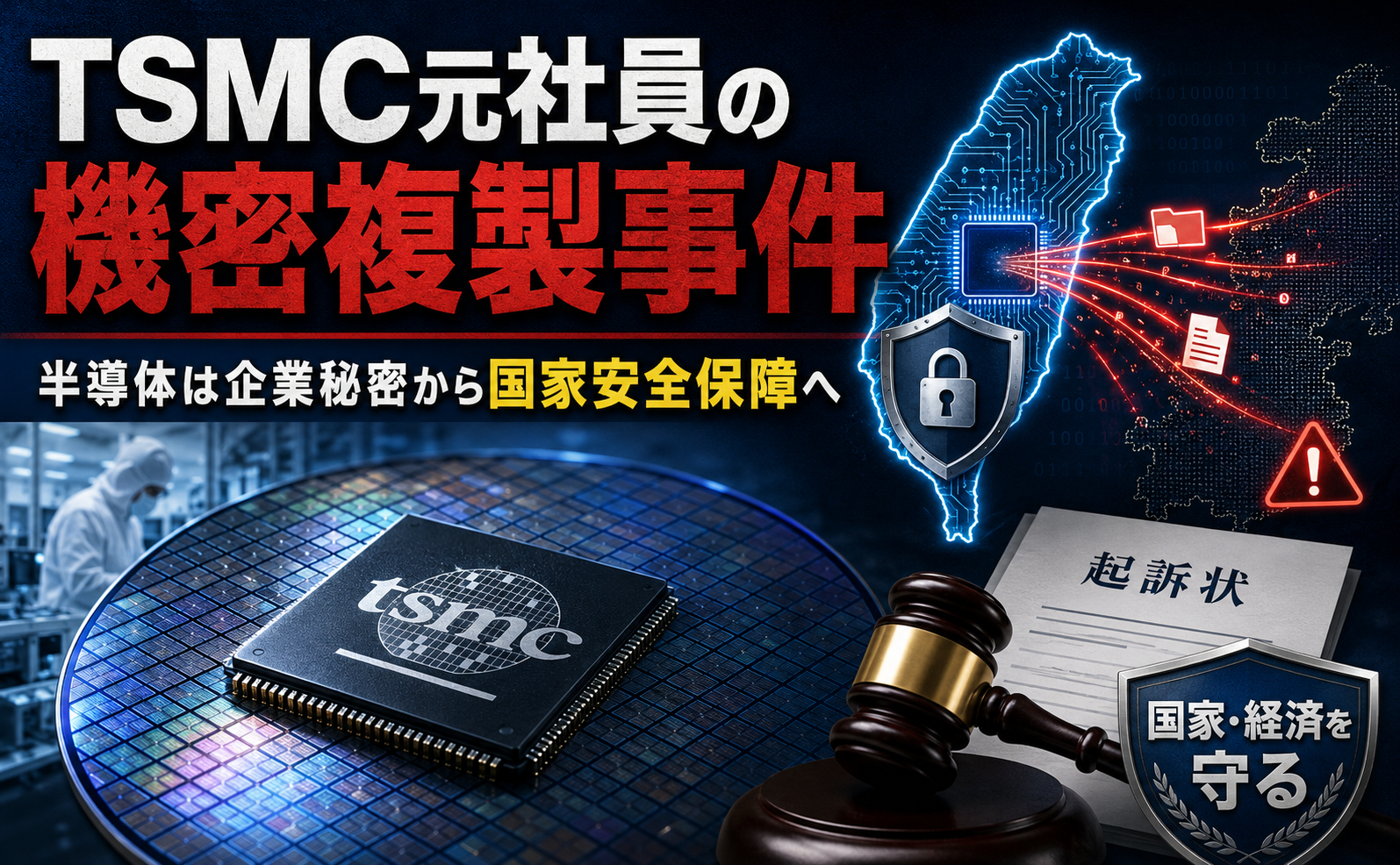
On July 20, 2026, Taiwanese prosecutors indicted a former employee of Taiwan Semiconductor Manufacturing Company (TSMC), the world’s largest contract semiconductor manufacturer, on charges including violations of the National Security Act and the Trade Secrets Act.
According to prosecutors, between 2023 and 2024, the former employee allegedly made unauthorized copies of 21 items of confidential information belonging to TSMC and intended to use them at a semiconductor materials analysis company established in China together with a Hong Kong national. The defendants are also alleged to have advanced a plan to send engineers from Taiwan to China to help develop the local semiconductor industry. Prosecutors have recommended a seven-year prison sentence.
TSMC reportedly detected the irregularities through an internal investigation and recovered the information that had been copied without authorization. According to the prosecution authorities, this is the first indictment involving the infringement of trade secrets classified as “National Core Key Technologies” for the purpose of using them in China. However, the case is currently only at the indictment stage, and the former employee’s criminal liability and the specific facts of the case will be examined in future court proceedings.
The Issue Is Not Simply Whether the Information Was Transferred
An important point in this case is that it is not being presented as one in which confidential information was confirmed to have ultimately reached the Chinese side. Rather, prosecutors allege that the information was copied for the purpose of using it in China.
According to news reports, the copied information was recovered through TSMC’s internal investigation. Based on the information disclosed so far, it therefore cannot be confirmed that the 21 items were actually used by a Chinese company.
Nevertheless, the former employee was indicted under the National Security Act. The likely rationale is that, when preventing the leakage of advanced technology, waiting until actual harm has occurred before imposing penalties would be too late.
Once semiconductor manufacturing technology is taken outside a company, it can easily be copied, analyzed, modified, and reused. Even when the information itself is recovered, it is impossible to retrieve completely what has already been viewed or retained in the memories of engineers. There is therefore an increasing need for legal intervention from the stage at which confidential information is copied or preparations are made to use it abroad.
This indictment may symbolize a shift in the focus of technology-leakage countermeasures from recovering losses after a disclosure to preventing conduct aimed at overseas use at an early stage.
Semiconductor Technology Is Becoming a National Strategic Asset
Manufacturing methods, material specifications, inspection techniques, yield-improvement measures, and similar information are ordinarily treated as trade secrets controlled by the company concerned. Traditionally, the removal of such information would primarily have been viewed as a dispute between a company and a former employee.
Advanced semiconductors, however, now form the foundation of a wide range of industries, including artificial intelligence, telecommunications, automobiles, defense, space, healthcare, and electric-power infrastructure. The leakage of one company’s manufacturing technology can affect not only its sales and competitiveness but also the industrial competitiveness and security of the country as a whole.
Taiwan amended its National Security Act in 2022 to establish a framework for punishing conduct such as the infringement of trade secrets concerning “National Core Key Technologies” for the purpose of using them in a foreign country, mainland China, Hong Kong, or Macao. The Taiwanese government has continued to revise the technologies covered by this designation, expanding the list to 42 items in February 2026.
This reflects a movement toward treating advanced technologies not merely as the property of private companies, but as strategic assets that must be protected by the state.
TSMC, in particular, manufactures semiconductors used in smartphones, data centers, AI processors, and other products on a global scale. If its technical information were transferred to overseas competitors, the consequences could extend beyond TSMC’s own competitiveness and affect Taiwan’s broader advantage in the semiconductor industry.
A defining feature of this case is that it is being treated simultaneously as a trade-secret infringement case and as an economic-security matter.
A Plan to Transfer Technical Materials and Personnel Together
According to prosecutors, the former employee and the other individuals involved allegedly planned not only to establish a semiconductor materials analysis company in China, but also to send Taiwanese personnel there to support the development of China’s semiconductor industry.
This illustrates the reality that modern technology leakage cannot be accomplished merely by removing blueprints or documents.
Advanced semiconductor technology includes not only information recorded in documents, but also tacit knowledge that is difficult to put into writing, such as experience accumulated at manufacturing sites, criteria for determining process conditions, and methods for responding to defects or malfunctions.
Obtaining equipment settings or material-mixing conditions does not necessarily make it possible to manufacture semiconductors of the same quality immediately. Engineers who understand what the information means and can reproduce the relevant processes in an actual production environment are also required.
For parties seeking to acquire technology, obtaining confidential documents and securing experienced engineers therefore tend to be inseparable. The reported plan in this case allegedly combined several elements: copying information, establishing a local company, and transferring personnel.
Future measures against technology leakage must therefore go beyond preventing the removal of electronic files. Companies will need to assess risks across a broader range of circumstances, including departing employees, prospective employers, joint ventures with overseas companies, recruitment agencies, and consulting agreements.
The Role of TSMC’s Internal Investigation
A critical factor in limiting the potential damage in this case was TSMC’s detection of the irregularities through its internal investigation.
No matter how strict a confidentiality agreement may be, the agreement alone cannot prevent information from being removed. Such agreements are useful for pursuing liability after a breach, but they do not physically or technologically prevent misconduct.
Companies need systems for continuously reviewing which information employees have accessed, whether unusually large volumes of information have been viewed or copied, and whether suspicious activities have occurred before an employee’s departure.
At the same time, subjecting every employee to uniform surveillance is not necessarily appropriate. Excessive monitoring may damage trust between companies and employees and impede the sharing of information necessary for research and development.
The key is to establish access privileges based on the confidentiality level of the information and to maintain appropriate records of the viewing, copying, printing, and external transmission of especially important information. Limiting departing employees and outside contractors to only the information they genuinely need can also be effective.
This case may be regarded both as an example in which internal controls failed to prevent misconduct entirely and as one in which systems for detecting irregularities and recovering information performed a meaningful function.
Harsher Penalties Alone Cannot Prevent Technology Leakage
Punishment under national-security legislation and the strengthening of criminal penalties are important tools for deterring technology leakage. However, increasing penalties alone will not resolve every problem.
When engineers receive attractive offers from overseas companies, their decisions may be influenced not only by financial incentives but also by the research environment, promotion opportunities, the extent of their professional autonomy, and the opportunity to participate in new ventures.
Overly restricting legitimate job changes and international mobility could make it more difficult for Taiwanese companies themselves to recruit highly skilled personnel. It is also necessary to distinguish clearly between the general knowledge and skills employees acquired through previous employment and the trade secrets of a particular company.
Companies should not attempt to control all knowledge held in their employees’ minds. What matters is identifying specific technical information that has been managed as confidential and implementing reasonable protective measures for that information.
Effective measures against technology leakage must therefore combine criminal law with trade-secret management, employee training, appropriate compensation and working conditions, departure procedures, and compliance checks involving an employee’s new workplace.
Japanese Companies Should Not Regard This as Someone Else’s Problem
Although this case occurred in Taiwan, it is also relevant to Japanese companies.
Japan is increasing investment in fields of high economic-security importance, including semiconductors, storage batteries, manufacturing equipment, advanced materials, robotics, AI, and quantum technology. Joint research with overseas companies, the recruitment of foreign engineers, and cross-border supply chains are also expanding.
In such an environment, companies must not only protect their own information, but also avoid carelessly receiving the trade secrets of other companies.
When a new employee brings materials from a former workplace and the receiving company uses them, not only the individual employee but also the company may face liability. It is not sufficient to assume that there is no problem simply because the employee brought the information voluntarily.
At the recruitment stage, companies should clearly instruct candidates not to bring confidential information from previous employers. After employment begins, they should also establish systems that do not require employees to use materials belonging to former employers. In joint research and outsourcing arrangements, companies should confirm that information provided by the other party has been lawfully obtained.
Preventing technology leakage is not limited to defensive measures intended to keep information from leaving the company. Controls designed to prevent technical information of unclear origin from entering the company are equally important.
Protecting People and Protecting Technology
As competition in the semiconductor sector intensifies, the value of the knowledge and experience possessed by individual engineers increases. As a result, companies increasingly view personnel both as important assets and as potential information-leakage risks.
There are, however, limits to a management approach based on treating employees with suspicion.
Creating a research environment in which engineers want to continue working, evaluating their achievements appropriately, and presenting clear career prospects can also serve as long-term measures against technology leakage. Stronger information controls and investment in personnel are not mutually exclusive.
On the contrary, clearly classifying confidential information and explaining to employees why it must be protected can make the boundary between ordinary research activities and freedom of employment, on the one hand, and protected trade secrets, on the other, easier to understand.
Semiconductor Competition Does Not End with Building Factories
Governments around the world are providing enormous subsidies to attract semiconductor factories to their domestic markets. Yet simply acquiring factories and manufacturing equipment is not enough to produce cutting-edge semiconductors reliably.
Stable production requires manufacturing conditions that achieve high yields, methods for analyzing materials, equipment-specific adjustment techniques, and knowledge accumulated over many years regarding the handling of defects and other problems. Much of this information is not disclosed through patents, but instead remains confidential within companies.
International competition over semiconductors is therefore not only a competition in capital investment. It is also a competition over trade secrets and skilled technical personnel.
This indictment demonstrates Taiwan’s position that such competition should not be left solely to private companies, but should also be addressed as a matter of national security.
At the same time, the criminal liability of the indicted former employee will be determined by the courts on the basis of evidence. Even when assessing the seriousness of the case, it is essential to distinguish between the prosecution’s allegations and the facts ultimately established by the court.
The case involving the alleged copying of 21 items of TSMC’s confidential information is more than a suspected act of information removal by a single former employee. It demonstrates that semiconductor technology has become not only a trade secret supporting corporate competitiveness, but also an asset capable of affecting a nation’s industrial foundation and security.
Going forward, companies and governments will need to adopt more precise measures that prevent organized technology transfers and the unlawful acquisition of information while preserving legitimate mobility for engineers and continued international cooperation.