
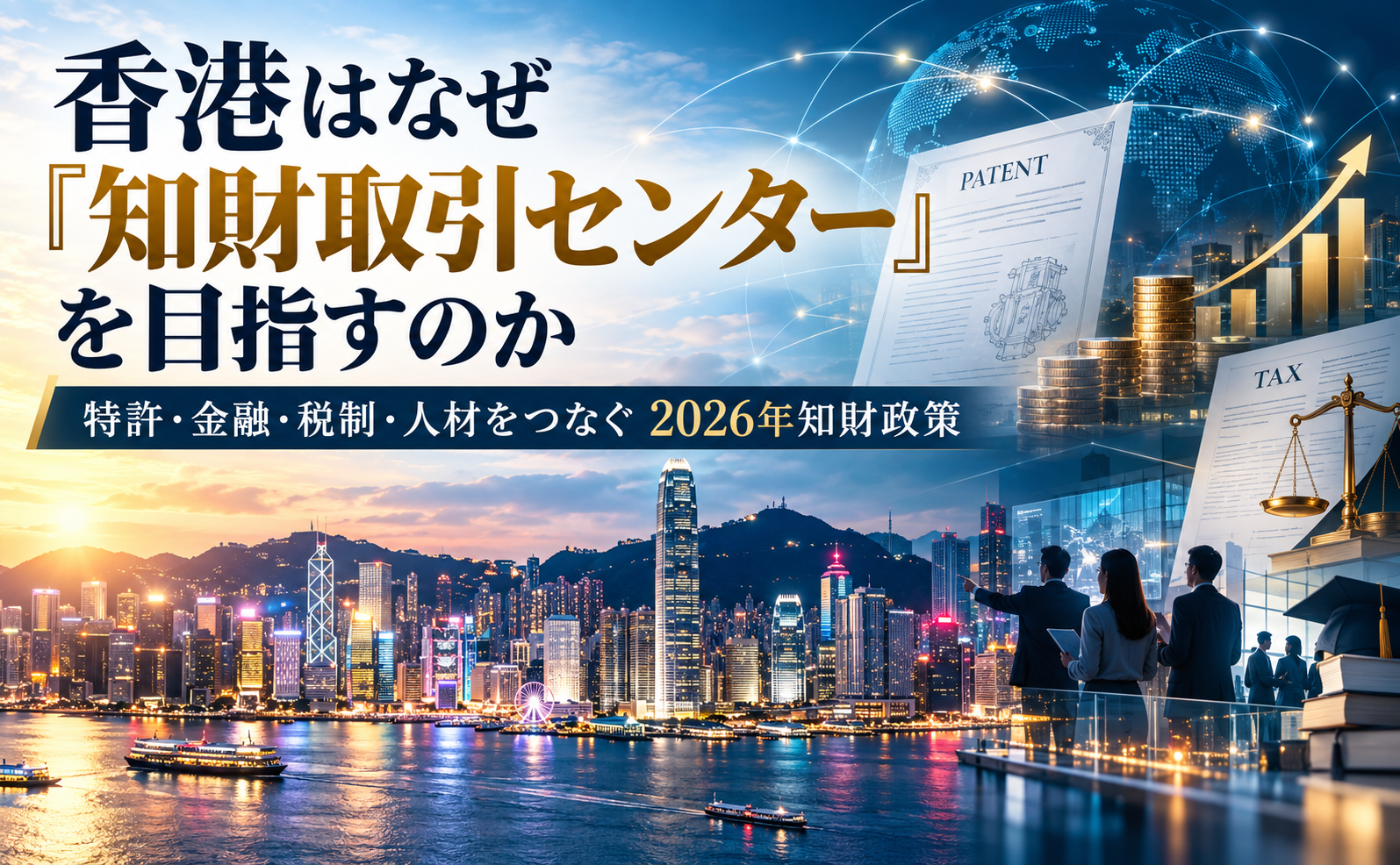
The Hong Kong government is stepping up efforts to promote intellectual property not merely as a “right to be protected,” but as an asset that can be traded, attract financing, and be commercialized.
In the Policy Address announced by Chief Executive John Lee on September 16, 2026, the government set out a coordinated strategy for developing Hong Kong into a “regional intellectual property trading center.” The measures include strengthening examination capabilities under the Original Grant Patent (OGP) system, promoting IP-backed financing, introducing tax deductions relating to the acquisition and licensing of intellectual property, developing IP professionals, and establishing a regulatory framework for patent agency services. The Intellectual Property Department of Hong Kong has also positioned these measures as part of a broader policy framework encompassing IP valuation and financing, reductions in transaction costs, and the development of professionals capable of managing and commercializing intellectual property.
Viewed individually, these initiatives may appear to be a collection of separate measures relating to patent law and taxation. Seen as a whole, however, Hong Kong’s objective becomes considerably clearer.
It is seeking to create a market in Hong Kong in which intellectual property itself can circulate.
From a City Where Patents Can Be Obtained to a City That Can Examine Patents Itself
One of the first developments worth noting is the strengthening of the OGP system.
In December 2019, Hong Kong introduced the OGP system in addition to its existing re-registration system. Under the OGP framework, applicants can file directly for a standard patent in Hong Kong without first filing a corresponding application with the China National Intellectual Property Administration (CNIPA), the UK Intellectual Property Office (UKIPO), or the European Patent Office (EPO).
Under the latest policy, Hong Kong plans to launch a pilot support measure in 2027 to promote OGP filings in key technology sectors, with the aim of establishing the capability to conduct substantive examination independently in those sectors by 2030.
What is important here is that this is not simply a matter of saying that patents can also be obtained in Hong Kong.
To conduct patent examination independently, Hong Kong must continuously secure examiners capable of understanding technical subject matter and assessing novelty and inventive step. Building this capability in-house therefore also means accumulating technical and intellectual property expertise within Hong Kong itself.
Hong Kong’s first five-year IP development plan likewise calls for expanding the patent examiner team while systematically cultivating professionals capable of handling the creation, protection, management, financing, utilization, and commercialization of intellectual property.
The strengthening of the OGP system can therefore be viewed not merely as an enhancement of Hong Kong’s patent office functions, but as part of the basic infrastructure required to establish Hong Kong as a center for IP-related business.
The Focus of IP Policy Is Expanding from “Protection” to “Asset Utilization”
Another particularly interesting aspect of the latest policy is the explicit emphasis placed on “IP financing.”
Hong Kong launched an IP Financing Sandbox in December 2025. Through collaboration among banks and specialists in insurance, valuation, law, and other fields, the initiative is testing mechanisms that allow businesses to raise funds by leveraging their intellectual property. According to materials relating to the 2026–27 Budget, the pilot program involves three major Hong Kong banks, their corporate clients, and providers of legal and other professional services.
IP finance presents challenges that are unique to intangible assets.
For land and equipment, market prices and potential resale values are relatively easy to estimate. By contrast, the value of a patent, trademark, or other intellectual property right can vary significantly depending on factors such as the strength of the right, the size of the relevant market, the availability of alternative technologies, and the potential for licensing revenue.
For intellectual property to function as a financial asset, therefore, the mere existence of a legal right is not enough. A system is needed that connects valuation, legal expertise, and finance.
Hong Kong’s decision to adopt a sandbox approach can be understood as an attempt to test these difficult issues through actual transactions and real-world cases.
The 2026 Policy Address also states that the IP Financing Sandbox has already produced successful cases and that the government intends to expand participation and prepare for a more practical next stage.
This indicates that Hong Kong’s policy focus is moving beyond simply “protecting intellectual property” toward policies designed to “generate financing from intellectual property.”
The Tax Measures Reveal an Intention to Attract Intellectual Property to Hong Kong
The tax-related measures are equally important.
The Hong Kong government has announced plans to introduce legislation in 2026 providing tax deductions for capital expenditure incurred in acquiring intellectual property rights or rights to use intellectual property.
According to JETRO, Hong Kong already provides certain deductions relating to IP acquisition costs, but consideration is being given to expanding the scope to cover transactions between related companies, upfront lump-sum payments under licensing agreements, and intellectual property used outside Hong Kong.
Hong Kong has also already introduced a “patent box” tax regime. Under this framework, qualifying income derived from research-and-development-based intellectual property is taxed at a preferential profits tax rate of 5%, instead of the standard 16.5%.
Looking at these two measures together makes the policy direction even clearer.
On the one hand, Hong Kong seeks to reduce the tax burden associated with acquiring or licensing intellectual property. On the other hand, it provides preferential treatment when income is subsequently generated from that intellectual property.
In other words, Hong Kong appears to be seeking to attract the entire IP business cycle—acquisition, ownership, utilization, and monetization—into its economy.
The distinctive point is that the objective appears to extend beyond simply increasing the number of patent applications. Hong Kong is also attempting to attract companies’ IP management functions themselves.
The “IP Academy” and Patent Agency System Are Not Secondary Measures
Creating an IP trading market requires more than legal systems and tax incentives.
It also requires a broad range of professionals: people who can value intellectual property, structure licensing agreements, support patent applications, and understand financing based on IP assets.
For this reason, the Hong Kong Intellectual Property Academy is scheduled to formally commence operations in the fourth quarter of 2026. It is expected to provide systematic, practice-oriented training for professionals working in fields including technological innovation, cultural and creative industries, commerce and industry, and professional services.
At the same time, the Hong Kong government is developing a regulatory framework for patent agency services, including a registration system, professional titles, and qualification requirements. A public consultation is scheduled for 2026, followed by the preparation of specific legislative proposals in 2027.
These may appear to be two separate policies, but they are connected by a common objective: increasing the number of professionals capable of handling intellectual property.
Even if a sophisticated patent system is established, the market will not grow unless there are sufficient companies and professionals able to use it. Similarly, even if an IP financing framework exists, financing will be difficult to arrange without professionals capable of explaining the value of patents to financial institutions.
Talent development and the establishment of professional service frameworks can therefore be regarded as essential market infrastructure for Hong Kong’s ambition to become an IP trading center.
Integration with the GBA Prevents the Market from Being Confined to Hong Kong Alone
Another important element is Hong Kong’s coordination with the Guangdong-Hong Kong-Macao Greater Bay Area (GBA).
The policy objectives include establishing a special working group in the first quarter of 2027 to promote greater alignment of rules and systems among Guangdong, Hong Kong, and Macao. Hong Kong also plans to examine model arbitration rules for the GBA during 2026 and 2027, while promoting initiatives that connect GBA companies seeking overseas expansion with Hong Kong’s legal and professional services.
Efforts to increase IP transactions inevitably raise issues involving contracts and dispute resolution.
Patents and trademarks exist under the legal systems of individual jurisdictions, but transactions involving licensing, joint research, technology transfer, and mergers and acquisitions often cross borders and regional boundaries.
This gives rise to questions such as which law applies, where disputes should be resolved, and how court judgments or arbitral awards can be enforced.
This helps explain why Hong Kong is seeking to develop connections not only with IP trading, but also with legal, arbitration, and professional services.
Hong Kong’s five-year plan also explicitly states its intention to deepen cooperation with mainland China and to support mainland Chinese companies in using Hong Kong as an IP trading platform for overseas expansion.
The concept of a “regional intellectual property trading center” should therefore probably be understood not as an attempt to build a market that operates solely within Hong Kong, but as an effort to make Hong Kong a hub through which intellectual property and technology can move between the GBA, mainland China, and overseas markets.
What Really Matters Is the “Liquidity” of Intellectual Property
When the recently announced measures are considered together, the OGP system can be seen as a mechanism for creating rights; IP financing as a mechanism for obtaining capital from those rights; the tax system as a mechanism for reducing the cost of acquiring and using rights; the IP Academy and patent agency framework as mechanisms for developing the professionals who handle those rights; and regulatory coordination with the GBA and arbitration systems as mechanisms for enabling cross-border transactions involving those rights.
Connecting these measures along a single line reveals what the Hong Kong government appears to be emphasizing at the policy level.
That is the “liquidity” of intellectual property.
Even an excellent patent cannot be regarded as fully utilized economically if it is never sold, licensed, or used to raise financing.
Conversely, if patents can be properly valued, understood by financial institutions, licensed among companies, and supported by professionals capable of handling contracts and dispute resolution when necessary, intellectual property can become an economic asset that actively circulates rather than a dormant legal right sitting outside a company’s balance sheet.
What is particularly interesting about Hong Kong’s latest policy is its attempt to build all of these mechanisms simultaneously rather than addressing them in isolation.
Hong Kong’s Changes Are Also Relevant to Japanese Companies
From the perspective of Japanese companies, these developments are also worth following closely.
In the future, it may become increasingly important to evaluate Hong Kong not only from the conventional perspective of whether to obtain intellectual property rights there, but also from the broader perspective of where to locate functions relating to IP management, licensing, technology transfer, and IP finance within Asia.
The actual benefits and practical implications of using Hong Kong could change substantially depending on how the OGP support measures for key technology sectors scheduled for 2027 are implemented, how the patent agency service framework is designed, how the tax deduction system for IP acquisition and licensing develops, how the IP Financing Sandbox is expanded, and what form the arbitration rules within the GBA ultimately take.
Hong Kong does not appear to be aiming merely to become a city in which large numbers of patents are obtained.
Rather, it appears to be seeking to create a place where intellectual property can be generated, protected through legal rights, valued, financed, licensed, traded, and, when necessary, supported by dispute resolution mechanisms.
When discussing an “IP powerhouse,” attention often focuses on the number of patent applications or registrations. Hong Kong’s current initiatives, however, may be worth watching as an example of how competition in intellectual property policy is expanding beyond the question of “how many rights a jurisdiction possesses” to include “how effectively those rights can be put into motion within economic activity.”