
Introduction
The Office of the United States Trade Representative, or USTR, has launched an investigation into Vietnam’s protection and enforcement of intellectual property rights under Section 301 of the Trade Act of 1974. In response, on May 30, Pham Thu Hang, spokesperson for Vietnam’s Ministry of Foreign Affairs, stated that the investigation is a procedure under U.S. law, while calling on the United States to conduct an objective and fair assessment.
Vietnam positions the protection and strengthened enforcement of intellectual property rights as an essential policy for building a transparent and sound investment and business environment, promoting innovation, and fully implementing its international commitments. Vietnam has also indicated its willingness to continue consultations and information sharing during the investigation process, while urging the United States to fully recognize its past efforts and substantive achievements.
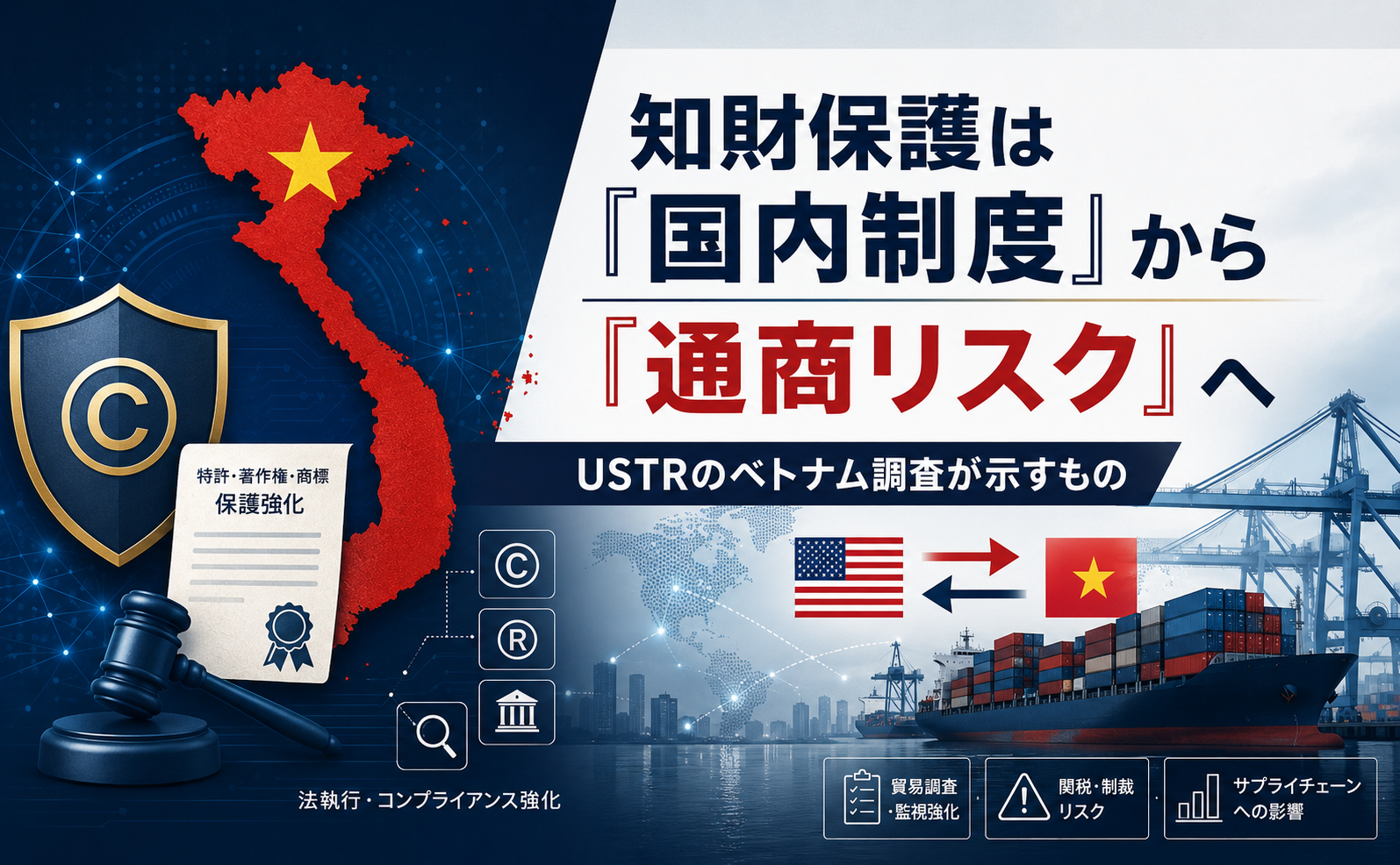
This development is not merely a matter concerning the intellectual property system of Vietnam alone. It is a case that illustrates how the protection and enforcement of intellectual property rights have become directly connected to international trade policy, supply chains, and corporate activities.
The Significance of a USTR Section 301 Investigation
An investigation under Section 301 of the Trade Act of 1974 is a powerful procedure used by the United States when it takes issue with the trade practices of another country. If, as a result of the investigation, certain practices are found to be unfair or unreasonable for U.S. companies, the matter may lead to trade measures such as additional tariffs.
At the center of the current issue is the protection and enforcement of intellectual property rights in Vietnam. In particular, in the “2026 Special 301 Report” released by the USTR on April 30, Vietnam was designated as a “Priority Watch List” country. One of the reasons cited was the inefficiency of enforcement against copyright infringement in the digital environment.
What is important here is that the issue is not limited to the establishment of an intellectual property system itself. The question is whether infringement can actually be stopped and whether rights holders can obtain effective remedies. The mere existence of laws is not enough. The effectiveness of enforcement, including administrative measures, judicial procedures, customs enforcement, and platform responses, becomes the subject of evaluation.
Vietnam’s Position and Achievements
Vietnam distances itself from the view that it is passive about intellectual property protection. Spokesperson Hang emphasized that the protection and strengthened enforcement of intellectual property rights are a consistent policy of Vietnam.
In fact, Vietnam has shown certain achievements in terms of innovation policy. In the 2025 Global Innovation Index of the World Intellectual Property Organization, or WIPO, Vietnam ranked 44th among 139 countries and regions, placing it in a favorable position within ASEAN. This indicates that Vietnam is seeking to transition from being merely a low-cost production base to a growth model that includes technological development and startup cultivation.
Furthermore, on May 5, the Prime Minister issued Official Telegram No. 38/CD-TTg, instructing measures against acts of intellectual property infringement. This can be positioned not merely as a formal response to pressure from the United States, but also as a policy measure aimed at improving the domestic investment environment.
However, what the United States focuses on is not only these policy documents or rankings. The issue is the extent to which counterfeit goods, pirated products, and digital copyright infringement are actually deterred in the market, and whether rights enforcement is conducted swiftly and predictably. Therefore, Vietnam will need to show not only legal reforms and administrative guidance, but also concrete enforcement results.
The Core Issue Is “Enforcement” Rather Than “Systems”
In international evaluations concerning intellectual property rights, there has been a growing tendency in recent years to focus less on whether a system exists and more on whether it actually functions.
For example, even if patent laws, trademark laws, and copyright laws are in place, rights holders cannot be said to receive sufficient protection if the seizure of infringing goods is limited, court proceedings take too long, or damages awards are kept low. In the digital environment in particular, pirated content and websites selling counterfeit goods can spread rapidly and circulate across borders. As a result, there are increasing situations in which conventional seizures and litigation alone cannot keep pace.
The fact that the USTR is taking issue with enforcement against copyright infringement in Vietnam’s digital environment can also be understood in this context. In the digital field, it is important to detect infringement, request removal, prevent recurrence, secure cooperation from platforms, and coordinate criminal and administrative measures. Merely recognizing rights under laws and regulations is no longer sufficient to obtain a favorable international evaluation.
Intellectual Property as a Trade Issue
What deserves particular attention in this news is that the issue of intellectual property protection is linked to trade measures.
Intellectual property rights are originally systems designed to protect inventions, brands, works of authorship, know-how, and other assets, thereby encouraging creation and investment. In the international economy, however, the level of intellectual property protection can also become a factor in market access and trade negotiations. In countries where rights protection is insufficient, foreign companies cannot invest with confidence, and technology transfers and licensing agreements are less likely to proceed. As a result, intellectual property systems are positioned at the intersection of industrial policy, investment policy, and trade policy.
In recent years, Vietnam has increased its presence as a manufacturing hub. Amid U.S.-China tensions and the restructuring of supply chains, more companies have come to regard Vietnam as an important production base or procurement source. If a U.S. investigation into intellectual property protection proceeds in such a country, the impact may extend not only to local companies but also to foreign companies with bases in Vietnam.
Responses Required of Companies
The WTO and International Trade Center under the Vietnam Chamber of Commerce and Industry has warned that, depending on the outcome of the investigation, trade measures such as additional tariffs may be imposed, and has called on companies to ensure strict compliance with intellectual property rights. This call has highly practical significance.
What is important for companies is to strengthen management not only from the standpoint of seeking protection as rights holders, but also from the standpoint of not infringing the intellectual property rights of others. Intellectual property risks exist in various aspects of corporate activities, including manufacturing outsourcing, parts procurement, OEM production, e-commerce sales, advertising materials, software use, and content use.
In particular, companies engaged in transactions related to Vietnam need to confirm whether their products infringe third-party trademark rights, design rights, copyrights, or patent rights. It is also important to establish contractual warranties and audit systems to ensure that suppliers and distributors are not handling counterfeit goods or unauthorized content.
When intellectual property issues become trade issues as in this case, the matter may develop beyond individual infringement litigation into tariffs, import and export restrictions, suspension of transactions, and reputational risks. Intellectual property compliance has become a theme that should be addressed through coordination among management, procurement, sales, overseas business divisions, and legal departments.
Challenges for Vietnam
For Vietnam, the current investigation represents a risk, but it is also an opportunity to enhance the credibility of its intellectual property system.
If Vietnam seeks an objective and fair assessment from the United States, it will not be sufficient for Vietnam simply to explain its efforts in abstract terms. It will be important to present concrete data and examples, including the number of seizures, administrative sanctions, criminal cases, court precedents, damages awards, takedown responses to online infringement, and cooperation systems with rights holders.
Strengthening intellectual property protection also benefits not only foreign companies but domestic companies and startups as well. Once domestic companies enter a stage in which they develop their own technologies and brands, allowing imitation and unauthorized use to persist will hinder the growth of domestic industries. Strengthening the intellectual property system is therefore not only a response to external pressure, but also a foundation necessary for Vietnam’s own industrial upgrading.
Implications for Japanese Companies
This news is also relevant to Japanese companies.
Vietnam is one of the important manufacturing bases, sales markets, and development hubs for Japanese companies. Trademark filings, anti-counterfeiting measures, contract management, confidential information management, and software license management in Vietnam will become more important than ever.
In addition, if Vietnam is involved in a supply chain that includes exports to the United States, deficiencies in intellectual property compliance may spill over into transaction risks in the U.S. market. Japanese parent companies should not leave these matters solely to local subsidiaries or business partners, but should also review their own intellectual property management systems.
Particular caution is required against making judgments based only on impressions such as “this is commonly done locally” or “the business partner says there is no problem.” When an issue develops into an international trade matter, legality and transparency as viewed by the United States and international rights holders become more important than local practices.
Conclusion
The USTR’s Section 301 investigation into Vietnam’s protection and enforcement of intellectual property rights once again shows that intellectual property is not merely a specialized legal field, but a theme directly connected to international trade, the investment environment, and supply chain strategy.
Vietnam has received a certain level of recognition in WIPO’s Global Innovation Index and is also moving forward with policy responses to combat intellectual property infringement. At the same time, what the United States is taking issue with is not only the existence of systems, but the effectiveness of actual enforcement.
For companies, it is becoming increasingly important not only to “protect” intellectual property rights, but also to “avoid infringement,” “avoid involvement in infringement,” and “manage compliance across the entire supply chain.” This investigation can be seen as providing companies connected to Vietnam with an opportunity to review intellectual property compliance as part of international transaction risk.