
Introduction
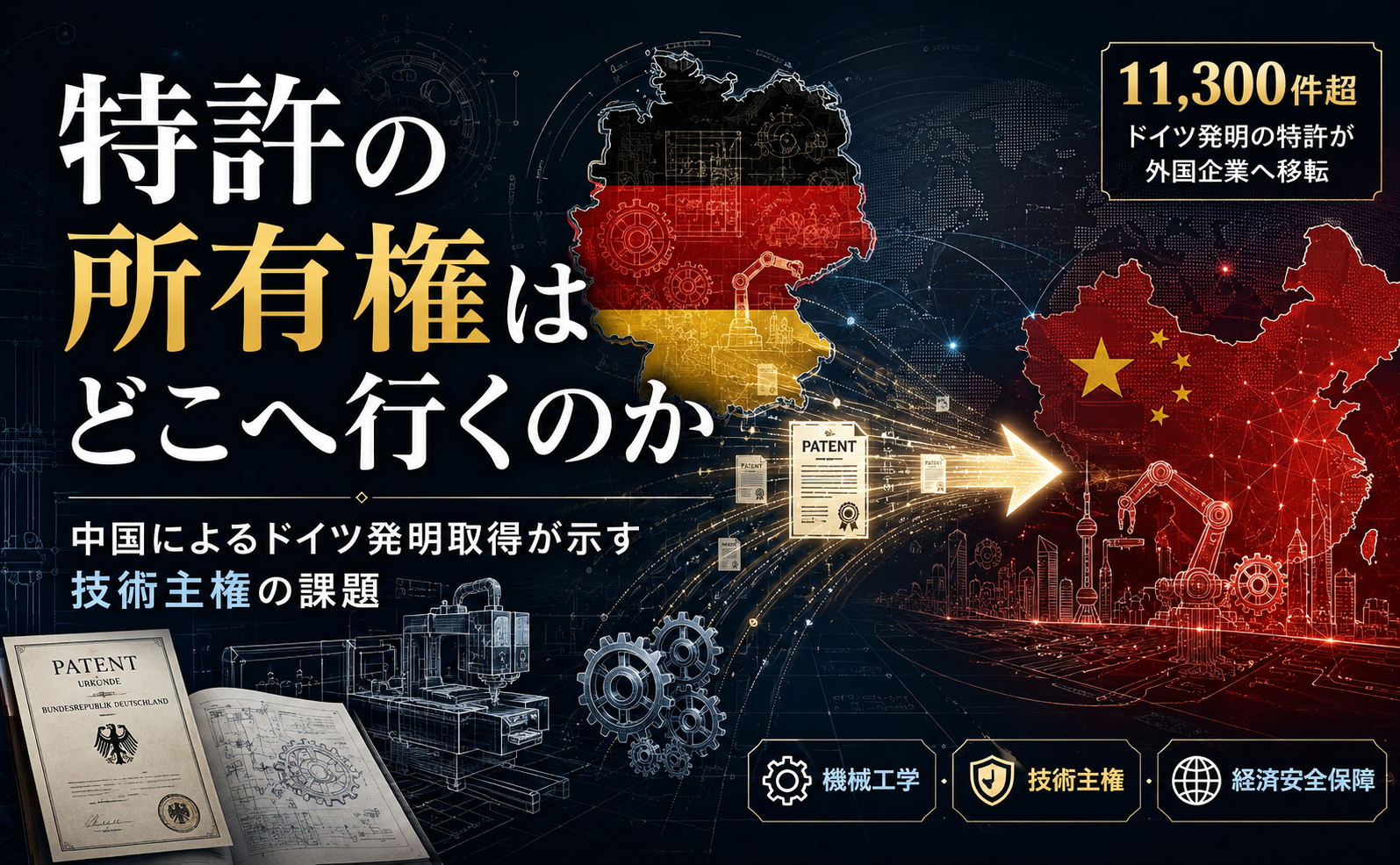
According to a study conducted by the German Economic Institute at the request of the Bertelsmann Foundation, China has acquired ownership rights to more than 11,300 patents developed in Germany over the past 20 years. It has also been reported that nearly one-third of inventions originating in Germany are owned by foreign companies, of which about one-third are held by U.S. companies and about 11% by Swiss companies.
One particularly notable area is mechanical engineering. Patent applications in this field increased from 3,300 in 2000 to 4,300 in 2022, and China is said to have been especially active in acquiring technology in this sector.
This news is not simply a story about China acquiring a large number of German patents. It highlights the intersection of intellectual property and economic security: where inventions are created, who owns them, and which country’s industrial competitiveness they ultimately support.
Patents Separate the “Place of Invention” from the “Place of Control”
When people think of patents, attention often turns to the location of the inventor or the research and development base. From an industrial perspective, however, what matters more is who owns the patent, who controls the licensing rights, and who takes the lead in commercialization.
Even if an invention is developed in Germany, once the patent rights are transferred to a foreign company, decisions regarding how the technology is used, how it is licensed, and how product development is prioritized will be influenced by that foreign company. This is not necessarily a problem in itself. In a global economy, patent ownership commonly crosses borders through corporate acquisitions, joint research, business transfers, and licensing agreements.
Indeed, German companies also own patents overseas. In that sense, the international transfer of patents should not be viewed negatively in itself. The issue is not the volume of transfers, but their quality and direction. The key question is what kinds of strategic technologies, in which fields, under what conditions, and to which entities are being transferred.
The Significance of Mechanical Engineering
It is important that the latest study places particular emphasis on the mechanical engineering sector. Mechanical engineering is a core field that has supported the competitiveness of German industry. It is closely connected to many key industries, including automobiles, machine tools, industrial machinery, robotics, and manufacturing equipment.
The transfer of patents in this field to foreign companies does not merely mean a series of individual rights transfers. It may also mean that foundational technologies for manufacturing are moving outside the country. Patent rights cover not only products themselves, but also manufacturing methods, control technologies, component structures, process improvements, maintenance technologies, and more. When such technologies accumulate, they can have a major impact on future industrial competitiveness.
The fact that China has been active in acquiring technologies in this field should be understood not merely as investment activity, but as a technology acquisition strategy linked to industrial policy. For China, which is seeking to upgrade its manufacturing sector, Germany’s mechanical engineering field is an extremely attractive target.
The Boundary Between “Normal Competition” and “Imbalance”
The German Economic Institute explains that German companies also own patents overseas and that this is part of normal competition. This view is reasonable. If all international technology transfers and corporate acquisitions were treated as problematic, free investment and innovation would be hindered.
At the same time, however, the institute points to an “imbalance”: while the Chinese market remains closed to foreign investors, Chinese authorities are promoting strategic acquisitions in Europe and the United States. This is the core of the issue raised by the news.
The problem is not that Chinese companies acquire patents from foreign companies. The problem is reciprocity: whether European companies can acquire technologies and companies in the Chinese market with the same degree of freedom. If one market is relatively open while the other is restrictive, then even transactions that formally take place between private companies may in substance become asymmetrical competition.
If this asymmetry continues, a structure may emerge in which strategic technologies flow out of open countries and regions, while technological accumulation advances in closed countries and regions. This is not an issue that can be fully addressed by the principles of free trade and investment liberalization alone.
Patent Transfers Are Not Synonymous with “Technology Leakage”
That said, it would be premature to conclude that a transfer of patent ownership to a foreign company immediately constitutes technology leakage. The patent system is based on disclosure. After a certain period from filing, the content of an invention is published in patent gazettes. In this sense, the patent system is also designed to disclose technical information to society.
Patent rights may also be acquired through various routes, including corporate acquisitions, joint development, the establishment of subsidiaries, business restructuring, or changes in researchers’ affiliations. In some cases, business operations may continue under foreign capital while employment and research and development bases remain in Germany.
Therefore, the important point is not the simplistic view that “it is dangerous because a foreign company owns it.” Rather, it is necessary to examine specifically how transfers of patent ownership affect research and development bases, manufacturing bases, supply chains, standardization activities, and control over licensing.
What Europe Needs Is Not Isolation, but Selection
The policy implication of this news is not that foreign capital should be excluded. What is needed instead is an institutional ability to identify strategically important technologies.
If every patent is treated as a security issue, corporate activity will be excessively restrained. On the other hand, if the transfer of important technologies is left entirely to the market, there is a risk of losing long-term industrial foundations. What is therefore required is a mechanism for comprehensively evaluating factors such as the technological field, the acquiring entity, transaction terms, licensing restrictions, the maintenance of research and development bases, and importance within supply chains.
In fields such as mechanical engineering, semiconductors, AI, telecommunications, energy, robotics, and medical technology, individual patents do not merely have value on their own. Groups of patents, when combined, can form industrial control. It is therefore important to consider not only the transfer of individual patent rights, but also the transfer of entire portfolios.
Companies Also Need to Redesign Their IP Strategies
This is not a challenge for governments alone. Companies also need to manage intellectual property not merely in terms of the number of applications filed or rights obtained, but as a management asset: how it should be retained, how it should be used, and to what extent it should be transferred externally.
Selling patents or transferring them as part of a business transfer may be a rational decision in the short term. However, if those patents later become the foundation of core technologies or standardization, an easy transfer may undermine long-term competitiveness.
Companies need to evaluate their patents by distinguishing between “rights currently being used” and “rights that will become future bargaining power.” In joint research agreements and M&A agreements, they must carefully design not only the ownership of patents, but also implementation rights, sublicensing rights, the handling of improvement inventions, the maintenance of research and development bases, and non-compete restrictions.
This Is Not Someone Else’s Problem for Japan
Although this news concerns Germany, it is not someone else’s problem for Japan. Japan also has strength in manufacturing and holds important intellectual property in many fields, including machinery, materials, components, precision processing, robotics, and environmental technologies.
Japanese companies also face situations in which patent ownership crosses borders through business restructuring, partnerships with foreign capital, startup acquisitions, and joint research. The perspective of which country’s companies accumulate the results of research and development, in which markets those results are used, and which standards and supply chains they support is indispensable for Japanese companies as well.
In particular, in startups and university-originated technologies, control over intellectual property can easily shift during the process of fundraising and commercialization. How to balance short-term funding needs with long-term technological sovereignty will become increasingly important.
Conclusion
What this study shows is the reality that patents are no longer merely legal rights, but assets deeply connected to industrial competition between countries and economic security.
Even if an invention is created domestically, once its ownership or implementation rights move overseas, who enjoys the fruits of that technology changes. Of course, international technology transfer and investment have the benefit of promoting innovation. However, if strategic technologies are transferred in one direction under a market environment lacking reciprocity, that cannot simply be called free competition.
In future IP strategy, simply increasing the number of patent applications will not be enough. It will be necessary to determine which technologies should be protected, which should be opened up, and which should be used as bargaining tools. Understanding where patent ownership is moving should become the starting point for thinking about technological sovereignty, both for companies and for nations.