
Introduction
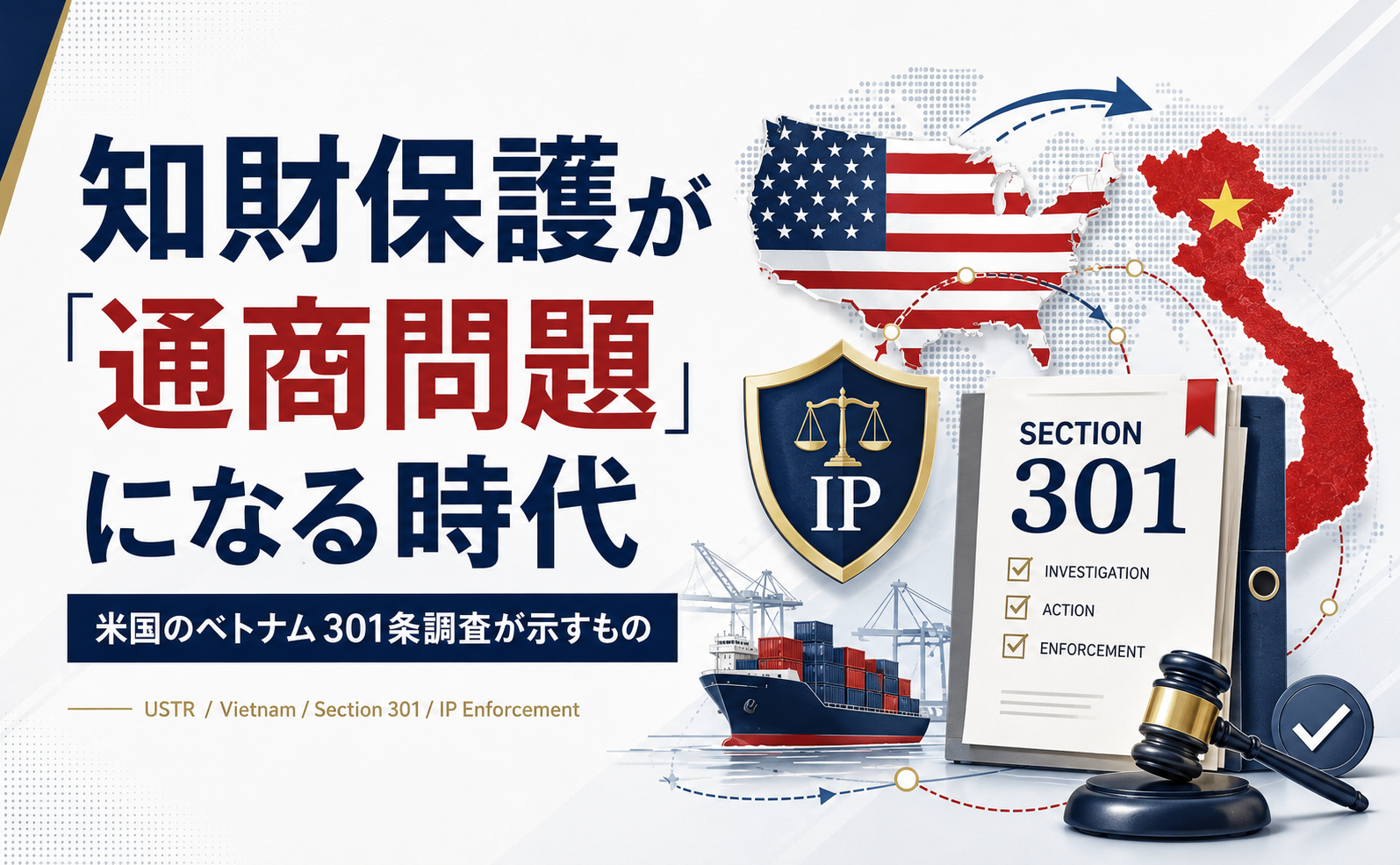
On May 29, the Office of the United States Trade Representative, or USTR, announced that it had initiated an investigation under Section 301 of the Trade Act of 1974 into Vietnam’s policies and practices concerning the protection and enforcement of intellectual property rights.
The background to this is the 2026 Special 301 Report released by USTR on April 30. In that report, Vietnam was designated as a “Priority Foreign Country,” meaning that its protection of intellectual property rights and enforcement against infringement were regarded as particularly problematic. USTR pointed out deficiencies in areas such as sustained and effective action against online piracy, enforcement against counterfeit goods, border controls, measures against the use of unauthorized software, and criminal measures against the piracy of cable and satellite signals.
A Section 301 investigation under the Trade Act is not merely a fact-finding exercise. If, as a result of the investigation, foreign measures or practices are found to be unreasonable or discriminatory and to burden or restrict U.S. commerce, they may lead to countermeasures such as additional tariffs. This news shows that the protection of intellectual property rights has become an issue that goes beyond corporate legal affairs and the protection of rights holders, and is now directly connected to trade negotiations between nations.
Why Vietnam Has Come Under Scrutiny
One notable aspect of this investigation is that the issue is not limited to Vietnam’s intellectual property system itself, but also concerns the effectiveness of its enforcement.
An intellectual property system is not sufficient simply because laws have been put in place. Even if there are provisions protecting trademark rights, copyrights, patent rights, and other rights, such protection cannot be considered adequate from the perspective of rights holders if counterfeit goods and pirated content cannot actually be stopped.
What USTR appears to be particularly concerned about are areas where harm can easily spread across borders, such as online piracy and counterfeit goods. If a piracy website is based in one country but provides content to users around the world, the resulting harm is not confined to that country’s domestic market. Similarly, if counterfeit goods circulate through international supply chains, this can lead to damage to brand value and harm to consumers.
In other words, from the U.S. perspective, insufficient enforcement within Vietnam is being positioned as an issue that directly affects the interests of U.S. companies, as well as the U.S. content and brand industries.
The Weight of a Section 301 Investigation
Section 301 of the Trade Act is a powerful mechanism through which the United States can consider unilateral countermeasures against unfair trade practices. In the field of intellectual property, the United States has in the past used this mechanism to raise concerns about other countries’ systems and practices and to apply pressure in trade negotiations.
This investigation does not mean that additional tariffs will be imposed immediately. However, the very fact that a Section 301 investigation has been initiated means that the United States has moved this issue beyond the stage of merely expressing concern and into a stronger trade procedure.
Vietnam, in particular, has increased its presence in recent years as a manufacturing base. Its importance has grown as a destination for diversifying China-related risks and as an export base for the U.S. market. The initiation of a Section 301 investigation against such a country shows that issues relating to IP protection can also affect supply chain strategies.
Relationship with U.S.-Vietnam Trade Negotiations
This investigation is taking place while negotiations concerning a trade agreement between the United States and Vietnam are ongoing. It has been reported that the United States and Vietnam agreed in 2025 on a framework for a bilateral trade agreement, and that final adjustments have continued thereafter.
The fact that the IP issue has developed into a Section 301 investigation at this timing suggests that the United States may also be positioning improvements in IP enforcement as an important negotiation item in the context of the trade agreement.
IP provisions are an important component of free trade agreements and economic partnership agreements. In recent years, however, the focus has shifted from the level of protection stated in treaty provisions to whether infringement can actually be stopped, whether rights holders can obtain prompt remedies, and whether criminal, administrative, and civil enforcement mechanisms function effectively.
In this case as well, the significance lies in the fact that the United States is not merely seeking legislative reform from Vietnam, but is demanding a continuous and deterrent enforcement system.
Implications for Japanese Companies
This news is not an issue only for U.S. companies. It is also important for Japanese companies that have manufacturing bases in Vietnam, Japanese companies that develop their brands in the Vietnamese market, and companies that distribute content or software in Vietnam and the broader ASEAN region.
First, there are increasing situations in which measures against counterfeit goods and piracy cannot be left solely to local agents. Online infringement spreads through multiple channels, including domains, servers, payment systems, advertising, and social media. Accordingly, it is necessary to combine various measures, such as acquiring rights, monitoring infringements, submitting takedown requests, seeking administrative enforcement, filing criminal complaints, and recording rights with customs authorities.
Second, companies operating in Vietnam may be victims of infringement, but at the same time they may also be subject to scrutiny regarding compliance in the areas of software use and license management. The fact that USTR has raised concerns about the use of unauthorized software demonstrates the importance of software management systems that cover local subsidiaries and contractors.
Third, companies need to be aware of IP risks as trade risks. If measures such as additional tariffs or import restrictions are considered, the impact will not be limited to IP departments, but may also extend to procurement, manufacturing, logistics, sales, and corporate planning. IP issues are no longer matters that can be handled entirely within the IP department.
“IP Protection” Is Itself Part of the Investment Environment
Vietnam is attracting significant attention as a destination for manufacturing relocation, a consumer market, and a growing market in the digital economy. At the same time, if enforcement of intellectual property rights does not function adequately, investment risks will increase for companies that possess advanced technologies, brands, content, and software.
IP protection is not merely a system for protecting rights holders. It is a foundation for creating a market environment in which genuine products are properly valued, investments in creative works and technological development can be recovered, and consumers can choose safe products and services.
In this sense, USTR’s latest move represents pressure on Vietnam, but it also demonstrates the U.S. view that IP protection is a core element of the investment environment.
Conclusion
This Section 301 investigation is an issue concerning Vietnam’s intellectual property system, but at the same time it is also an event that symbolizes the growing importance of intellectual property rights as a major point of contention in international trade policy.
The focus going forward will be on what improvement measures Vietnam presents, whether the United States evaluates those measures as sufficient, and whether the results of the investigation lead to concrete trade measures.
For companies, what is important is not to view this news merely as a trade friction issue between the United States and Vietnam, but to use it as an opportunity to review IP risks, supply chain risks, and compliance risks in their own overseas business operations. The effectiveness of IP protection has become an important infrastructure that determines whether companies can conduct business with confidence in overseas markets.